Tag Archives: history

Fairy Tales at 16 – Queer Films Saved Us!

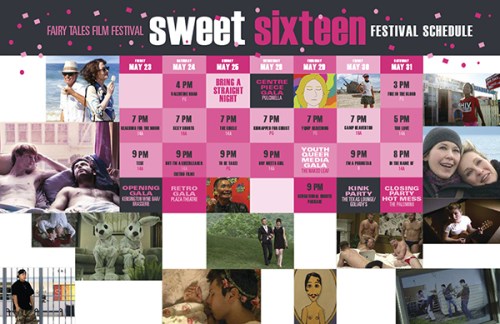
The Fairy Tales Queer Film Festival starts tonight at the Plaza Theatre.  It is one of my favourite times of the year!

In June 1999, this cultural institution began in Calgary, then called the Fairy Tales Gay and Lesbian Film Festival.  It opened for two nights in the Garry Theatre in Inglewood (no longer a theatre, but a live music venue).  There were sell out crowds as well as lots of excitement on those two sweltering summer evenings – in a venue with no air conditioning!  Movie goers, fanned themselves with programs, drank cool beverages and managed to sweat buckets with no complaints: a sort-of cinematic sauna experience…

Fairytales Founders: Trevor Alberts, Kelly Langgard and Kevin Allen (from L. to R.)

Fairytales Founders (1999): Trevor Alberts, Kelly Langgard and Kevin Allen.

Seeing ourselves represented on the big screen for sixteen years now has been nothing short of alchemy for me personally.  After a week of watching queer film (I am a pretty hard core festival goer), I am always disoriented to find the outside world as straight as it is.

However, it is the documentaries I have seen at Fairy Tales that have stayed with me the longest.  My short list includes:

Edie & Thea: A Very Long Engagement (whose protagonist Edith Windsor later brought down the U.S Defense of Marriage Act last summer at age 84).

Call Me Kuchu (last year’s Fairy Tales Centrepiece Gala, about Ugandan gay-rights activist David Kato, which devastated me for days).

Beyond Gay: The Politics of Pride (following Vancouver’s Pride Parade Director travel to other pride demonstrations around the world – including Russia – which spontaneously got a standing ovation in the cinema afterwards!)

United in Anger: The History of Act Up (a stunning look at how AIDS activists fighting under the highest stakes, changed the world).

Every year the programming team at Fairy Tales combs through hundreds of submissions, to select the festival’s annual line-up.  I am sure there are more memorable films to be seen this week at Festival #16 – check them out!
chart

[KA]

Slaying Premiers – Then & Now

The recent abdication of Premier Alison Redford as head of the Alberta Progressive Conservative (PC) Party caused a reflection here on political transitions in the past, and former culture wars between the government and Alberta’s queer community.

Premier Don Getty was also chased out by his party in the early 90s, which started the reign of “King Ralph” Klein who became Premier in December 1992.  He then took the PCs to an electoral victory in June, 1993.

The run-up to that provincial election was marked with high-profile anti-gay comments from Alberta Government Cabinet Ministers.  Then Deputy Premier Ken Kowalski, publicly mused on CBC Radio that: “taxpayers’ money shouldn’t be used to support people with ‘abnormal’ lifestyles.”  He was referencing provincial government arts funding that had gone to the Banff Centre who had supported a performance art piece which dealt with themes of lesbian sexuality.

Diane Mirosh, the PC Cabinet Minister responsible for the Human Rights Commission said that: “gays and lesbians had [already] too many rights and perhaps they should be rescinded.”  The irony, of course, is that they had fewer rights than other Albertans because sexual orientation was then not a protected ground of the Alberta Individual Rights Protection Act: the provincial human rights legislation of  the day.

CLAGPAG PosterThe Calgary queer community was vocal in its outrage and organized an anti-PC campaign during the election, which happened to be the same month for Calgary and Edmonton’s Pride Celebrations.  This was also the year Edmonton’s Mayor Jan Reimer proclaimed Edmonton Gay and Lesbian Pride Day, in sharp contrast to the ruling provincial government’s position.

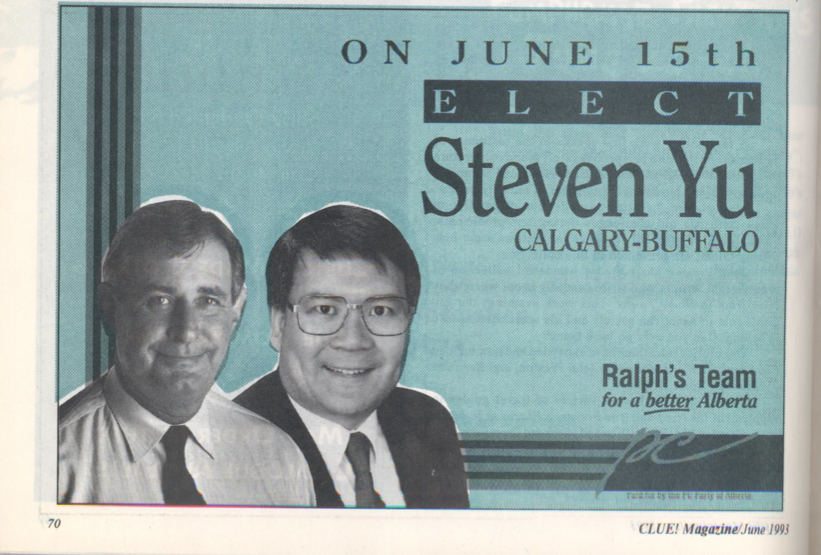
Elect Steven YuDespite the dodgy comments from PCs about human rights, they cagily advertised in Calgary’s gay press for their candidate, Stephen Yu, in Calgary Buffalo, long considered the queerest riding in the city (he came in 2nd, taking 40% of the vote).

Interestingly, in the last provincial election (2012), it was widely believed that anti-gay comments from Wild Rose Party candidates were a deciding factor in Alison Redford’s sweep into power despite polls predicting her demise.  The PCs rhetoric around tolerance in modern times is in stark contrast to the past.  However, the fact that the Alberta Progressive Conservative Party takes down its own leaders – from within – remains similar.

[KA]

Worker’s Pride: Labour Unions and our History

The Alberta Federation of Labour (AFL) was one of the supporters of Calgary’s 2013 Pride Parade.  A volunteer association of unions and employee organizations, the AFL also has a Pride and Solidarity Standing Committee, “…to encourage active involvement of gay, lesbian, bisexual and transgender persons in union activities and other activities affecting them, to promote, audit and organize educational programs concerning gay, lesbian, bisexual and transgender persons in the workplace…” among other elements.  This has not always been the case.  The bond between labour and LGBTQ people has developed slowly over the last 30 years and the rise of public service associations.

Canadian WORKERUnions began to grow in importance in the 1960s with massive strikes that lead to long term change, such as the Federal Public Service Staff Relations Act, 1967, which gave public servants collective bargaining rights.  The push for ongoing dialogue between union and employer served as examples to gay and lesbian activists on how to get organized, and created the avenues for their own dialogue in the work environment.  As well, they saw the workers as member of the locals as needing to have their rights protected. According to historians Gary Kinsman, the rise of the Canadian Union of Public Employees and the formation of the Public Service Alliance of Canada in 1966, began to make it more difficult for RCMP and employers to ask about a person’s sexuality. Kinsman states that:

“Because one of the things the new unions challenged was the sort of paramilitary or quasi-military hierarchy that was in the public service, and the various forms of discipline that took place.  And that obviously opened up some more space for lesbians and gays who were employed in the public service to begin to organize and, eventually, begin to speak out.”

[TM]

Sources and Further Reading

Canadian Labour – http://www.canadianlabour.ca/human-rights-equality/pride

Troster, Ariel. “The Canadian War on Queer Workers”, Our Times, Vol 29 Issue 3 June-July 2010. http://ourtimes.ca/Features/article_127.php

Highlights in Canadian Labour History – http://www.cbc.ca/news/canada/highlights-in-canadian-labour-history-1.850282

Tom Warner. Never Going Back, a history of queer activism in Canada. University of Toronto Press, 2002.

Gary Kinsman and Patrizia Gentile. The Canadian War on Queers: National Security as Sexual Regulation. UBC Press, 2010.