
{My husband Gordon is part of the Calgary Chinook Lesbian and Gay Endowment Fund. Every year they give a deserving member of the local LGBTQ community a hero award – this year they gave two! Here is his recent speech addressed to the 2016 recipients, Nancy Miller and Richard Gregory. A standing ovation ensued. Gordon also has a history blog called Edwardian Fernie; check it out if you are interested in period architecture, culture and gardens! – Kevin}
“Where were you in 1988, when the first pride workshops were being held in Calgary, or in 1990, the year of the pride rally and where were you again in 1991 the year of Calgary’s first pride parade.
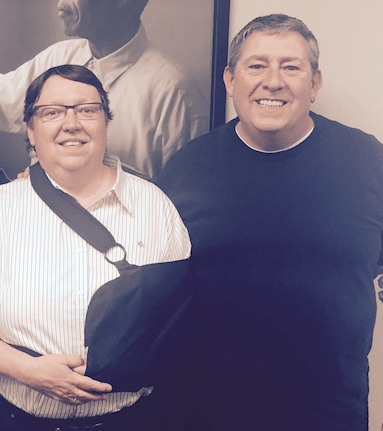
Nancy Miller and Richard Gregory in 2015
If you were our Hero Award recipients, Nancy Miller and Richard Gregory, you were activists on the front lines of the gay rights movement in Calgary and you were leaders in organizing the rallies as well as the parades and not giving an inch to politicians and citizens who wanted to treat gay and lesbian Albertans like they didn’t exist; or if they did, like they were a lower order of citizen who were not entitled to equal rights. And not having equal rights meant you could be fired from your job, evicted from an apartment, refused custody of your children, refused service in restaurants and not ensured safety and protection when you walked down the street.
It was for many of us, like me, a time when our ability to pass, and our privilege, protected us from the vagaries of the police and their state sanctioned bullying of the LGBT community. It was a time when AIDS deaths were reaching record highs in Calgary, and the city’s response was ever greater hysteria and paranoia as well as hostility towards the gay community particularly in the form of violent gay bashings. After all what were baseball bats for? Many in the gay community were afraid and were even hostile towards activists.
I quote Nancy, who in a Metro interview acknowledged:
“I have to admit there were lots of people within our own LGBTQ community who were not happy with us. They didn’t want us to be drawing attention to the community. They had found ways to survive without rocking the boat too much and they were comfortable and felt safe there. They were afraid we were going to open a whole can of worms. Which of course we did.”
Nancy and Richard did not take the safe or comfortable route, though they might have, instead, they got busy organizing the lesbian and gay community so that finally by the 1990’s Calgary’s activists were working hard to establish gay rights through the Pride moniker. Some of you will remember that a pride rally or parade in the early 90’s was not the feel good happy events attended by tens of thousands like today. The organizers and participants, who numbered in the hundreds, were literally facing the prospect of physical violence from police and anti-LGBT homophobes as well as the risk of possibly losing their jobs, their homes and their families. It is no wonder that some opted to wear lone ranger masks or paper bags!
Our Heroes, Nancy and Richard, were not only involved with fighting for our rights through the idea of Pride, they were involved with CLAGPAG, the Calgary Lesbian and Gay Political Action Guild, an organization which is where we find the roots of Pride. This was merely one aspect of CLAGPAG and their activism. They were involved in the struggle for gay and human rights on many levels, including the Delwin Vriend legal battle. But it was not only with the big battles that our award recipients made a difference, it was the many smaller day to day skirmishes that also moved forward the struggle for our rights.
I found copies of the Calgary Herald in the early 90’s in which Nancy was out and proud and asserting the right to equality. The journalist wrote, “that Nancy Miller isn’t crazy about interviews, but she speaks up for the record anyway – for a couple of reasons. For one thing, she believes clear, honest, open dialogue is the only way to promote understanding. For another, she doesn’t have a thing to lose.”
“She’s not afraid she’ll be fired for telling the world she’s lesbian.” She was not afraid to insist that, “We in the LGBT community contribute a lot to the city that goes totally unseen and recognized.” You have to remember by that time Nancy had reason to be afraid for she had been discharged from the Canadian Military for being a lesbian and had also had the courage to refuse to cooperate in the naming of lesbians and gay men in a military investigation.
For four decades, Nancy Miller has been advocating for social justice, human rights and reproductive choice. In addition to being involved with CLAGPAG, she has been an organizer of Take Back the Night marches, served as a board member for the Calgary and Alberta Status of Women Action Committees, Women Looking Forward, The Lesbian Information Line (co-founder), Planned Parenthood Alberta and the Calgary Sexual Health Centre (formerly CBCA). A proud feminist, today Nancy provides strategic communications, writing and video production services to progressive candidates, non-profits and small businesses.
Like Nancy, Richard Gregory was not only critical to developing Pride he was, in addition to being a leader at CLAGPAG, an Aids Calgary volunteer as well as board member, and in 1989 organized the Aids Quilt project’s visit to Calgary.
In 1995 he ran for council in ward 8 as the first out gay man in Calgary to run for political office. He was at that time also chair of the advisory committee of the social services program at Mount Royal College.
During those years he was also a committee member of the OXFAM-Canada Human Rights Initiative Project and worked for the Boys and Girls Club of Calgary. Today he is the president of Alberta College of Social Workers Council. And is the department chair of the health and human services program at Medicine Hat College.
I want to close with something which Richard Gregory wrote for CLUE Magazine in 1994. He reported in the month of October that he went to an open house held by MLA Mark Hlady of Calgary Mountainview, given that there weren’t many people in attendance he spent a half an hour with a clearly extremely homophobic MLA, who even believed Alberta should opt out of the Canadian Charter of Human Rights and Freedoms in order to avoid giving the LGBT community equal rights.
Richard quizzed him about his understanding of the charter, of the bible, its connection to human rights, the rights of LGBT citizens. I could only think the MLA must have been very happy when someone else finally showed up to take their turn. That month he also attended a conference on human rights in Alberta, and I will quote his take away message from the conference:
“I suggest we go to town hall meetings, confront them in their own territory, be really clear on what we want. There is no time like the present to demand equal rights in this province. Each voice must stand and be heard. I guarantee that if only half the gays and lesbians and members of the transgender communities in Alberta wrote a letter to the Premier – rights would be extended to us. Many people state they are not political – this is not about being political – it is about being equal and being treated as such. Don’t expect someone else to do it.”
Richard Gregory and Nancy Miller did not expect someone else to do it, they did it, and are still doing it and we are all the better for it and that is why they are our Heroes. Please join me in paying tribute to this amazing duo – they make us proud!”
{GS}



 Calgary Gay History