Tag Archives: Calgary Herald

Questions from Trans Youth in the ’80s

{The first post from volunteer researcher Levin Ifko! Enjoy – Kevin}

Today I’m going to share some information about a column I found while looking through the online Calgary Herald archives via the Calgary Public Library. This archive has been useful in my attempt to better understand the way trans people may have been perceived by Calgarians, or perhaps more accurately, how trans people may have been presented to the Calgary Herald’s readership. 

There have been quite a few findings here (many of which I’m looking forward to sharing with you shortly!). However, I wanted to begin my writing for the Calgary Gay History Project by sharing something near and dear to my heart and to my lived experience: figuring things out as a trans young person. 

Described as a place where “young readers’ questions on human relations and sex are answered,” the “Youth Clinic” was a write-in advice column by Canadian psychiatrists Dr. Saul Levine and Dr. Kathleen Wilcox. Although initiated by the Toronto Star, the “Youth Clinic” grew to be syndicated nationwide. By late 1983, the Calgary Herald had picked it up, encouraging local readers to mail in their own questions to the Herald’s P.O. Box. 
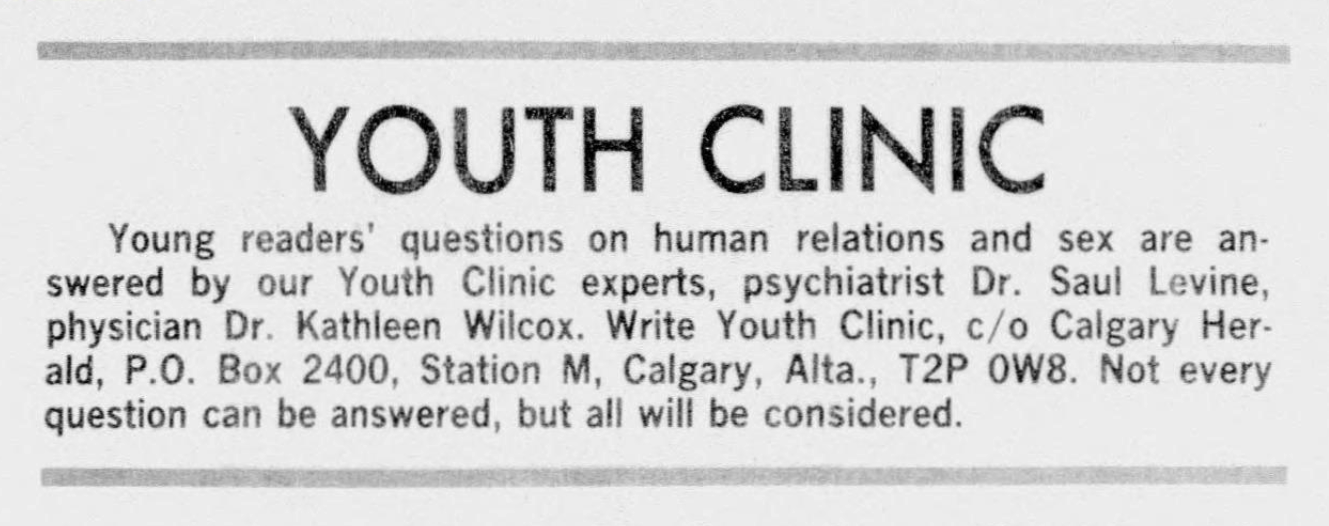
A Calgary Herald Classified Ad promoting “Youth Clinic.”

Between 1983 and when the Calgary Herald stopped syndicating the column in 1991, I found three separate queries from young people who wrote in to discuss questions relating to their gender. Although it isn’t quite clear where in the country these young readers are writing from, I believe and hope that these questions were seen by young people in Calgary who were having similar feelings. 

The first question of this nature was published in 1984, with the youth writing 

“Dear Dr. Levine: I am writing you this letter in hopes that I can better understand myself. You see, I am a bisexual male. No, that is not my problem. I’ve come to accept my bisexuality. Here’s where I need your help: I go by the name Sarah and have the uncontrollable desire to dress as a girl…” 

The youth goes on to ask: “Why do I have this desire to be a woman?”; then inquires about accessing literature on the subject, and laments about how difficult the process may be to get the care they desire. I felt a pang of familiarity reading this question, which still feels tender when thinking about the road ahead as a young queer and trans person. 

Another interesting note here is that the youth illustrates a common problem with accessing gender affirming care at the time: having to prove one’s same-sex attraction. This meant that gender affirming care would be given to trans people based on the belief that they were going to be exclusively heterosexual post-transition. As our young reader points out, “I’m bisexual. From what I understand I wouldn’t pass the program anyway.” 

In 1985, another young person wrote: 

“My problem is that I am a female in a male body. I have known since I was 5 years old. I am now 19. It is not an easy subject to discuss because most people have no idea how I feel. Sometimes I dress in women’s clothing and it feels so right. When I take them off, I become depressed and feel cheated and cry. I want to be a woman so badly.” 

They go on to write, “I read any material available about transsexuals and sex-change operations, but such articles are usually vague or outdated.” This stuck with me, as access to information that is updated and relevant remains a common issue for trans young people to this day. Thankfully, since I came out in 2015, there has been incredible work done in this city to expand access. However, many times our best bet is still – of course – networks of support and understanding between other trans people. 

This last article excited me, as it’s not every day in the archive that you stumble upon discussions from youth who may be exploring transmasculinity. In 1987, this young person wrote: 

“I always dress up like a boy and my way of talking and everything is like a boy. I don’t have feelings like girls, but I am not a lesbian. Please suggest what I can do with this problem.” 
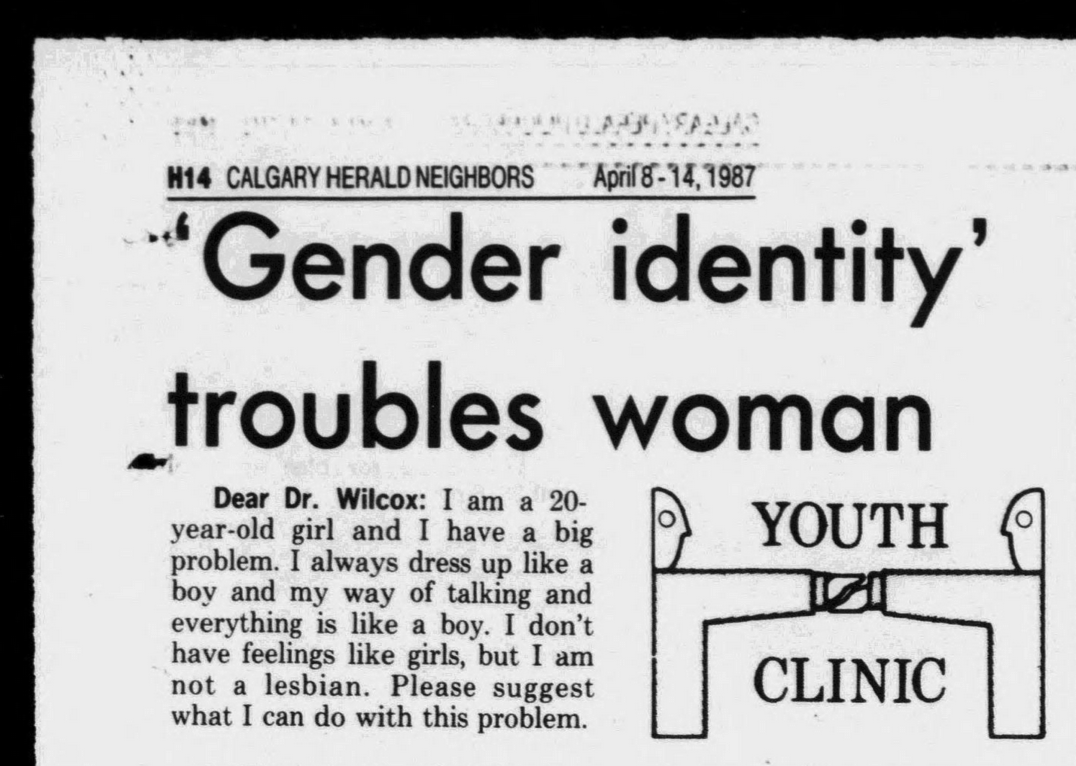
1987 Youth Clinic Column in the Calgary Herald

As for the answers to these youths’ questions? 

Of course, the psychiatrists’ responses use terminology that differs from how many people view gender today, often referring to “transsexualism” as a “psychological-medical condition.” Yet I found that Dr. Levine and Dr. Wilcox did a pretty decent job of navigating some of these queries. Usually, they would explain the concept of “transexualism,” address some of the challenges and hardships these youth brought up, and using their expertise, encourage readers to further explore these feelings with gender specialists in their area, at one point acknowledging that “the definitions do not do justice to the complexity of these labels, nor the difficulties that those who are so depicted inevitably encounter.” 

One response from Dr. Levine sounds eerily as if it came from today, when he writes “I am sure that as a result of this answer, I am going to get a barrage of letters for encouraging this person to get a sex-change operation, and by so doing, leading other young people down the path of iniquity.” But Dr. Levine goes on to encourage further exploration before a “definitive recommendation and plan of action are instituted.” 

Really, the most exciting finding here is the truth. Young people, in this city and across the country, have always explored and questioned their gender identity. Youth have knowledge about their own gender and sexualities, and they can know and ask for what they want. As these records from the Calgary Herald show us, queer and trans youth have always been here. 

{LI}

Defending Lesbian Moms in YYC

{The Calgary Gay History Project is revisiting its most impactful blog posts—now numbering in the hundreds—since its inception nine years ago. Defending Lesbian Moms in YYC was initially published on August 25, 2017.}

For decades in Calgary, if you were out as a lesbian and had children, you would likely have them taken away. Therefore the stakes were high for gay women: being a mom was decidedly a good reason for keeping the closet door barricaded shut. Unofficial estimates claim up to 50% of lesbians in the 1960s and 1970s had children through previous heterosexual relationships or marriages. If they were outed, former husbands or even the state itself would intervene to ensure that these “unfit mothers” had their children removed.

Lois Szabo, recently honoured with a park named after her, is a lesbian and also a mother. She was able to work out a child rearing arrangement with her husband privately. Sadly, Lois knew of other lesbians in the 1960s who lost access to their children completely and became utterly broken. One lesbian she knew was institutionalized. Another killed herself slowly through alcoholism.

In fact, it was not until November 21, 1975, when an openly lesbian mother was awarded custody of her child in Canada. In the groundbreaking decision of K. vs. K., Justice D. W. Rowe of the Alberta Provincial Court reasoned that a child’s likelihood of becoming gay would not increase solely by being raised by a homosexual parent – contrary to the view widely held in Canadian society. Regrettably, this decision did not set a new legal standard as throughout the 1980s lesbian mothers continued to lose custody battles specifically due to their sexual orientation.

However, the 1975 decision fired up feminist activists to begin challenging the legal bias against lesbians in Canadian courts. In 1978, the first Lesbian Mothers’ Defence Fund (LMDF) was started in Toronto, initially through a grant from a local church group and then sustained through private donations.

In Calgary, Lynn Fraser was working at the Calgary Status of Women Action Committee, a job she described as “very low paid but very exciting.” Lynn was an unapologetic feminist and activist. She recalled, “I had a big button I always wore that said, ‘Lesbian Mother,’ which sometimes caused me trouble – but I never backed down.”

Lynn had organized Feminist Town Halls in Calgary which included both actions and public speakers. In 1982, the first “Women Reclaim the Night March” was staged in Calgary in conjunction with a talk by Andrea Dworkin, a well-known American anti-pornography activist. Another speaker in the Town Hall series was Francie Wyland, the coordinator at Toronto’s LMDF.

Screen Shot 2017-08-24 at 1.51.38 PM

Francie Wyland, Dustin Smith, and his mother, Lynn Fraser. Photo: Garth Pritchard, Calgary Herald July 2, 1981.

There was a loose collective interested in starting a LMDF chapter in Calgary after Francie Wyland spoke to the lesbian community in 1981. Lynn met Marilyn Atkinson and her partner Lou at that first gathering featuring Francie. Marilyn also became a key organizer in the collective. As a mother herself, Marilyn volunteered to provide peer support to lesbian mothers and women during any potential custody struggles. The collective was based out of Gay Information Resources Calgary (GIRC) initially.

Lavender Marilyn

Lou with Marilyn Atkinson featured in Calgary’s Lesbian Publication The Lavender Times on the occasion of their 25th Anniversary.

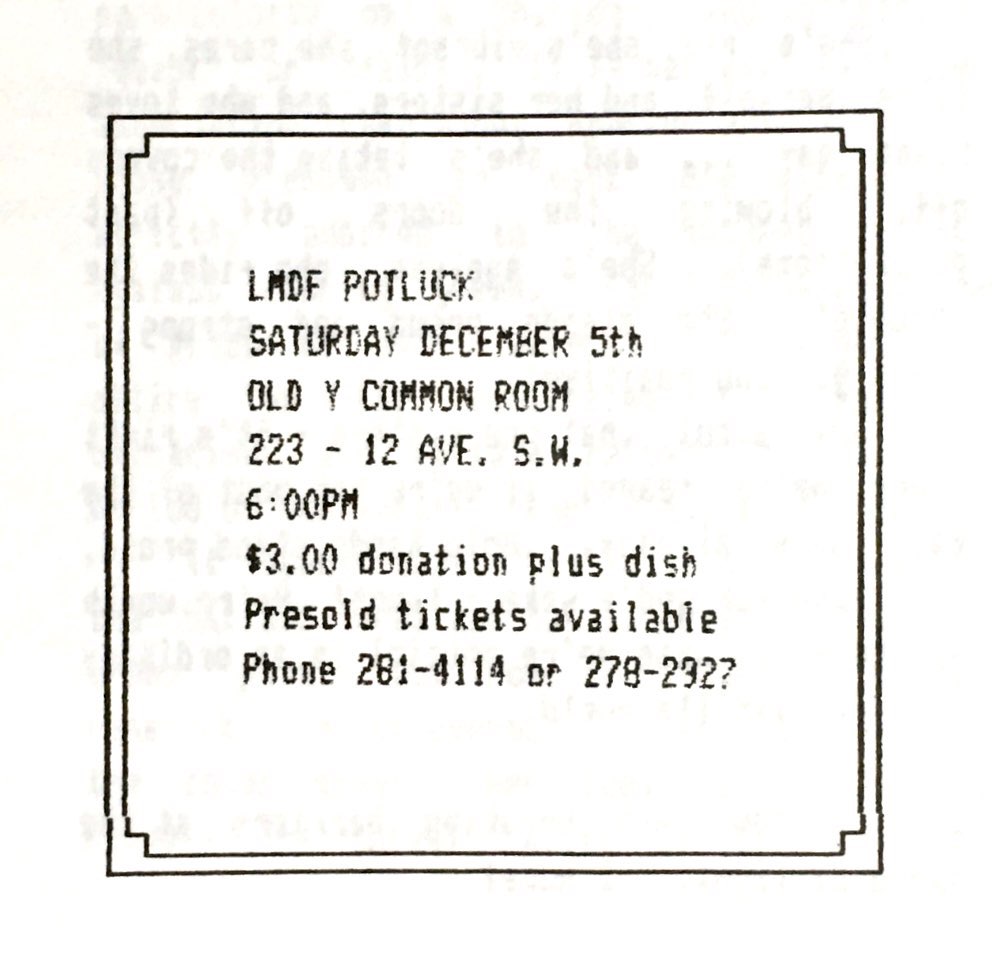
The LMDF was a low-budget, grass roots organization. Pot-luck suppers and community dances were its primary source of funding. In 1982, two Calgary lesbians took pledges to cycle across the county to raise money for the LMDF. It took them four months, but they made it to St. John’s that summer after starting in Vancouver.

In 1983, the father of Lynn’s son, Dustin, started making noises about challenging her for custody of their child. That mobilized Lynn to call Francie in Toronto for LMDF advice. Beltline lawyer, Neva Ramsay, volunteered to do the incorporation papers for the local chapter and on April 21st, 1983, the Lesbian Mothers Defence Fund Society of Alberta was born. Dustin’s father backed off.

There was a lively social scene with Calgary’s LMDF, which moved out of GIRC into their own office at the Old Y. The potlucks and dances would even attract lesbians without children! A bonus to the socializing was that their children got to play with other kids who had lesbian moms, making their family structures seem much more commonplace.

The Lavender Times, November 1987

The LMDF offered information, support, referrals to lawyers, and financial help to lesbian mothers struggling to keep or win custody of their children. The advice in child custody cases included: going to court is the last resort; do not leave your children behind; beware of ex-husbands kidnapping your kids. The LMDF also advocated for social change in the judicial system, proclaiming that the straight court system failed lesbians.

Lynn recalls: “It was an exciting time to get your voice out there and be heard. There was so much misinformation and so much fear—it seemed like almost everybody was in the closet.”

As the LMDF developed, Marilyn was hired to organize lesbian conferences which she remembered proved quite popular: “Women came from everywhere to attend.” The first conference in 1985, was funded by the local lesbian community itself. When the conferences began to attract public funding, protests were heard.

Maureen Buruill, a lobbyist with REAL Women of Canada in January 1987 wrote an editorial in the Calgary Herald complaining about her own organization’s lack of funding:

“Women’s groups across Canada receive funding from the Secretary of State’s Women’s Program. One example was a grant to the Calgary Lesbian Mothers Defence Fund to set up a “lesbian-gay” workshop collective. This organization also received a grant to arrange a lesbian conference. Why is our tax money given to these groups and refused to a group seeking to preserve family values?”

Despite the social conservative yowling, the legal system evolved to have less bias against lesbian mothers. Consequently, the LMDF’s activities morphed into helping lesbians get pregnant – initially by connecting donors to mothers but also by running sperm! It was not until 1992 that artificial insemination in hospitals became legally available to single and unmarried women, including lesbians in Calgary. The LMDF then began fundraising for artificial insemination in doctor’s offices and stopped running sperm themselves. Several babies were born from the LMDF’s sustained efforts.

In 1992, the society changed its name to the Lesbian Mothers Support Society to better reflect its efforts and developed a notable online presence. It also was active in advocating Provincially for adoption rights for the partners of lesbian mothers. The society wound down its operations in 2002. However, in its 21 years of history, the LMDF made a huge difference: defending lesbian mothers and moving social justice forward in Calgary.

{KA}

Lois Szabo Commons Open!

Lois Szabo Commons officially opened yesterday, and although we could not be there, we hungrily read the press and social media accounts of the park’s launch. The honour is well-deserved.

Lois with friends and family at the Park’s dedication ceremony. Photo: Marlene Hielema via Facebook.

Lois told me she received so many hugs from the assembled crowd that it may have counteracted her pandemic’s hug deficit! She was particularly chuffed to get a hug from Mayor Naheed Nenshi (two of them apparently).

Here is a media round-up!

City of Calgary Press Release

CBC: Beltline park opens to honour Lois Szabo, Calgary LGBTQ leader

660 News: Lois Szabo Commons opens, recognizes prominent leader in Calgary’s LGBTQ2S+ community

Global News: New Beltline community space named after Calgary LGBTQ2S+ leader opens

Calgary Sun: New Beltline park commemorates LGBTQ2S+ community leader Lois Szabo

Calgary Herald: New park in the Beltline commemorates local LGBTQ2S+ community leader Lois Szabo

Although the media accounts are similar, they each have a different photo of Lois! {My favourite is the Calgary Herald’s below}

Congratulations Lois and thank you City of Calgary!

{KA}