Before GIRC. YYC gay support in the 70s.

The Calgary Gay History project recently posted about the origins of Gay Information and Resources Calgary (GIRC). However there was an earlier, somewhat short-lived group, “A People’s Liberation Coalition” (PLC), which pre-dates GIRC.

Started in early January 1973, the PLC aimed to serve the local gay community by offering information and counselling: the peer support model which carries through to this day. Their office was located at the Old Y (now CommunityWise) in room 314, and they attempted to have office hours from 7-11 PM, seven days/week.

After its founding,the PLC announced their intention to sponsor “a mixed boogie” at a local community hall.

An Australian gay activist named Brian Lindberg who travelled through Western Canada later in 1973 described the movement in Calgary as going through a difficult period. He wrote:

The gay information centre was staffed by only a few people (one in particular) who continued to maintain the service even though little assistance could be obtained. Considering the population size of Calgary, I was surprised not to find a well organized gay liberation movement.

Some of the people involved, in PLC were activists, Windi Earthworm, My Lipton, Len Girivitz and Jeannie MacKay, who as a group were later responsible for GIRCs founding in 1975. We know that some of the PLC liberationists came from the University of Calgary. My Lipton, a lesbian feminist, was described in the student newspaper, The Gauntlet, as a “militant gay liberationist,” and was involved in the founding of a Gay Liberation Front chapter on campus in the Autumn of 1972.
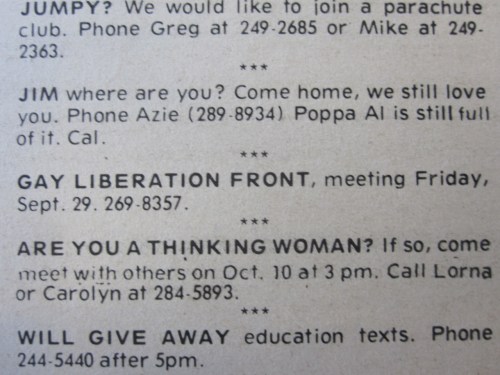
Gay lib front meeting - first ad_announcement_Sept 1972

Little else is known at present about the PLC. At the Old Y they are not listed as one of the historic groups who had office space there.  If you know more, contact us: here.

{KA}

72 years in jail for being gay in Calgary

We are proud to be working with Third Street Theatre and playwright Natalie Meisner on a new play about Calgary’s gay history. The play, called 69, is delving into the past of Everett Klippert, the Calgary Transit employee whose court trials eventually decriminalized homosexuality in Canada in 1969.

Consequently, we have been poking around in archives and talking to Klippert’s family members about earlier times. At the Provincial Archives of Alberta, we found the file for Klippert’s first trial in 1960. Klippert, had come under police scrutiny, due to the father of one young man he had had sex with. The father learning of his son’s affair, was outraged and asked police to investigate. On March 21st, Klippert was remanded into custody on a charge of “contributing to the delinquency of a young boy.” Bail was set at $500.

{It is important to note that in 1960 there was no age of consent for gay sex, as the entire act was illegal. The court records do not indicate the age of said “young boy,” although Klippert’s future court proceedings found no issue concerning the age of his victims.}

The next day, March 22nd, his bail was increased to $9000, as the crown brought 17 more charges forward – “indecent assault on 17 young Calgary boys” due to the discovery of Klippert’s little black book, a document of his dating life. The Albertan newspaper (predecessor of the Calgary Sun) wrote: “Klippert faced the court with bowed head Tuesday, elbows on the dock rail and face hidden in his hands, as the magistrate read the 17 new charges.”

On April 4th, Klippert’s family had come up with the bail: an equivalent of $72,000 in today’s dollars. However he was kept in remand until April 14th, while Ed Adolphe, the Crown Prosecutor, adjusted the charges to 18 counts of gross indecency.

Klippert 1960 IndictmentFor the trial on May 2nd and May 4th Klippert had pled guilty. Ed Adolphe put forward evidence that Klippert frequented boxing matches, wrestling matches, swimming pools and other places where he was likely to come in contact with young boys. As a bus driver he allowed them to ride free of charge, gaining their friendship, Adolphe alleged.
The defence lawyer, Derek Maguire, told the court that Klippert had a psychiatric assessment which explained his homosexual tendencies arose from an unhappy childhood; his mother died when he was five years old, and he had no one in particular looking after him. He also cited that the 33-year old Klippert had been steadily employed since he was 16, and asked Justice Hugh Farthing to consider placing him on probation.

Farthing described the case as “a particularly painful and distressing matter.” He cited the U.K.’s Wolfenden Report, which recommended homosexual behaviour between consenting adults in private should no longer be an offence. However, about Canada he added “the law of the country, rightly or wrongly, regards this weakness as a crime, and my sworn duty is to administer the law of the country. We don’t know what harm has been done to these boys… They were not developed and were easily influenced by a man older than themselves.”

And with that statement, Justice Farthing sentenced the former Calgary bus driver to a four year term in the Prince Albert Penitentiary for each of the 18 charges – the sentences to run concurrently. He did publicly note his temperance in sentencing: the maximum penalty he could have given was five years for each charge, and served sequentially, equalling life imprisonment for Klippert.

{KA}


GIRC Origins

Calgary has had a steady succession of social service groups for the LGBTQ community. Gay Information and Resources Calgary (GIRC) began in June 1975, and was spearheaded by gay artist and activist Windi Earthworm. It lasted until the early 80s, and notably hosted the National Gay Rights Conference in 1980.

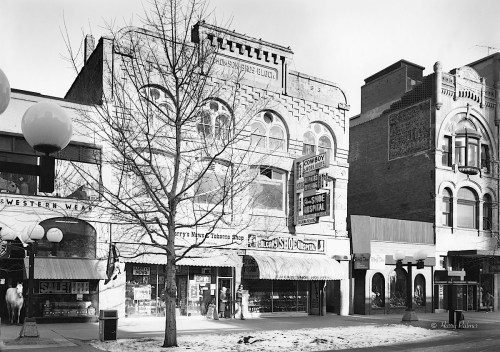
Although it eventually became resident at the Old Y, its first location was in the historic Thomson Brothers Block on Stephen Avenue, now part of the Hyatt Hotel complex.

Thomson Bros Block, 1983

Thomson Bros. Block in 1983.  Photo Credit: Harry Palmer, http://www.aportratitofcanada.ca

Windi and his cofounders were considered radicals: upsetting the homophobic and uptight status quo. To announce the founding of the new group, they sent postcards to other gay groups locally and nationally. The phrase, “Calgary has finally gotten off its ‘cowboy ass'” was deemed abusive language by Canada Post, but with push back, GIRC got them through the mail unaltered.

Marketing their new organization further proved difficult with local media. Calgary had two daily newspapers at the time, the Albertan and the Calgary Herald. GIRC targeted local gays with a simple ad consisting of their name and address. This was accepted by the Albertan, who commented, “if it’s alright with Trudeau, it’s alright with us.” {A reference to the Trudeau backed 1969 omnibus bill which decriminalized homosexuality.}

The Calgary Herald flatly refused.  GIRC organized a meeting with the newspaper’s advertising manager, who opined that GIRC’s goal was to destroy the family.  He said: “The Herald is a family medium and it’s going to stay that way.” GIRC complained to the Alberta Human Rights Commission and the Alberta Press Council; both refused to help.

Media censorship of LGBTQ content was prevalent throughout Canada in the 1970s. There were several high profile lawsuits in other cities, as Canadian society struggled with an increasingly vocal and visible queer minority. In Calgary this kind of censorship continued until the end of the century with media resistance to the Gay and Lesbian Community Services Association’s (GLCSA) Out is OK advertising campaign. Like GIRC 25 years earlier, the ad consisted only of text: the phrase “Out is OK” and a telephone number.

 
Screen Shot 2016-01-14 at 5.26.52 PM

{KA}