Tag Archives: queer

Klippert Month – Finale

In exactly one week (November 7th) we will have arrived at the 50th anniversary of the Supreme Court verdict in Klippert v. The Queen. In the ruling, Everett George Klippert was declared a dangerous sexual offender for having consensual gay sex. It was confirmed that he should be incarcerated for life to protect both himself and Canadian society.

In this final of four posts, I would like to explore the role of Canadian media in bringing his case forward to the court of public opinion. Newspapers across the country gave the Klippert case a good airing with the bulk of editorials condemning the decision.

In fact Pierre Trudeau’s famous quote:

“Take this thing on homosexuality, I think the view we take here is that there’s no place for the state in the bedrooms of the nation, and I think what’s done in private between adults doesn’t concern the Criminal Code.”

was a borrowed phrase from the Globe and Mail’s editorialist Martin O’Malley. (Trudeau thanked O’Malley for the quotation.)

Screen Shot 2017-10-30 at 11.22.54 PM

Pierre Trudeau’s 1967 media scrum with the “bedrooms” quote. Click to watch. Source: CBC Archives.

Sidney Katz, who had researched and written about the gay community extensively, wrote a notable column in the Toronto Star titled: “Gentle George Klippert – must he serve LIFE?” His second article quoted the dismayed reactions of many Toronto homosexuals.

The Winnipeg Free Press editorialized: “It is possible to deplore such activity without treating its practitioners as if they were monsters.” Even the Calgary Albertan (now the Calgary Sun) opined that “the spectre of a possible life sentence seems to us a little severe.”

The only big city newspaper in Canada to react in support of the decision was the Edmonton Journal whose position was against homosexual law reform citing its belief in the tendency of homosexuals to prey on the young.

The Montreal Gazette described Klippert “as the most publicized homosexual in history.”

The irony, of course, is that Everett was quickly forgotten and languished in jail for four more years. Even today, people remember Pierre Trudeau’s famous quote but do not connect it to homosexuality and its decriminalization. Many are shocked to learn that homosexuals were ever prosecuted in Canada in the first place.

Everett Klippert became a symbol of injustice and the trigger for law reform in Canada. Despite his life story being featured in every daily newspaper of note, he was not a subject of the nation’s mercy. Not really.

The point of Klippert month was to remember the person: not just the court case; not just the symbol; and not just the political wedge issue he represented in 1967.

He was a Calgarian.

He enjoyed work.

He was honest to a fault.

He had a family who loved him.

And he was gay.

Screen Shot 2017-10-30 at 11.27.44 PM

Everett George Klippert. Source: Family Photo.

{KA}
Klippert Month – Week 3

Everett Klippert was born in Kindersley, Saskatchewan in 1926, the youngest of nine siblings. His family relocated to Calgary when he was just 2 years old. Sadly, Everett’s mother died in May 1933 from kidney disease.

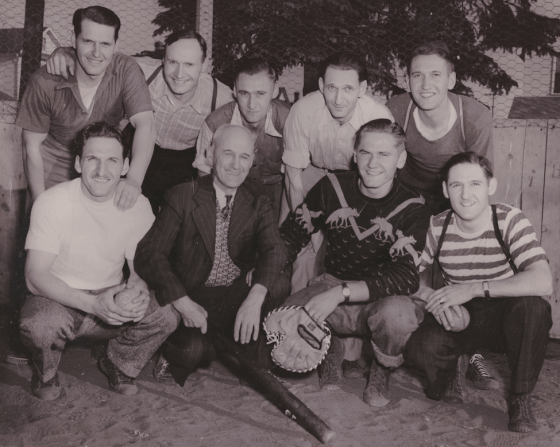
Everett’s 20-year older sister Leah took it upon herself to look after her eight younger brothers. The family was evangelical Baptist, and Leah made sure that the family regularly attended services at the Crescent Heights Baptist Church. There were so many brothers in the Klippert family that they were able to form their own baseball team with their father, called “the Klippert Nine,” which was once featured in the Calgary Herald.

Screen Shot 2017-10-19 at 12.42.25 PM

Everett (middle back row) with his father and brothers: The Klippert Nine. Source: Klippert Family, Photographer Lorne Burkell.

Everett’s siblings were discomforted by the police’s revelation of his homosexuality, but they stood by him – particularly Leah – throughout his drawn-out troubles with the state.

In 1960, after Everett’s first arrest, the Klippert family paid $9000 in bail: an equivalent of $72,000 in today’s dollars. For the trial, the family also procured a supportive reference letter from their Church Reverend, J. E. Harris. Although found guilty and incarcerated in Prince Albert, Saskatchewan, Everett’s siblings made efforts to visit him in the Penitentiary.

Leah worked as a legal secretary in the offices of J. D. Salmon, Solicitor for the City of Calgary. It was she who kept writing Everett’s legal correspondence, engaging lawyers, and appealing his court verdicts as unjust: ultimately pushing his case to the Supreme Court. In early 1967, she along with her brother Howard trekked to the Court of Appeal Case in the Northwest Territories.

Howard Klippert was brought forward as a witness for the defence. In the trial, he said: “to the best of my knowledge Everett has been well liked and well received with my friends and family. He has always been noted for his gentleness and willingness to help others. I have never known him to be violent – never. On many occasions when going to school together, I have had to protect him from others who would start a fight with him.”

Everett would not be released from jail until 1971 and went to live with his brother William in Calgary. Phyllis, Everett’s sister-in-law, said: “He was the funniest person you ever met. He lived with us for 17 years. When he was around, there wasn’t any dark cloud anywhere. He was part of our family for years.” Despite his sunny character, she added that his years in jail had left Everett feeling stalked, and embittered.

Walter Klippert said he and his brothers never talked about their youngest sibling being gay, but “we knew he was out with boys a lot. See, he was a transit driver for the city. He was a popular driver, very happy go lucky. He was really nice to everybody, anybody.”

Eventually, Everett would move to Edmonton and marry his good friend Dorothy at age 57 (she was 65). He reportedly was happy and content in his final years of life, but both he and his family did not talk about the past. He died in 1996 at age 69.

Documentary filmmakers in 2001 interviewed several members of the Klippert family, including Everett’s widow. Most were resistant to the idea of a film. Dorothy said: “I don’t think it is right to bring up the past when you have no concrete way of knowing how he felt about it.”

Everett was buried next to his sister Leah at her daughter’s farm. While she was alive, Leah’s attitude was that she loved Everett, full stop. How could the fact that he was gay, ever change that?

{KA}

Klippert Month – Week 2

It was (Inter) National Coming Out Day this week, which makes it timely to discuss Everett Klippert and his repeated disclosures. Despite homosexuality being a criminal offence in 1960s Canada, and his multiple convictions of gross indecency, he was always frank and truthful in his interactions with the state, even though he paid a severe penalty for that honesty.

Screen Shot 2017-10-12 at 4.05.44 PM

Young Everett Klippert (right) in Klippert Family Photo.

When Calgary Police questioned him about the 18 names in his little black book, which was also his dating record, he confessed to having had homosexual relations with them all.

In Pine Point, NWT, local RCMP brought Klippert in for questioning and threatened him with an arson charge of which he was innocent. Using it as leverage to open Klippert up about his sex life, he readily confessed to having had intimate relations with four men there.

In every court case, he pled guilty. A court psychiatrist reported that Klippert told him his “homosexual behaviour had existed since the age of 15; that to him homosexual activity [was] his only satisfactory sexual outlet. He found the thought of heterosexual conduct abhorrent. He told me that he never had heterosexual relations.”

Screen Shot 2017-10-12 at 4.08.47 PM

Hand-scribbled judicial annotations in Klippert’s 1960 conviction in Calgary. Source: Provincial Archives of Alberta.

Gay activist and lawyer Douglas Saunders interviewed the incarcerated Klippert in December 1967 in what he described as the “fortress-like Penitentiary at Prince Albert, Saskatchewan.” His unjust treatment gave his convictions a certain resolve. Klippert told Saunders: “If I meet someone on the outside now and he asks me, I’ll say sure I’m a homosexual, what are you? I’m not going to be ashamed of it anymore.” Klippert who grew up Christian took comfort in his prison bible and noted Psalm 22:24 to Saunders: “For he has not despised or scorned the suffering of the afflicted one; he has not hidden his face from him but has listened to his cry for help.”

Coming out cost Klippert much. We can thank his candour for prompting Canada to change its draconian laws around sexual orientation in 1969.

{KA}