Tag Archives: QC Magazine

RuPaul & AIDS in 1996

Twenty years ago, RuPaul was the headliner for Calgary Cares ’96, a benefit for AIDS Calgary. It was the fourth benefit of its kind in the city and raised approximately $50,000 for the agency.

screen-shot-2016-10-21-at-3-03-50-pm

RuPaul at Calgary Cares ’96. Photo: Shelagh Anderson (QC Magazine, July 1996)

RuPaul had then just been discovered by mainstream audiences, with the 1993 music video hit, Supermodel (You Better Work), and the groundbreaking model contract in 1995 with MAC cosmetics’ Viva Glam Couture Colour Collection. 100% of the proceeds from that collection were donated to the fight agains AIDS. In 1996, that amounted to a $5 million contribution which has grown to over $400 million today.

In the summer of 1996, Calgary was averaging about 10 new cases of HIV diagnoses a month and had the fourth highest incidence rate of HIV infection amongst Canadian cities (after Toronto, Montreal and Vancouver).

RuPaul suffered some flight delays, but after travelling 32 hours to get to Calgary made a late appearance, singing “Dude looks like a lady” for hundreds in attendance, and then hosted an impromptu press conference afterwards with local press.

Calgary Herald copy-editor Terri Inigo-Jones asked a few days later if RuPaul was not “a symbol for the best hopes for humanity’s future.”

In a June 19th, op-ed piece titled Lack of caring spawns new dark ages, the copy-editor characterized the mid-nineties as a downward slide towards the end of civilization. Despairing over neoliberal gains in the public sphere, and a perceived intolerance and pettiness in society, the author found hope in Calgary Cares:

Fortunately, modern equivalents of the early European monasteries may exist and, once again, humanity’s best qualities and best hope for the future may lie on the fringes.

Attending the fourth annual Calgary Cares fund-raising event for AIDS Calgary recently, it struck me that the true moral fibre of which society is so proud is at its strongest beyond mainstream thinking.

The event had a community feeling. About 1,300 people attended and many of them would not find acceptance in the mainstream. Every year, elected officials are invited to the event but none have accepted.

It was unconditional love that drove the 10-person organizing committee to put in 3,000 hours of volunteer labor before the show and that made hundreds of others help out on the night itself. Their efforts are expected to raise $25,000 for people in need. There was not a whisper of whether or not they could afford it or should do it. The only thought was that it must be done.

RuPaul was the star guest of the evening at the Max Bell Arena. A seven-foot, cross-dressing black man in a red patent leather bustier and thigh-high boots and a blonde wig as a symbol for the best hopes for humanity’s future?

Deal with it, folks. Our hope as a society and as a species lies in our unconditional concern and compassion for our fellow men, women and children and in our tolerance for diversity.

After all, without diversity society cannot evolve and without evolution there is no future.

It was in that summer that a corner was turned in the fight against AIDS. In July 1996, the success of new anti-HIV drugs, called protease inhibitors, were announced at the International AIDS conference in Vancouver. Almost immediately the death toll from the disease in Calgary came to a virtual halt.

{KA}

Anti-Mother’s Day in Calgary

{Please join us for this week’s upcoming Beltline Gay History Jane’s Walk (May 7th at 10am) with special guest artist Bogdan Cheta performing!  – Kevin}

IDAHOT-for_partners_official_handles-2015-ENThis is our second post in advance of the International Day Against Homophobia, Transphobia and Biphobia, May 17th: our focus is society’s war on lesbian mothers in Calgary.

Well into the 1990s in Canada, lesbian mothers who had children in prior heterosexual relationships had trouble retaining custody of those children. For most of the 20th Century, Canada’s courts did not favour homosexual parents in keeping custody of their children; most judges viewed homosexuality as a negative factor in child rearing.

Consequently the stakes were high for lesbian mothers in coming out: many suffered isolation, fear, and often kept to the closet. In 1978, the first Lesbian Mothers’ Defence Fund was started in Toronto, and a chapter started a few years later in Calgary.

The Lesbian Mothers’ Defence Fund (LMDF) offered advice, support, referrals to lawyers, and financial help to lesbian mothers struggling to keep or win custody of their children. Advice in child custody cases included: going to court is the last resort; do not leave your children behind; beware of ex-husbands kidnapping your children. The LMDF also advocated for social change in the judicial system, proclaiming that the straight court system failed lesbians.

Screen Shot 2016-05-06 at 2.23.00 PM

Calgary LGBT publication, QC Magazine: Dec. 1995

Club Carousel founder Lois Szabo remembers lesbians in the 60s and 70s utterly broken after the loss of their children – and with no access rights – to embittered former husbands. Marilyn Atkinson, one of the Calgary LMDF organizers, was a mother herself. As a volunteer, she provided peer support to lesbian mothers and women during their custody struggles.

The LMDF was a low-budget, grass roots organization located at the Old Y. Pot-luck suppers and community dances were its main source of funding. In 1982, two Calgary lesbians took pledges to cycle across the county in order to raise money for the LMDF.  It took them four months but they made it to St. John’s that summer after starting in Vancouver.

As the LMDF developed, Marilyn was hired to organize lesbian conferences which proved quite popular with many lesbians coming from afar to attend. The first conference in 1985, was largely funded by the local lesbian community itself. When the conferences finally began to attract public funding, protest was heard.

Maureen Buruill, a lobbyist with REAL Women of Canada in January 1987 wrote a newspaper editorial complaining about her own organization’s lack of funding:

Women’s groups across Canada receive funding from the Secretary of State’s Women’s Program. One example was a grant to the Calgary Lesbian Mothers Defence Fund to set up a “lesbian-gay” workshop collective. This organization also received a grant to arrange a lesbian conference. Why is our tax money given to these groups and refused to a group seeking to preserve family values?

Despite vocal opposition, the LMDF, made a huge difference in fighting for lesbian mothers and moved social justice forward in Calgary.

New Gala, Next Walk & Queer Archive Donation

Calgary queer history readers and/or party aficionados might be interested in Third Street Theatre’s inaugural “Stars of the Stage & Screen” gala & costume party on Friday, June 27th at the Arrata Opera Centre at 8pm.

All money raised goes to the next production season of Third Street Theatre – Calgary’s only queer theatre company that challenges stereotypes and gives a voice to a marginalized LGBTQ community.  Tickets and info: here.

We will be reprising our Beltline Gay History Walk on Saturday, July 26th from 7:00-8:30 PM as part of Historic Calgary Week.  Come out to learn about meaningful spots in our communities history including the location of Calgary’s first gay bar, Club Carousel.  The walk will start and finish at CommunityWise (the Old Y) at 223 12 Ave. SW.  Usually we head to a Beltline Pub afterwards for more conviviality.  Everyone is welcome!

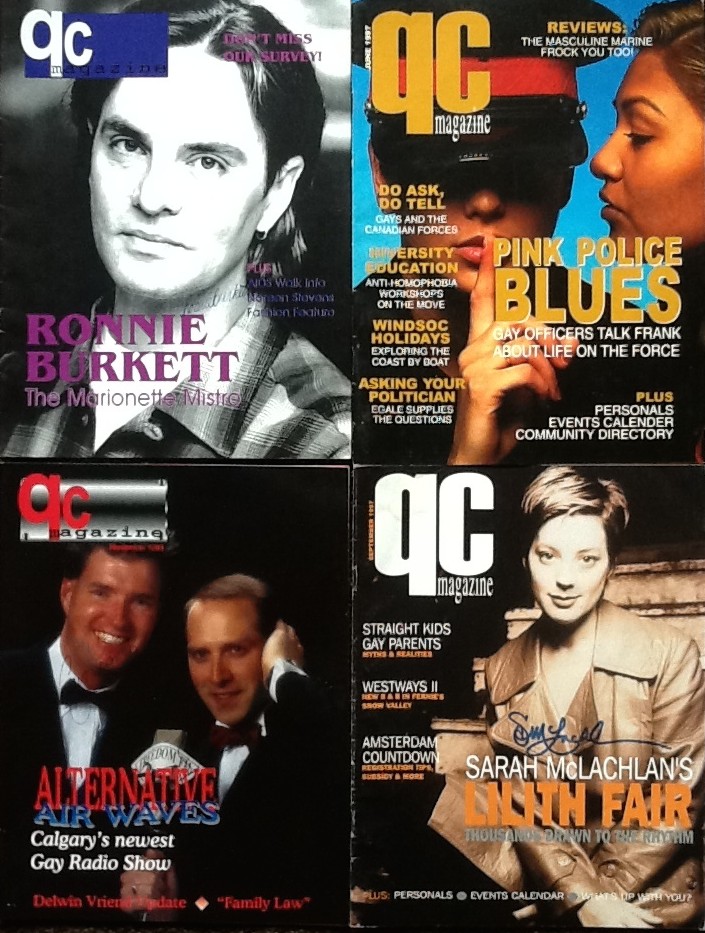
Finally, I had lunch this week with an old colleague and friend of mine, Shelagh Anderson, the former publisher of QC Magazine, who now lives in Nova Scotia with her wife and daughter.  She donated a complete collection of the Calgary based queer periodical which ran for about 3 years beginning in 1995 for the archives we are building.  As a bonus: many of the covers are signed by the subjects of the cover story.  Thank you Shelagh!

QC Covers

{KA}