
In 1982 the Canadian Charter of Rights and Freedoms gave all Canadians equal rights “regardless of race, national or ethnic origin, colour, religion, sex, age or mental or physical disability.” However, the Charter was initially silent on sexual orientation. It was not until November 1989 when the Federal Court of Canada first accepted sexual orientation as a prohibited ground of discrimination under the Charter. It ruled that Timothy Veysey, a gay prison inmate in Ontario had the right to conjugal visits with his same-sex partner.
Up until then, Canadian Courts had mostly manifested a double-standard in discrimination cases. Discrimination based on race or religion, for example, was clearly defined and remedied. Homosexuality, on the other hand, was up for debate whether it could be a protected ground at all. Judges either deferred to society’s objection to homosexuality, based on diffuse religious grounds: “rebutting a millennium of moral teaching ” or punted it back to legislators to decide.
In December 1987, Delwin Vriend began working for King’s College: A Christian Liberal Arts College in Edmonton. Throughout his employment, he was given positive evaluations, salary increases and promotions for his work performance. On February 20th, 1990 in conversation with the President of the College, Delwin was asked about his sexual orientation. He disclosed he was gay. Causing much anguish and hand-wringing, the College developed a position statement on homosexuality which was adopted by its Board of Governors on January 11th, 1991. Shortly after that, the College asked Vriend to voluntarily resign – he would be paid 3 months severance. He declined and was fired.
{Read the King’s College Memo of Jan 14, 1991, communicating its position statement on homosexuality: here. Source Library and Archives Canada}
Within weeks, Gay and Lesbian Awareness (GALA), an Edmonton-based civil rights organization, began organizing actions to “respond to this dreadful and unacceptable firing.” With Delwin’s support, they set up a “Delwin Vriend Defense Fund” to assist with legal costs, and began soliciting donations from the community.
In June of that year, Vriend and GALA tried to file a complaint with the Alberta Human Rights Commission on the grounds that his employer discriminated against him due to his sexual orientation. The Commission gave Vriend a pass explaining he could not make a claim because the Individual Rights Protection Act (IRPA) did not include sexual orientation as a protected ground.
In early 1994, GALA wrote to their sister organization, the Calgary Lesbian and Gay Political Action Guild (CLAGPAG) seeking moral and financial support to sue the Government of Alberta. They need $6,000 more dollars to take the case to the Court of Queen’s Bench.
Financial support rolled in and on April 13th, 1994, Judge Anne Russell decisively ruled that Alberta’s human rights law was inconsistent with the Charter of Rights. In her decision, she wrote: “Regardless of whether there was any intent to discriminate, the effect of the decision to deny homosexuals recognition under the legislation is to reinforce negative stereotyping and prejudice thereby perpetuating and implicitly condoning its occurrence.” The Alberta Human Rights Commission would now have to investigate discrimination cases based on sexual orientation.
On May 5th, the Government of Alberta appealed Russell’s decision and asked the courts to freeze the Human Rights Commission’s new mandate.
The Alberta Court of Appeal ruled 2-1 in favour of the Government, against Vriend, on February 23, 1996. Justice John McClung made national headlines with the sensational phrasing he used in his decision, including the number of times he used the word “morality.” He was bold enough to invoke both sodomy and a link to serial killers Dahmer, Bernardo, and Olsen. He wrote: “I am unable to conclude that it was a forbidden, let alone a reversible legislative response, for the province of Alberta to step back from the validation of homosexual relations, including sodomy, as a protected and fundamental right, thereby, ‘rebutting a millennium of moral teaching.'”
This mobilized Alberta’s gay community into action like no other court case had before. Fundraising efforts redoubled, and there were cheers heard when on March 6, 1996, Vriend decided to appeal to the Supreme Court of Canada which agreed to hear the case. Garden parties, garage sales, collection plates at gay bars – there were solicitations for the Delwin Vriend Defense Fund seemingly everywhere.
On November 4th, 1997, the Supreme Court hearings began. The Court heard from 17 interveners including provincial governments, religious organizations and civil liberties groups. Alberta Premier Ralph Klein pandering to his socially conservative base threatened to invoke the notwithstanding clause (section 33 of the Charter) in order to override any defeat the Court might deliver. The entire country appeared to be hooked on the Court Case and vitriol filled newspapers and airwaves.
Then on the morning of April 2, 1998, the Supreme Court was about to deliver its verdict. Vriend recalled: “I remember standing outside the door of the lawyer’s office in Edmonton, just after nine o’clock in the morning. I just couldn’t bring myself to step inside. Then I heard the cheers from inside the office, and I just started crying.”

Victorious Vriend at a News Scrum on April 2nd, 1998: Source CBC News Edmonton
The Supreme Court minced Appeal Justice McClung’s previous legal arguments and ruled unanimously in favour of Vriend. They wrote that the exclusion of homosexuals from Alberta’s Individual Rights Protection Act was a violation of the Charter of Rights and Freedoms.
They further wrote: “the exclusion from the IRPA’s protection sends a message to all Albertans that it is permissible, and perhaps even acceptable, to discriminate against individuals on the basis of their sexual orientation. Perhaps most important is the psychological harm which may ensue from this state of affairs. In excluding sexual orientation from the IRPA’s protection, the government has, in effect, stated that “all persons are equal in dignity and rights” except gay men and lesbians. Such a message, even if it is only implicit, must offend” Section 15 of the Charter.
At a press conference later that day Vriend said: “Shame on you, Ralph Klein, shame on you (Treasurer) Stockwell Day. You had until 7:45 this morning to do the right thing, and you demonstrated to the very end that you are not a government of the people. You are a government against the people. Haha, I win!” to the applause of supporters.
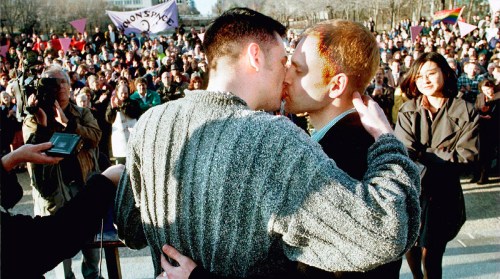
Delwin Vriend, right, gets a congratulatory kiss from partner Andrew Gagnon at a post-verdict rally at the Edmonton Legislature. [Photo Credit: The Canadian Press/Kevin Frayer]
Many Calgarians were jubilant that night, filling gay bars to capacity. Local television journalists were doing live newsfeeds from the bars too, fervently trying to get a soundbite from joyous revellers.
Vriend, emotionally drained from the long unfolding court cases, would shortly thereafter move to Paris, France. He explained that he had had a lifetime’s fill of media attention, demonstrations, protests and hate mail.
The Vriend decision proved to be of great importance to future legal battles in Canada. It was specifically used to argue provincial cases against bans on same-sex marriage throughout Canada. Also, the decision shaped legal precedent concerning provincial and federal government relationships.
During the 10th Anniversary celebrations at Edmonton City Hall, the landmark decision was described as “Alberta’s Stonewall,” referencing the riots that sparked the gay liberation movement in New York in 1969.
Former Edmonton City Councillor, Michael Phair, who had been involved with the Delwin Vriend Defense Fund from the very beginning recalled: “I remember the immediate rally and goodwill with the verdict. People were very celebratory, but over the next few days, things began to darken substantially with the backlash. I and many others were caught in the maelstrom that occurred for about a week after the decision. Because I was an out public figure, there had been some death threats, and extra security had to be called in. It was not until Klein finally accepted the decision and said that he wouldn’t use the notwithstanding clause that things settled down.”
In 2013, Delwin Vriend travelled to Calgary and was honoured with the inaugural Chinook Fund Hero Award which is given annually by the Calgary Chinook Fund in thanks and recognition for outstanding contributions to the LGBTQ community and our history.
{KA}



 Calgary Gay History