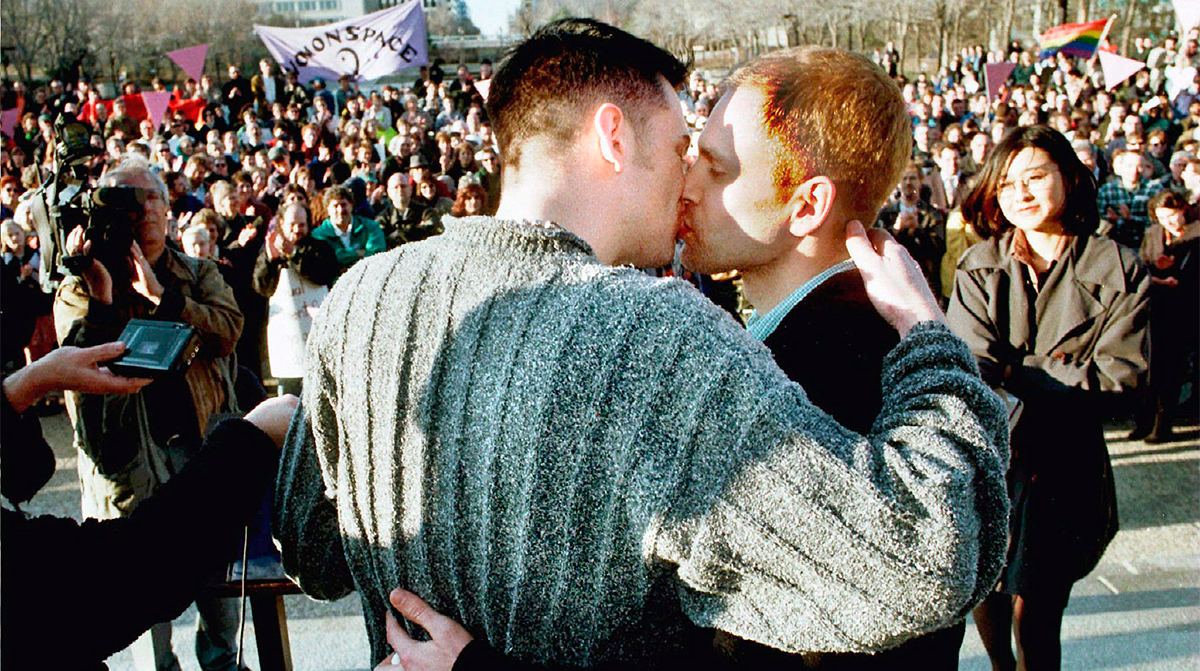
This week, Australians voted for marriage laws to be changed to allow same-sex marriage, with the yes vote claiming 61.6% to 38.4%. The debate was divisive (and at times nasty), the vote was expensive, and many within and outside the country critiqued the idea that a plebiscite is an appropriate tool for determining minority rights.

Australians celebrating the yes vote. Photograph: Scott Barbour, Getty Images, in The Guardian.
In Canada, the road to marriage equality had many speedbumps, twists, and turns. Here in Alberta, our political leaders strenuously resisted changes to the definition of marriage, including agitating for a national plebiscite on the issue.
Here is a brief timeline of Canada’s (and Alberta’s) journey to same-sex marriage.
September 1995. Openly gay, Bloc Québécois, Member of Parliament (MP) Réal Ménard introduces a motion calling for legal recognition of same-sex relationships. The House of Commons votes 124-52 to reject it.
March 1998. Another gay MP, New Democrat, Svend Robinson introduces a private member’s bill to legalize same-sex marriage. It does not pass first reading.
May 1999. The Supreme Court of Canada rules in M. v. H. that same-sex couples in Canada are entitled to receive many of the financial and legal benefits commonly associated with marriage.
June 1999, The House of Commons overwhelmingly passes a resolution to re-affirm the definition of marriage as “the union of one man and one woman to the exclusion of all others.”
March 2000. The Alberta Government passes Bill 202 which amends the provincial Marriage Act to include an opposite-sex-only definition of marriage. The bill also promises to invoke the notwithstanding clause in the Canadian Charter of Rights and Freedoms to insulate the legislation from any legal challenge based on Charter rights violations.
January 2001. Metropolitan Community Church (MCC) Reverend Brent Hawkes attempts an end run for same-sex marriage by taking advantage of a little-used common law marriage protocol “reading the banns of marriage.” The Ontario registrar refuses to accept this marriage as legally performed triggering a lawsuit.
June 2003. The Court of Appeal for Ontario confirms a lower court ruling declaring Canadian laws on marriage violate the equality provisions in the Canadian Charter by being restricted to heterosexual couples. The court decides there would be no grace period for adjustment, making Ontario the first jurisdiction in North America to recognize same-sex marriage. (It also ruled the MCC banns marriages legal). Prime Minister Jean Chrétien announces that the Federal Government would not seek to appeal the decision to the Supreme Court.
July 2003. The B.C. Court of Appeal makes a similar decision. Same-sex marriages are now allowed in British Columbia.
March 2004. The Quebec Court of Appeals rules similarly to the Ontario and B.C. courts and orders its decision to take effect immediately. Now, more than two-thirds of Canada’s population live in provinces where same-sex marriage has been legalized.
February 2005. The Civil Marriage Act, Bill C-38, is introduced by Prime Minister Paul Martin’s Liberal minority government. He advises that it will be a free vote in the House of Commons. Many Liberals assert they will vote against the government on this bill. Then Calgary based Canada Family Action Coalition declares a boycott on Famous Players Theatres because of a ten-second ad that urges moviegoers to contact their MPs to say they support same-sex marriage
May 2005. Paul Martin’s minority government survives an impossibly close (153-152) motion of confidence, almost scuttling the legislation.
June 2005. Bill C-38 passes third reading in the House of Commons in an extended debate well into the evening of June 28th. The vote total is 158-133. The Prime Minister allows the Liberal backbenchers a free vote but whips his cabinet into voting for the bill causing Minister Joe Comuzzi, a traditional opponent of same-sex marriage, to resign from cabinet. The voting breakdown is:
| Party |
For |
Against |
Absentees |
Total |
| Liberals |
95 |
32 |
4 |
131 |
| Conservatives |
3 |
93 |
2 |
98 |
| Bloc |
43 |
5 |
6 |
54 |
| NDP |
17 |
1 |
1 |
19 |
| Independents |
0 |
2 |
2 |
4 |
Calgary Centre MP Lee Richardson is one of only a handful of Conservative MPs who vote in favour of Bill C-38. Stephen Harper controversially claims that “the law lacks legitimacy because it passed with the support of the separatist Bloc party.” NDP MP Bev Desjarlais is stripped of her position in the NDP’s shadow cabinet for voting against it. Alberta Premier Ralph Klein opines that the Alberta Government might opt to stop solemnizing marriages entirely, suggesting that the Government would issue civil union licences to both opposite-sex and same-sex couples.
July 12, 2005, Klein concedes that expert legal advice suggests that refusing to marry same-sex couples had little chance of succeeding in a court challenge. “Much to our chagrin,” he adds.
July 20, 2005. Bill C-38 receives royal assent after passing in the Senate the previous day. The law affects Alberta, Prince Edward Island, Nunavut and the Northwest Territories, the only jurisdictions in Canada whose courts had not yet decided in favour of same-sex marriage.
December 2006. Prime Minister Stephen Harper brings a motion to reopen the definition of marriage with his Conservative minority government. The House of Commons defeats the motion 175-123. Prime Minister Harper declares the issue concluded.
Epilogue:
In a recent interview, former Prime Minister Paul Martin acknowledged his conflicted voting history on the issue. Martin noted that he opposed same-sex marriage in 1999 but later realized that he had not given sufficient consideration to the question. He related a personal anecdote of close family friends who have a lesbian daughter. She was happily partnered in Vancouver. He emphatically said: “What right do we have to deny happiness to people?” This personal revelation helped make Canadian history.
{KA}