
World AIDS Day began in 1988, when an international meeting of health ministers in London, England declared December 1st a day to highlight the enormity of the AIDS pandemic. Today in Canada, men who have sex with men* still make up the majority of new HIV infections annually: 57% or about 1400 new infections/year. Men who have sex with men are 131 times more likely to get HIV than men who do not. Pause to consider that.
The world is an angry place today. Foreign national events such as Brexit and the U.S. Election were notable in their antagonistic rhetoric. But even at the most local level, Calgarians are bellicose over reasonably low stake issues such as cycle tracks, public art, and election line-ups (issues I am personally connected to, which have given me lots of practice with wrath management technique).
Recently, I came upon a manifesto in zine form called Queers Read This. It was distributed at the June 1990 Pride March in New York City, and “published anonymously by queers.” It is a concentrated distillation of rage at a time when the stakes could not have been higher. AIDS, at the time, was a growing epidemic and for most, an almost certain death sentence.
The publication has exhortations to “bash back,” meet hatred with hatred, and give no inch to straights. It very much defended the word Queer as a militant signifier of strength which galvanized and branded the generation of activists who came of age then.
Calgary was part of this movement. 1990 was the year of the first Pride Rally in the city. It was also a time of tragic AIDS deaths, frequent gay bashings and other forms of homophobic backlash. Yet it was this anger which helped us stand our ground and ultimately win our human rights battles.
So I am reframing my relationship to anger. Anger can affect social change. Anger can be something positive – like the 1400 Canadian men who have sex with men who will get infected with HIV this year.
*{Men who have sex with men is a term that refers to behaviour rather than identity; it captures not only gay and bisexual men but also those who do not identify themselves based on their sexual practices.}
ANGER (An Essay from Queers Read This)
“The strong sisters told the brothers that there were two important things to remember about the coming revolutions, the first is that we will get our asses kicked. The second, is that we will win.”
I’m angry. I’m angry for being condemned to death by strangers saying, “You deserve to die” and “AIDS is the cure.” Fury erupts when a Republican woman wearing thousands of dollars of garments and jewelry minces by the police lines shaking her head, chuckling and wagging her finger at us like we are recalcitrant children making absurd demands and throwing a temper tantrum when they aren’t met. Angry while Joseph agonizes over $8,000 for AZT which might keep him alive a little longer and which makes him sicker than the disease he is diagnosed with. Angry as I listen to a man tell me that after changing his will five times he’s running out of people to leave things to. All of his best friends are dead. Angry when I stand in a sea of quilt panels, or go to a candlelight march or attend yet another memorial service. I will not march silently with a fucking candle and I want to take that goddamned quilt and wrap myself in it and furiously rend it and my hair and curse every god religion ever created. I refuse to accept a creation that cuts people down in the third decade of their life.
It is cruel and vile and meaningless and everything I have in me rails against the absurdity and I raise my face to the clouds and a ragged laugh that sounds more demonic than joyous erupts from my throat and tears stream down my face and if this disease doesn’t kill me, I may just die of frustration. My feet pound the streets and Peter’s hands are chained to a pharmaceutical company’s reception desk while the receptionist looks on in horror and Eric’s body lies rotting in a Brooklyn cemetery and I’ll never hear his flute resounding off the walls of the meeting house again. And I see the old people in Tompkins Square Park huddled in their long wool coats in June to keep out the cold they perceive is there and to cling to whatever little life has left to offer them. I’m reminded of the people who strip and stand before a mirror each night before they go to bed and search their bodies for any mark that might not have been there yesterday. A mark that this scourge has visited them.
And I’m angry when the newspapers call us “victims” and sound alarms that “it” might soon spread to the “general population.” And I want to scream “Who the fuck am I?” And I want to scream at New York Hospital with its yellow plastic bags marked “isolation linen”, “ropa infecciosa” and its orderlies in latex gloves and surgical masks skirting the bed as if its occupant will suddenly leap out and douse them with blood and semen giving them too the plague.
And I’m angry at straight people who sit smugly wrapped in their self-protective coat of monogamy and heterosexuality confident that this disease has nothing to do with them because “it” only happens to “them.” And the teenage boys who upon spotting my Silence=Death button begin chanting “Faggot’s gonna die” and I wonder, who taught them this? Enveloped in fury and fear, I remain silent while my button mocks me every step of the way.
And the anger I feel when a television program on the quilt gives profiles of the dead and the list begins with a baby, a teenage girl who got a blood transfusion, an elderly baptist minister and his wife and when they finally show a gay man, he’s described as someone who knowingly infected teenage male prostitutes with the virus. What else can you expect from a faggot?
I’m angry.
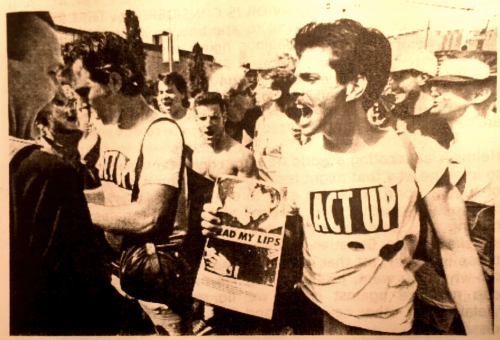
Photo: Queers Read This published anonymously by queers.
{KA}


 Calgary Gay History