Tag Archives: Gay history

Gay History Walk Revisited & Other News

The queer history project has some exciting news.  The province has come on as a project sponsor through the Alberta Historical Resources Foundation – thank you province’o’mine, and thank you Culture Minister Heather Klimchuk, who wrote us a kind congratulatory letter.

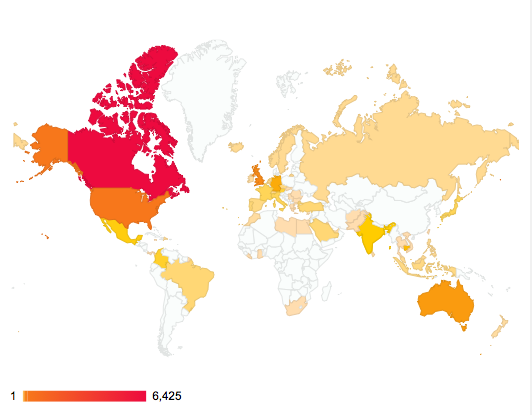
Since the project launched at last year’s Pride Week, there have been more than 7000 readers on the site including visitors from over 55 countries.  We have had two incredibly well attended public presentations, and one amazing gay history walk as part of the international Jane’s Walk movement supported locally by the Calgary Foundation.
Screen shot 2013-08-07 at 4.53.15 PM

Many of you who missed the walk last May, have been asking for a repeat, and I am happy to report we have one scheduled for the evening of Wednesday, August 28th from 7:30 – 9:00 PM.  [I suspect that we will retire to a local pub afterwards for any who want to mingle and chat!]

The walk will commence from CommunityWise (formerly the Old Y) at 223 12 Avenue SW – an important building that was a focus for our city’s fledgling gay right’s movement in decades past.  A current tenant there is Calgary Outlink, our queer community support organization, who also is an ongoing sponsor of the queer history project.

Finally, we will have a table at this year’s Pride Street Festival, Sunday, September 1st.  Come by, pick up a project postcard, and talk to us about queer history in Calgary – we would love to meet you.

p.s. If you have not seen it, Stephen Fry’s open letter to U.K. Prime Minister David Cameron, calling for a ban of the Sochi Olympics is powerful.  Closer to home Alberta queer right activist, Kristopher Wells, called for a similar ban in an Edmonton Journal editorial.

p.p.s.  For links to more queer news sites, check out blogger Joseph Atkins
Top 50 LGBT Google+ Pages Worth Following“.

[KA]
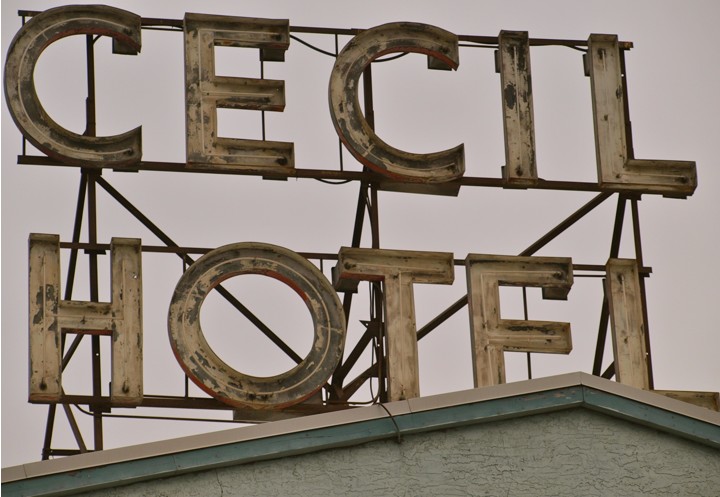
Lesbians, Softball and the Cecil Hotel

Sports, and specifically softball, provided an important outlet for the development of lesbian subculture and identity in North America.  Sally Munt writes in Heroic Desire: Lesbian Identity and Cultural Space, “any sample of publicly identifiable US lesbians from the period 1960-1968 would have likely been corralled from the local softball team.”  Calgary was part of this trend and in the 60s had a couple of women’s teams that were predominantly lesbian in their make-up.

After a game, teammates would go to their favourite watering holes, which for many was the backroom of the Cecil Hotel.  Lois Szabo remembers being really excited when she discovered the Cecil.  “We stumbled upon it by accident – all these women – it was like finding mecca,” she remembers.

Cecil 1

Photo Credit: Del Rath

Carolyn Anderson’s 2001 Lesbian Oral History Thesis (available from the University of Calgary: here), contains more conversations about softball.  She recounts one story,

“I wanted to be involved with all these women but I didn’t particularly want to play softball. I actually thought it was a pretty boring game so I became the team doctor. It seemed to suit everybody just fine. I would always take something to read like my medical books or whatever lesbian stuff I was getting in the mail and I could just be around all the neat dykes. The coach still remembers me and how she would look up into the stands and there was this woman reading through this whole game. After the games, some of the women tended to frequent the bars.”

The Cecil Hotel had a notorious past as a saloon and boarding house, and was always described as a blue collar bar.  Built in 1912, the building became a locus for prostitution, drugs, murder in modern times.  The City eventually revoked its business licence in 2009; police were called to the Cecil 1,700 times in its final year of operation.

Jen Gerson, in the National Post quotes Leo Silberman one of the Cecil Hotel’s owners.  “When I bought the place [in 1968], the women were worse than the men,” he told the Calgary Herald before he passed away in 2007. “They fight like heck every day. Very, very rough.”

Lois concurs, “I remember that some of the women would get into fights, particularly the butch women if someone looked at their femme in the wrong way.”

However tough, softball and the hotel bar provided much needed gathering places for Calgary’s lesbian community in the 60s.  Another quote from the oral history thesis explains, “With the ball teams, you had your north side gang and your south side gang. We were the south side gang and we all went to the Cecil [hotel]. We liked the Cecil because there was a nice private backroom there. It was marked for Ladies and Escorts and we’d laugh because we didn’t know which we were! God, we used to have a lot of fun there. They used to cater to us because we were the best part of their business.”

[KA]

Borderland: Gay Iranian Fringe Show comes to Calgary

Izad Etemadi, a 23-year old Iranian-Canadian, will be featured at this year’s Calgary Fringe Festival with his one-man play, Borderland, August 3 – 10th.

Borderland Image

Contemporary Iran is a dangerous place for queer people.  It is one of a handful of countries currently with the death penalty for being a convicted homosexual, and has conducted widely condemned public executions in recent history.  Not surprisingly, homosexuality is driven deeply underground in Iran, and many flee the country to seek refugee status in the West.

Although Izad grew up in Canada, he grew curious about how his life might have been in Iran.  “My parents often remind me how lucky I am to live in Canada, not only being gay but even working as an artist would not have been possible,” he explains.

Borderland tells the story of Navid, a gay Iranian man running from himself and his home. He arrives at Borderland – a secret hiding place – in search of acceptance. There he meets Leila and Zia (also played by Izad) and the drama unfolds.  Borderland has received critical acclaim, described as a Tour De Force in its current run at the Hamilton Fringe Festival.

“Many audience members have been quite moved by the play, at least the ones I have talked to.  When I started researching the play online, I found people living like me in Iran had really horrifying lives.  Yet many people do not realize how scary and dangerous it is over there,” Izad remarks.

Although Canadian audiences might feel relief that they do not suffer these indignities, similar threats, incarceration and legalized discrimination of homosexuals is part of our collective past as late as the 1960s.  Similarly there were executions of gay men in the British common law system, which included the Dominion of Canada until the death penalty was removed in 1861.

Izad remains hopeful that progressive social change can spread, noting the changes that are occurring in the United States.  He also wants to sensitize his audiences to the fact that Canada is playing an important role in the resettling of those who are fleeing Iran.

A Toronto-based charity, the Iranian Railroad for Queer Refugees (IRQR), exists to support Iranian queers around the world.   The organization supports Iranian queer refugees from when they decide to leave Iran until they resettle in a safe country, and have affected the outcomes of hundreds of lives.  IRQR’s name is inspired by the underground railroad: an informal network of secret routes and safe houses used by 19th century black slaves in the United States to escape to Canada with the aid of abolitionists who were sympathetic to their cause.

Izad says, “One of my biggest fears was the response to my play from the Iranian-Canadian community, but I have been overwhelmed by their support and their pride in my work.  One day, I would love to go to Iran myself, but currently it is not possible: I would have to do three years military service and if [the government] Googled me they probably would not like what they’d see.”

He concludes, “This has been my first time writing anything, and I have produced and put together the whole play myself.  It has been the biggest growing experience for me as a person – and one of the coolest summers I have had.”

[KA]