Tag Archives: Gay history

The OK Campaign

Calgary Outlink, our community hub, has been in Calgary in one form or another since 1975.

{The Calgary Outlink AGM is tonight and open to the public!}

In the late 1990s, the organization was called GLCSA (the Gay and Lesbian Community Services Association). In 1998 they embarked on an awareness initiative called the OK Campaign, spearheaded by a resourceful volunteer and former board member, Brian Crawford. The campaign literature explained that it “was designed to promote personal reflection specific to gay and lesbian issues in the mainstream media.” In reality it was a not-so-subtle political statement and outreach tool.

Screen Shot 2016-06-22 at 4.01.45 PM

The campaign ended up targeting 98% of Calgarians through bus, billboard and poster ads throughout the city. The campaign ran in September of 1998 and 1999, and was the first of its kind and magnitude in a Canadian city. In 1998, the World Wide Web was still emerging as a communications force. The GLCSA crisis and information phone line was heavily used.  In that year the organization logged 3700 calls, and utilized over 10,000 volunteer hours.  Just over a third of the people who used the phone service were under 25.

GLCSA aggressively fundraised in advance of the OK Campaign: the campaign budget being $56,000. The community delivered: many pledging a regular monthly contribution in support of the initiative. One fundraising dinner netted $27,000. The local office of Pattison Outdoor Group were hired to coordinate ad placement, and like many other gay advertising initiatives before the OK Campaign ran into troubles.

Screen Shot 2016-06-22 at 4.01.10 PMSome local shopping malls protested having the text only ads in their facilities. Worried that the ads could offend shoppers, they demanded the ads pulled. Mortified Pattison Account Executives gave bonus advertising of $15,000 to the Campaign to compensate for mall owners who had insisted the ads be taken down. Eventually the GLCSA wrote critical letters to those mall owners but were restrained in lodging a formal human rights complaint by the “public education only” nature of the campaign.

{KA}
#weareorlando YYC Memorial

I was in Victoria’s Butchart Gardens Sunday, when I got the news of the attack on the Pulse Nightclub in Orlando, Florida. Michael Platt from the Calgary Sun was calling and looking for a comment from the Calgary Gay History Project: connecting the massacre to so many crimes we have already faced in the LGBTQ community.

The contrast was intense.  So many pretty flowers in such a bucolic setting combined with the grim, terrible news of a large tragedy unfolding. After the call, my husband and I just sat there on a bench for a few minutes in silence.

To be honest, I am still processing the news. At times sad, at times defiant, I am particularly piqued by the notion that the sight of two men kissing set the murderous rampage in motion.

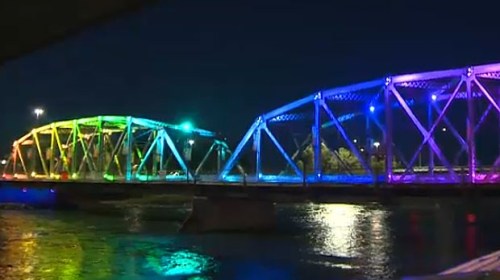
However I am heartened to see the strong reaction from the LGBTQ community as well as the support from our allies. Nolan Hill, who volunteers for the history project, was quick to help organize a well-attended vigil at Olympic Plaza on Sunday evening. Steve Gin & Lisa Murphy Lamb spearheaded an artistic response: KISS for Orlando through Loft 112. The City of Calgary lit the Langevin Bridge and Calgary Tower in pride colours.

langevin bridge

Calgary Outlink, our city’s LGBTQ community hub, with a large coalition of partners, are hosting a memorial service on Wednesday, June 22nd in the Jack Singer  Concert Hall Lobby at Arts Commons.  The We are Orlando – YYC Memorial begins at 6 PM  and will be a remembrance of all of the victims of Orlando.

YYC Memorial
This memorial is an opportunity for our city to grieve collectively for the lives taken in Orlando. This service is not based on any particular faith. Followers of any faith, or those who do not follow any faith – everyone – is welcome to attend.

My hope is that the Orlando shooting will have a transformative effect on society, shining the spotlight on homophobia and transphobia, wherever it occurs – in our city, in our country, in the USA and in the 70+ countries where homosexuality is illegal and/or carries the death penalty). I also encourage Calgarians to think about how they can support the LGBTQ organizations and services we have here in our city, so that we can maintain and advance our hard-fought human rights victories, as well as foster trust and understanding in the hearts and minds of others.

{KA}


Trans Trans in YYC

There is a new museum exhibition at the University of Calgary called Trans Trans: Transgender Histories Between Germany and the United States, 1882-1966.

The exhibition opened last week at Congress – the enormous, wonderful, and overwhelming academic conference hosted by U of C. {Where the Calgary Gay History Project led three University Gay History Walks!}

Screen Shot 2016-06-08 at 10.34.29 AM

Calgary Gay History Projects’ Kevin Allen reposes at the Trans Trans Exhibition at U of C

We strongly encourage you to check out the exhibition in the next few days while you still can. Not only is it a fascinating study on the connections between transgender individuals and the medical community who supported them, but also it is a meditation on gender identity in the 21st Century. Plus you can transition from observer to observed by getting your photo taken in a reproduced living room that was central to trans medical history.

The exhibit synopsis (from the Nickle Gallery website) reads:

Trans Trans explores a network of individuals in Germany and the United States from the turn of the twentieth century into the 1950s who profoundly shaped transgender histories and identities. Exchanging letters and photographs among themselves, these individuals created new communities in private, but they also sought to educate doctors and the public by submitting their photographs and stories for publication in medical journals and popular magazines. The exhibition retraces the connections between these private individuals, the medical and scientific authorities with whom they entered into dialogue, and the ways in which these dialogues became public or remained hidden away within archives.

Turning traditional medical-scientific history on its head, the exhibition documents the driving role that trans individuals played in the development of medical concepts and treatments. The show exhibits extremely rare images from the world’s first popular magazine to focus on trans identity, The Third Sex, which was published in Berlin from 1930-1932, and it tracks connections between this earlier German history and the work of Dr. Harry Benjamin, whose 1966 book The Transsexual Phenomenon drew from his years of training in Germany and work with trans patients to make a plea for acceptance and supportive medical treatment to an American audience.

Trans Trans is produced in co-operation with Michele Hardy, Curator, Nickle Galleries; the Magnus-Hirschfeld-Gesellschaft in Berlin; the Institute for History and Ethics in Medicine of the Charité Clinic, Berlin; and the Kinsey Institute for Research in Sex, Gender, and Reproduction in Bloomington, Indiana.

Exhibition Production: Annette F. Timm

Curated by: Rainer Herrn, Michael Thomas Taylor, Annette F. Timm

{KA}