Tag Archives: Calgary

Klippert back in the news 50 years later

This has been quite a week in gay history. The Prime Minister’s Office promised a posthumous pardon for approximately 6000 men who were arrested and charged with gross indecency or buggery for consensual sexual acts between men in prior decades.

This was initiated by John Ibbitson’s in-depth review of Everett Klippert’s famous court cases published in the Globe and Mail last weekend, including the first ever published photos of Everett. The Calgary Gay History Project was proud to have supported that article through research findings and interviews.

The news set off a mini-storm of media interview requests locally. Calgary Gay History Project representatives Kevin Allen and Jonathan Brower, also of Third Street Theatre, were kept busy for days.

Jonathan at CBC

Jonathan Brower, interviewed twice at CBC in one day, February 29 2016

Here are some links to the highlights:

John Ibbitson’s breaking the news of the PMO pardon in the Globe and Mail.

CTV National coverage of the story.

Calgary Sun editorial, seeking a local response to the injustices of the past.

CBC Calgary interview on the Eye Opener.

Edmonton Journal editorial in support of a Klippert pardon.

Comment from a NWT Legislator.

Toronto Star editorial in support of pardons for gay men.

John Ibbitson’s follow up article about the speed of change in Canadian society.

We are truly grateful that this injustice has finally come to light in such a public arena. Journalists can change the world!

{KA}


The Kings Arms Tavern

The Palliser Hotel had a colourful watering hole when the hotel first opened in 1914.  Once known as the “Carriage House”, the pub is better known for its final name, the “Kings Arms Tavern” or as the gay community liked to call it, “The Pit.”

Tavern Sign in 1980

Tavern Sign in 1980

The Tavern was a known drinking establishment for gay men back into the early 1960’s.  You can still access the lower level entrance today on the 1st Street SW underpass, just south of 9th Avenue, into what is now a Starbucks.

Stop on a Gay History Walk in the Palliser Hotel - former location of the Kings Arms Tavern.

Stop on a Gay History Walk in the Palliser Hotel – former location of the Kings Arms Tavern.

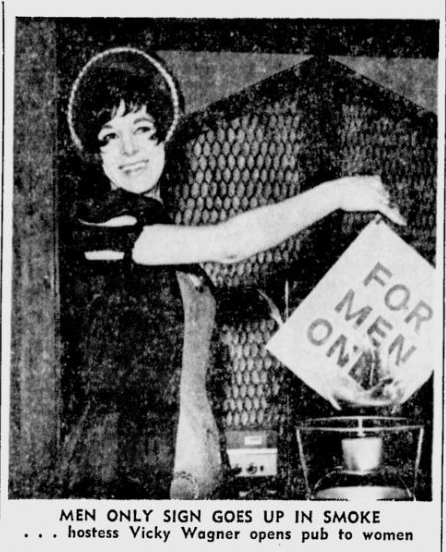
The Pit was not an exclusively gay venue.  It was a popular spot for the business lunch crowd, old-timers in the afternoon and the gay crowd in the evening. Described as an old fashioned beer parlor, it was one of the last pubs in Calgary which kept women out.  Then, on July 2nd 1970, it reopened after renovations including new carpet and a new name: Kings Arms.  Ringing in the end of the men-only pub era in Calgary, the Kings Arms first female employees set fire to the Men Only Door signs with a little pomp and circumstance.

Calgary Herald Photo at Kings Arms, July 3 1970

Calgary Herald Photo at Kings Arms, July 3 1970.

Throughout the 70s, the organized gay community grew in Calgary and the Kings Arms developed a gayer reputation.  It was a popular pre-clubbing drink venue, and Club Carousel which was at the apex of its popularity in the early 70s, was just a few blocks south on 1st Street.

By the late 70s, after a bar management change, the Kings Arms started to be uncomfortable with its reputation and started behaving badly.  A popular rumour was that the establishment was trying to oust its gay customers by closing earlier.  Suspected gay patrons were denied service due to clothing regulations, same sex kissing or sitting too close together.  In December 1978, the harassment had built to the point that tensions erupted between gay patrons and the tavern manager.  After a heated verbal exchange there was a dramatic eviction of 20 customers from the bar, facilitated by six police officers and four paddy wagons.

The Kings Arms Tavern closed its doors on July 31, 1982.  A large crowd of patrons, many from the gay community, came out for its final night.  Many thought that the Tavern was being closed because the Palliser did not like the reputation of having a gay bar at its hotel.  Earl Olsen, the public relations spokesman for the CP Hotel chain denied the allegation, saying the tavern was making way for a much needed coffee shop.  Sentimentality reigned on that final evening, with many patrons taking a piece of the tavern with them.  By the end of the night, all of the plaques and coats of arms that had adorned the tavern walls, were gone.

One of the gay patrons lamented, “they should never close down an institution.  [The Kings Arms] is not really a cruisy bar.  It’s just a nice place to sit and meet people and not be hassled.”

{KA}

Gauntlet Mining finds History Gems

The University of Calgary Student Press, 1970-1980: From Anonymous Classified Ads to Gay Liberation Op-Eds to Gay Academic Union as a Part of Campus Life

As the Criminal Code changes that decriminalized private same-sex acts between consenting adults in Canada went into effect in August 1969, the legal struggle against discrimination, for full civil and human rights of sexual minorities and for social and political change in Canada was just beginning. The 1970s are often called a formative age of queer activism: a time of gay and lesbian liberation movements, changing mores about sexuality in general, of a forging of a more visible community of people identifying by their sexual orientation, building upon but moving away from underground queer subcultures (as discussed in an earlier post on The Body Politic).

We looked at over ten years (1969-1980) of the University of Calgary student newspaper, The Gauntlet, to deepen our understanding of Calgary’s gay and lesbian history during this turbulent decade, and explore the role that the University and its student press played, providing a space for debate, but also for reaching out, support and organizing around an emerging advocacy agenda.

GLF

The Gauntlet Classified Ads – 1972

Despite the Gauntlet’s uneven editorial tone and often flawed reporting, as well as many omissions of landmark moments in gay and lesbian activism of the 1970s, a look at its writing from this decade still reveals important aspects of gay and lesbian history in the city. Moreover, it testifies to the role that the University of Calgary played as a public space, where early gay activism, as well as debate on some of the defining national gay and lesbian issues of the decade took place.

Read the full essay: here.

{NI}