Tag Archives: calgary public library

Calgary Pride: A Catalyst for Social Change

The Pride Movement has been a mighty agent of social change. But how did Pride impact Calgary specifically? Join us Tuesday, October 24th, from 6:00-7:30 PM, at the Central Library, where we delve into that question with a history panel of former and current Calgary Pride leaders.

Fundraising Buttons for Pride

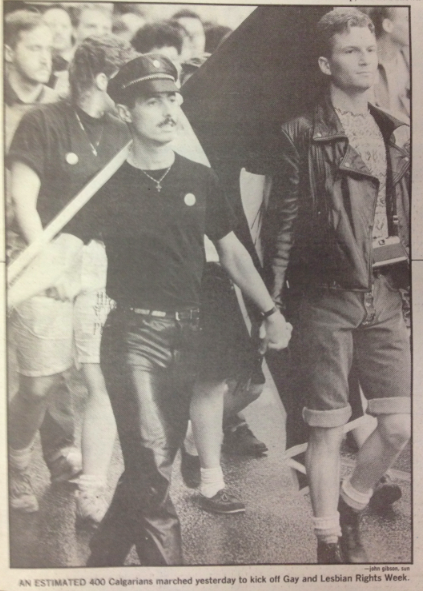
Calgary Pride has come a long way since its inception rally in 1990. The Calgary Gay History Project’s Kevin Allen will lead discussions with panelists about the evolution of Calgary Pride. We will begin by revisiting the humble beginnings of Calgary Pride, tracing its roots back to the early activists who paved the way. Discover how their courage and resilience shaped the movement we know today.

Learn about the impactful initiatives and events organized by Calgary Pride that continue to make a positive difference in our city. Our panelists will share their experiences and discuss the ongoing challenges and opportunities for social justice in Calgary. Looking ahead, we will explore the exciting prospects for Calgary Pride as it continues to evolve.

Panelists will offer insights into the strategies and goals of Calgary Pride as they work towards a future where everyone can live authentically. Take advantage of this thought-provoking evening that honours the past, celebrates the present, and embraces the future of Calgary Pride as a catalyst for social change in our city.

Calgary Pride: A Catalyst for Social Change is presented in collaboration with the Calgary Public Library and Calgary Pride. Spaces are limited—reserve a spot here.

Pride March in 1991: Calgary Herald Photo

{KA}

Calgary “Sex Deviates” Saved Library

{This week, we have a guest post from emerging historian Jason Brooks. Digging in the archives, he discovered that the storied Memorial Park Library was saved from redevelopment due to the shady company it kept! – Kevin}

In 1962, Calgary City Council was divided over the creation of a new central public library. While all sides agreed that the growing population required a new library, the location for such a building was contested. Mayor Harry Hays advocated for a location across from City Hall on the corner of 7th Ave and 2nd Street (later Macleod Trail) SE. However, opponents of this plan suggested the replacement of the then 50-year-old Memorial Park Library.

In response, Mayor Hays used a police report to argue that the site was dangerous to children since, “more homosexuals hang out there than anywhere else.” Despite the Mayor’s argument, the report concluded that no assaults had occurred to children under the age of 16 within the vicinity of Memorial Park.

After the debate, the new central library was built in 1964 at Mayor Hays’ preferred location. Memorial Park and its library continued to be a significant meeting point for Calgary’s queer community for the rest of the century, regardless of police scrutiny.

Memorial Park Library, photo courtesy #HistoricPlacesDays

{JB}

Gay men are smarter than straight men – so says history.

{The Calgary Gay History Project is revisiting its most impactful blog posts—now numbering in the hundreds—since its inception nine years ago. Gay men are smarter than straight men—so says history has been, hands down, its most popular post since it was published on July 18, 2013. It also has a notable time reference to the big Calgary flood.}

The sixties were a boom-time for psychometric assessment, and in particular Intelligence Quotient (IQ) research. Perhaps one of the most famous and controversial papers of the time, was Arthur Jensen’s article, published in 1969, How Much Can We Boost IQ and Scholastic Achievement? It concluded that 80% of the variance in IQ in the population studied was the result of genetic factors due to race.

Similar lines of research were done on homosexuals. In Canada, a University of Toronto Social Work professor, John C. Spencer, published an article in the Canadian Journal of Corrections (1961). He looked at 132 sexual offenders in the Toronto Forensic Clinic. These incarcerated individuals were categorized into three groups: exhibitionists, pedophiles and homosexuals. Spencer concluded that while exhibitionists and pedophiles had essentially normal IQ’s, the average intelligence of the homosexual offender was significantly higher than average (IQ of 114 vs. the population average of 100). Reading between the lines, he may have been an early homosexual rights advocate as he mused openly about criminal law being a vehicle for moral condemnation (see article image below).

Other researchers confirmed the IQ findings. Renée Liddicoat, published A Study of Non-Institutionalized Homosexuals, also in 1961, and found that South African homosexual men and women had significantly higher verbal IQ scores than that of her heterosexual control group.

A 1949 study of 100 neurotic homosexual and 100 neurotic heterosexual soldiers similarly found evidence of higher intelligence scores and educational achievement amongst the gay soldiers (Winterstein-Lambert, E. Bulletin de la Faculté de Médicine de Instanbul). In fact, this paper’s conclusion was that the gay community did not need psychological treatment, rather job placement support in order to deal with neurotic symptoms.

However, like many IQ studies there is a potential for cultural bias in the research as well as other sources of error. Some studies showed no difference, and at least one showed reduced intelligence in homosexual men. A quirky finding in many intelligence studies was the homosexual male’s sensitivity to art and culture. Silvio Marone, in the International Journal of Sexology (1954) wrote: “homosexual behaviour is not rare among artists, and homosexuality has a great influence on art.”

Finally, speaking of great influences, the Calgary Public Library’s Magazine’s and Newspapers department was devastated by the recent flooding in Southern Alberta. Many of the articles researched for this website have come from that basement department (such as: this one). We are really saddened by this particular loss. Individuals interested in donating to the Library’s flood recovery fund can find more information: here.

{KA}