Tag Archives: Calgary Police

The Calgary Police Archives

The police and the gay community have had a conflicted past across North America for most of the 20th Century. We see this former reality resonating in 2016 as the LGBTQ community debated how police participated in Pride Parades across Canada.

Locally, the Calgary Police have been in the news due to a recently released, unflattering, 2013 internal audit of workplace culture. The Police are one of many state institutions that are grappling with societal change, and increasingly, with reconciliation for prior stigmatization of the LGBTQ community.

police-flag

A research trip to Police HQ, one week after the Orlando shooting. We were surprised to see the Pride Flag flying at half mast…

A positive development, amidst this troubling news, is that the Calgary Police archives staff have been assisting the Calgary Gay History Project: combing through files looking for references to their relationship with the LGBTQ community in previous decades. The material is far from flattering.

Some samples:

In May 1946, Constable F.C. Shipley was awarded an entry in the merit book and an accelerated promotion due to catching Alfred V. Andrew in an act of gross indecency with another man at the Alexandra Hotel.  Andrew subsequently pleaded guilty and was sentenced to six months hard labour.

In November 1960, the Calgary Police fired one of their own employees, Charles Pippard, because, “it would appear that Pippard suffers from homosexual tendencies, but nothing can be uncovered to confirm this.”

And in Sept 1963, an editorial in the Police’s internal magazine, Patrol, gleefully announced:

Hats off to those members of the Detective Division whose resourceful and perseverance, coupled with a new and revolutionary scientific aid to criminal investigations, closed circuit television, were successful in exposing and subsequently convicting a group of men practicing acts of gross indecency in a public washroom.

The hue and cry that heralded the use of these so called ‘Big Brother tactis’ [sic] by the force, displayed as usual a lack of awareness and understanding of this dangerous trend which prompted the use of this device.

Homosexuality and the perversion it breeds is a social problem that is always with is. When, however, such perverts meet and practice various acts of indecency in any place to which the public have access, then there is no other course open to the Police than to use every means at their disposal to safeguard innocent citizens from this type of environment and ensure that these establishments are protected from such defilement.

It is unfortunate that to gain the evidence required to subject several innocent and unsuspecting citizens using the toilets in question, to the scrutiny of television cameras while engaged in a most fundamental act of nature.  That, it has been claimed, was a gross invasion of privacy.  Surely we are not such prudes that in the interests of public decency and morality, we cannot accept a little humiliation of this kind and in doing so perhaps prevent a child or young person from becoming the victim of the insatiable lust of some of these mentally sick individuals.

It is important that society-at-large comes to terms with our LGBTQ past, and stares at it unflinchingly, to prepare a space for reconciliation.  I thank the Calgary Police for opening up its history to the Project and allowing itself to be stared at.

{KA}

Pride and Pre-justice (a recap)

Proclaiming your gay pride in Calgary used to be hard. In previous years, homophobia and transphobia were actively practiced in our city. We had both an unsympathetic society and an unjust state. Here is the speediest of recaps.

1980 – Calgary gay activists host a national gay rights conference that ends in a controversial rally and march. Then Mayor Ross Alger and police Chief, Brian Sawyer are decidedly unsupportive.

1981 – Newly elected Calgary Mayor Ralph Klein proclaims he is a mayor for everyone including the gay community, then quickly distances himself from gays due to public outcry.

1987 –  Delegates from many of Calgary’s gay and lesbian organizations come together to form an umbrella organization called Project Pride Calgary. Inspired by the Stonewall Riots, they produce a Pride festival locally to celebrate community. Their first festival in 1988 includes a concert, workshops, a dance, and a family picnic – but no public rally or protest.

Screen Shot 2016-08-24 at 2.53.55 PM

1990 Pride Rally Poster

1990 – the Calgary Lesbian and Gay Political Action Guild (CLAGPAG), one of the Project Pride partners, organizes the first political rally, which they internally described as a media stunt. 140 people muster at the Old Y to pick up lone ranger masks, and then gather at the Boer War Statue in Central Memorial Park.

1991 – CLAGPAG more ambitiously, holds its first Pride Parade. 400 people at City Hall cheer gay Member of Parliament Svend Robinson, who gives an inspiring speech despite gloomy weather and even gloomier protesters, three of whom were arrested. 1991 is also the year Mayor Al Duerr famously proclaims gay pride week in Calgary but then denies future proclamations due to public pressure.

Screen Shot 2016-08-24 at 2.55.37 PM

Svend Robinson, June 16, 1991.  Photo: Luke Shwart

1998 – Vriend vs. Alberta. The Supreme Court decision forces Alberta to include sexual orientation as a prohibited ground for human rights discrimination. Alberta Premier Ralph Klein blusters, and stirs up his socially conservative base, but in the end capitulates.

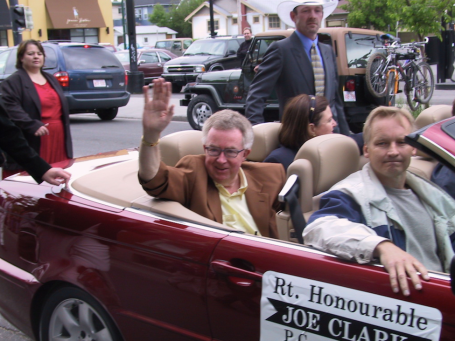
2001 – Former Conservative Prime Minister, Joe Clark, agrees to be Calgary’s Pride Parade Marshall and solicits scorn from social conservatives everywhere, including the Westboro Baptist Church. “We might have a big crowd preaching against those fags up there Sunday,” Reverend Fred Phelps says from Topeka, Kansas but then fails to show up.

Screen Shot 2016-08-24 at 4.08.43 PM.png

Joe Clark, June 10, 2001.  Photo: Grant Neufeld

2002- Calgary Police raid Goliath’s Sauna, and charge operators and found-ins under antiquated bawdy house laws, provoking legal challenges from the gay community. (The Crown eventually drops charges in 2005 citing changing community standards)

2005 – Same-sex marriage becomes legal in Canada. The Alberta Government remains officially opposed and threatens to invoke the notwithstanding clause to negate the law in Alberta, but doesn’t.

2006 – Parade marchers tussle with protestors carrying signs “no pride in sodomy.” One marcher is arrested.  Police Chief Jack Beaton says publicly he disapproves of the protestors.

Screen Shot 2016-08-24 at 8.56.42 PM

2009 Pride Board Members, Dallas Barnes & Sam Casselman.  Photo: Kevin Allen

2009 – Pride Calgary moves the parade from June to the September long weekend, and transitions from a grassroots collective to an incorporated non-profit society.

2011 – Mayor Naheed Nenshi is the first Calgary mayor to march in our Pride Parade, and is parade marshall that year, making national headlines.

Screen Shot 2016-08-25 at 10.59.22 AM

Mayor Naheed Nenshi, September 4, 2011 Photo: Todd Korol, The Globe and Mail

2016 – Protestors are hard to find and politicians are seemingly everywhere – it has been an amazing journey.

(KA}

Support the work of the Calgary Gay History Project – Donate through our Paypal Virtual Tip Jar!

Seeking the 620 crowd!

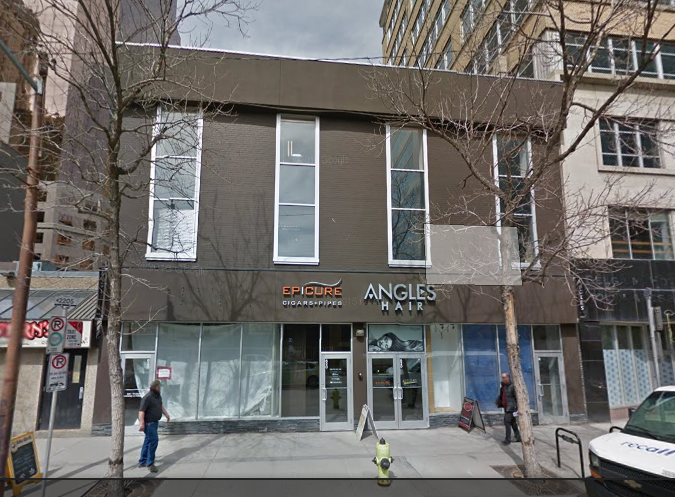
Before Club Carousel in the late 1960’s there was a bar called the 620 club at 620 8th Avenue SW near the site of the old Uptown Theatre.  Frequented by both gay men and lesbians, you accessed this underground bar by stairs in the back alley between 5th and 6th streets.

620 8 Avenue SW

620 8th Avenue SW Calgary today: image Google Earth

It opened in 1967 or 1968, and was owned by a man described as short and swarthy, with a big nose and a limp.  The 620 was just a number on the door, and there was no alcohol served – there was only popcorn and pop machines. The room was not very big, and was decorated by a lot of christmas tree lights with a central light bulb (red?) hanging from the ceiling.

Former producing director of Alberta Theatre Projects, Michael Dobbin, remembers: “It was a time when if you saw someone you recognized at the club [from one’s day-to-day life] it made you feel kind of queazy and you left.  It was only open on the weekends.  Getting there, you would sneak down the laneway, look both ways and then quickly go down the stairs.”

“One night I remember that it was really crowded and there were these three guys in suits – one of whom I found quite attractive – so I went up to him and asked him to dance and he responded gruffly, “No!’   When I went back to my friends, they asked me what I had done, and they said to me, ‘they are the police stupid, the light is flashing!'”

Before homosexuality was decriminalized in 1969 any same-sex couple dancing together was potentially subject to arrest under the charge of gross indecency.  The 620 Club used the flashing light to alert its clientele to suspected police presence, and dancing would either cease or gay men and lesbians would switch partners and grab each other to dance.

Lois Szabo in a 1973 edition of Carousel Capers wrote that: “In the past, many gay clubs have been set up and these businesses were primarily concerned with earning a fast buck!”  Her editorial point being that Club Carousel was the first gay club owned and operated by the community.

To date, that is all we know about the 620 club whose existence is still a bit of a mystery to the Calgary Gay History Project.  If you, or anyone you know has a recollection of the 620 club, we would be grateful if you would contact Kevin Allen at calgarygayhistory@gmail.com.

{KA}