Tag Archives: Calgary Police

Dying Young

{This is our last post in 2025! We at the Calgary Gay History Project wish you a warm and festive holiday season – Kevin}

In the history of Calgary’s queer community, few figures loom as large—yet remain as quietly influential—as Doug Young. Born in 1950 near Taber, Alberta, and raised in both Taber and Medicine Hat, Young’s life was marked by a deep commitment to social justice and community building that helped shape the early gay rights movement in Calgary.

Young’s academic journey took him from Medicine Hat College to the University of Calgary, preparing him for a lifetime of advocacy and community service. Before his activism fully took hold, he worked with the Alberta Service Corps and Canada Customs—experiences that undoubtedly broadened his perspective on community needs.

But it was in the late 1970s and 1980s that Doug Young became one of Calgary’s most active voices for gay rights. At a time when queer communities were often hidden and marginalized, Young stepped forward into leadership roles that were both challenging and essential. He served as President of Gay Information and Resources Calgary (GIRC) from 1977 to 1979, and continued on its board through 1981. Under his stewardship, GIRC became a vital resource—offering support, outreach, peer counselling, and serving as one of the few community touchpoints for queer people in the city.
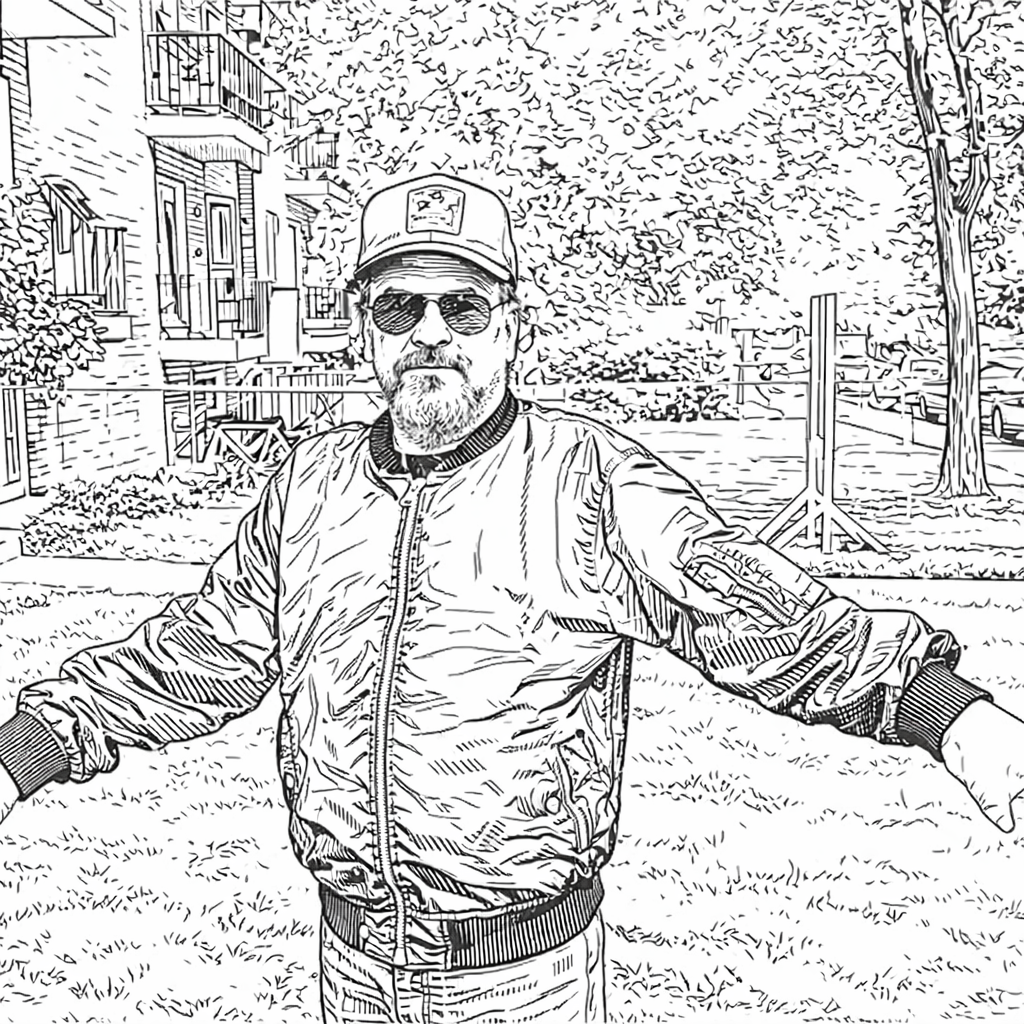
Line drawing of Doug Young derived from a photo in the Calgary Herald, June 14, 1994

Young didn’t limit his work to one organization. He was actively involved with the Alberta Lesbian and Gay Rights Association, AIDS Calgary, Gay and Lesbian Legal Advocates Calgary (GALLAC), the Right to Privacy Committee, and the Gay and Lesbian Community Police Liaison Committee—a network of groups focused on legal rights, health advocacy, safety, and community relations. This breadth of engagement speaks to both the urgency of the issues at the time and Young’s own drive to see real, sustained progress.

Young was an active spokesperson for the gay community and notably contributed to queer history through his extensive records. His personal papers were sorted and saved by Young’s friend John Cooper. They are now housed in the Glenbow Archives, which includes a remarkable hand-drawn map of gay spaces in the Beltline from the mid-1980s.
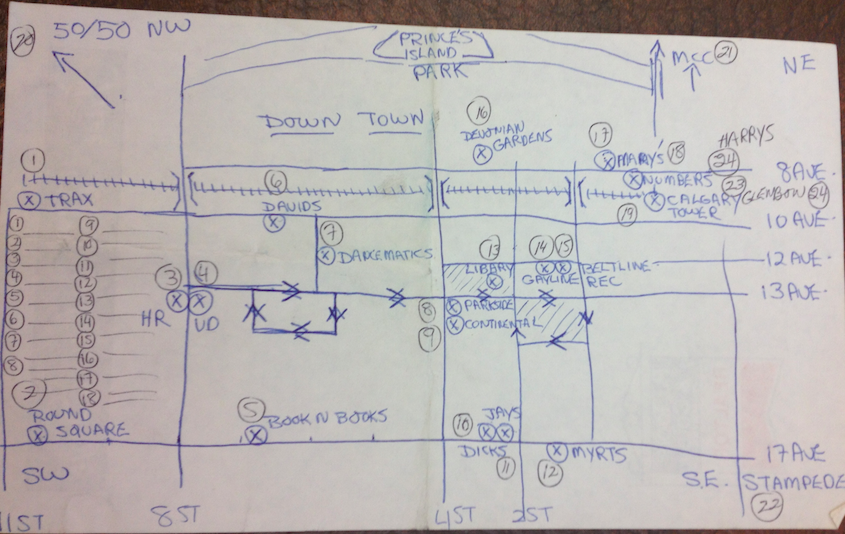
Doug Young personal papers, Glenbow Archives M-8397-1.

Perhaps most poignantly, Young’s leadership bridged the early gay rights era with the inevitable rise of the HIV/AIDS crisis. Community groups like AIDS Calgary grew out of activist networks in which Young was involved, helping mobilize volunteers, advocate, educate, and provide basic support during a time when fear and stigma often overshadowed empathy and action.

Doug Young passed away on April 15, 1994, from AIDS-related complications, a loss felt deeply across the community he helped nurture. While he did not live to see many of the legal protections and cultural shifts that came later, his efforts laid the necessary groundwork for Calgary’s queer organizations, public awareness efforts, and ongoing fights for equality.

At this dark time of year, I like to light candles to call back the light. I also light candles to remember those we’ve lost. Young would have been 75 in 2025 if he had lived, and I’m positive many other organizations would have benefited from his activism. The contributions of individuals like Doug Young are vital reminders of how far the community has come and how central grassroots leadership can make all the difference.

{KA}

Calgary “Sex Deviates” Saved Library

{This week, we have a guest post from emerging historian Jason Brooks. Digging in the archives, he discovered that the storied Memorial Park Library was saved from redevelopment due to the shady company it kept! – Kevin}

In 1962, Calgary City Council was divided over the creation of a new central public library. While all sides agreed that the growing population required a new library, the location for such a building was contested. Mayor Harry Hays advocated for a location across from City Hall on the corner of 7th Ave and 2nd Street (later Macleod Trail) SE. However, opponents of this plan suggested the replacement of the then 50-year-old Memorial Park Library.

In response, Mayor Hays used a police report to argue that the site was dangerous to children since, “more homosexuals hang out there than anywhere else.” Despite the Mayor’s argument, the report concluded that no assaults had occurred to children under the age of 16 within the vicinity of Memorial Park.

After the debate, the new central library was built in 1964 at Mayor Hays’ preferred location. Memorial Park and its library continued to be a significant meeting point for Calgary’s queer community for the rest of the century, regardless of police scrutiny.

Memorial Park Library, photo courtesy #HistoricPlacesDays

{JB}

In Hot Water: Our Relationship with the Police

Terry Haldane, Stephen Lock & the 2002 Goliath’s Bathhouse Raid

At around 2:30 PM on a Thursday, Calgary Police Service officers invaded one of our community’s safe havens, Goliath’s Bathhouse. This surprise raid occurred on December 12, 2002. In this series of blog posts, we will delve into the history of the Goliath’s raid. Along the way, we will explore injustice, changing queer culture and our complicated relationship with the police, past and present.

Read Part 1: The Raid: here.

Read Part 2: The Court Battle: here.

The relationship between police and various minority communities is a contentious and current issue: the Goliath’s Raid is an interesting case study.

Reflecting on the conduct of state agents, it appears both police officers and the case’s Crown prosecutor behaved professionally and compassionately. During the raid, one married man was so upset about the implications for his marriage, family, and religious community that he felt like throwing up. However, an officer came and reassured him that it was not like a murder or robbery charge, describing it as quite a minor thing. The Crown prosecutor generally avoided airing dirty laundry in the trial, and tried to get a publication ban on the names. According to Terry, he told Terry’s lawyer at tennis that a case like this is the last thing he’d want to be assigned because it made no sense. Even as far back as the 80s, Terry had positive, supportive experiences with police, especially when he experienced a brutal gay-bashing and multiple officers visited him, with one even giving Terry soup his wife had made.

Regarding the organization as a whole, Terry and Stephen still think the Calgary Police Service has yet to take full responsibility. Stephen brought up at a liaison meeting that then-police chief Jack Beaton should apologize. They privately learned later that Jack Beaton felt a tension between maintaining a healthy relationship with the community and his duty to investigate crime, and he did apparently ask the police commission if an apology could be issued, but was denied as they thought it would be seen as admitting fault. Calgary Police Service chief Roger Chaffin did apologize in July 2018 for “not fully considering the impacts of a 2002 Goliath’s bathhouse raid and the impacts that would have on the community […] we are sorry for the role we played in this part of your painful past.” Despite this, Terry and Stephen feel the apology wasn’t full-throated enough in explicitly taking responsibility.

Calgary Police Chief’s formal apology to the LGBTQ2+ community on July 27, 2018.

As mentioned earlier, prior to 2002, the relationship between police and gays was improving and actively being bettered. Though the raid felt like a backstabbing, Terry and Stephen also felt that within about five years, the relationship had mostly re-healed. They now see that relationship being threatened again by current discourse and political movements. Regarding the movement to exclude police from Pride, they have the sentiment of “how dare you” after their work on building that relationship. They respect Calgary Pride’s right to run their organization as they see fit and to be inclusive, but they don’t see this as a productive path forward. In response to the call to defund the police, Terry actually banded together with an officer’s mother and Brett Wilson (formerly of Dragon’s Den) to mobilize against this movement.

It is worth pointing out that Terry and Stephen’s story is primarily a reflection of white cisgender gay men’s interaction with police. People from different racial, economic, and gender backgrounds have experienced interactions with police that vary: with some people having no interactions or positive interactions, and others experiencing real discrimination and abuse from police. Nevertheless, it is still useful to look at this event as an example of how the police’s relationship with minority groups can be damaged and repaired depending on both party’s actions and attitudes.

In this case, the police put in the initiative to work with the gay community in the 1990s, betrayed that trust in 2002, and then spent the subsequent years rebuilding and finally apologizing—all of which required buy-in, hard work, forgiveness, and self-advocacy from members of the community. Both groups stand to benefit from one another: the police gain cooperation and insight from a community that may be harder to engage, and the gay community gains better protection and a reduced experience of discrimination from police. It is astonishing that people who faced direct discrimination from police encroachment on their sexuality are able to hold a pro-police position and then afterward work to help them connect with the community. It is a testament to the power of forgiveness.

As it stands, it seems at least some of the white gay male community has re-established a relatively functional relationship with the police. The case is not so with all members of the LGBTQ2+ community, each racial and gender community potentially facing injustice with varying degrees of severity. It is up to each community to determine if and how their relationship with the police can be mended. It is up to the police to put in the effort to adapt and build a cooperative relationship with them. CPS says that they are committed to serving our minority communities. Can we hold them to that and work with them to let them know what we need?

Next week: Part 4.

{SC}