Tag Archives: Calgary Olympics

Queering the Calgary Games

{Welcome to the final installment in our Winter Olympic Series, written by William Bridel!}

You may have heard of a recent show that is—pardon the pun—burning up the internet. Heated Rivalry has quickly garnered critical acclaim as well as a massive viewing audience both within Canada and globally. Situated in the context of men’s ice hockey, the show, while not without its flaws, is nevertheless broaching important conversations about queer representation in sport. Representation matters. That’s one of the reasons I wanted to write this series of posts about queer Olympians from Calgary.

Sharing these stories has provided an opportunity to celebrate queer representation in sport and to highlight that we’ve always been here! While building on that theme, this post has a somewhat different focus: the 1988 Olympic Winter Games, which were held in Calgary.

While some infrastructure built for those Games is now defunct (think ski jumps and the sliding track at Canada Olympic Park) and others torn down (think Olympic Plaza downtown), throughout Calgary, there are reminders everywhere that this city hosted the world now nearly 40 years ago—the Olympic Oval, the Saddledome, Nakiska Station, the C-Train northwest expansion, to name just a few. During our interview, Lindsay Alcock talked about the lasting influence seeing Olympic events in Calgary had on her athletic career. Alcock, Anastasia Bucsis, John Fennell, and Eric Mitchell all trained in Olympic venues built for the ’88 Games. Brian Pockar, the figure skater featured in the first of this series, played a key role in the production of the Closing Ceremonies.

At the community level, a local bus driver, Mark Perry-Schaub, was accepted as a transportation volunteer for the Games but was forced to fight for that position when it was discovered he had AIDS, and the organizing committee told him he was no longer welcome to serve in that role. You can read more about Perry-Schaub’s story here.
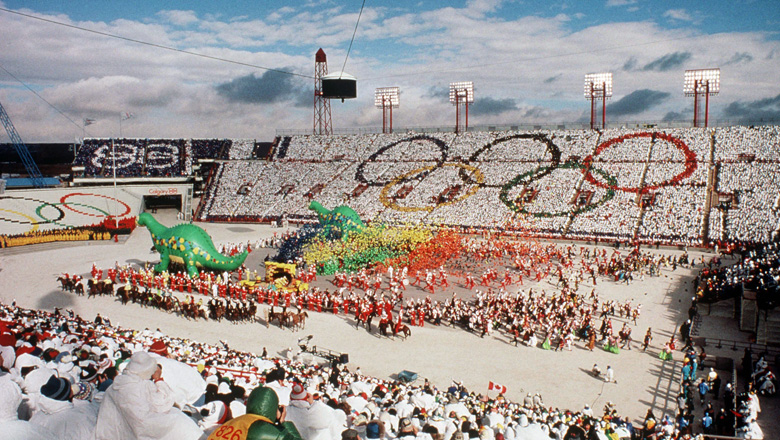
An image from the 1988 Opening Ceremonies, held at McMahon Stadium. This photo was retrieved from the Canadian Olympic Committee website.

The 1988 Games also had an impact on queer fans of sport. One research participant, Fred, spoke about the impact of the Games on community at the time, including meeting at Off Centre, a queer bar that would eventually become Money-Pennies, to meet friends from the community, talk about events, and the general vibe in the city at the time. He also shared this memory:

“Tons of us went… when the Jamaican bobsled team was down on Stephen Ave selling their t-shirts and stuff to raise money to pay for their trip. The bar was stuffed. I’ve got pictures of us all wearing Jamaican bobsled t-shirts, because everybody from the bar had to own that. We all went down to Olympic Plaza and cheered on Eddy the Eagle for being the last and the worst ski jumper. But we were all together. Like you cheer on the underdog. I’ve got pictures of us going into the big Olympic pin swapping tents… I still have all my pins in a box somewhere.”

Queer podcasters Bronwin Parks and Elinor Svoboda of the Late in ’88 podcast reminisced about the 1988 Games in their second episode, “Hometown Olympic Fever.”  In general, they commented that anyone in Calgary at the time was aware of the Games, with a noticeable change in the city leading up to and during the event, which they recognized even though they were quite young at the time. They also discussed with friends—and historian Kevin Allen—the impact various events had on them in relation to gender identity and sexuality. One friend commented on figure skater Brian Orser, specifically the celebration of his silver medal and the disconnect between Orser being applauded for that, whereas performances of non-traditional masculinity were viewed negatively in pretty much all other aspects of social life at the time. The whole podcast series is a great listen, but I recommend this one in particular as well as the bonus “Olympic Relics” episode.

While I didn’t live in Calgary at the time, as a 15-year-old figure skater, I was glued to the CBC for all the figure skating events. I cried when Tracy Wilson and Rob McCall won the bronze medal in ice dance—the first ever Olympic medal for a Canadian team in that event. I cried when Brian Orser finished second in the men’s event; an outstanding result without question, but one that I knew he was disappointed with at the time. And I lost my mind when Elizabeth Manley had the skate of her career, famously sporting that white cowboy hat as she exited the ice, earning the silver medal. I also ADORED Katarina Witt for her many achievements in the sport, her performance ability, and the DRAMA she brought to the ice (and off the ice as well)! I may have, in fact, performed along with her in my family room, the opening moves to her long program, choreographed to music from the opera Carmen. Only in recent years, however, have I begun to understand the impact Witt had on other queer folks. Comedian and actor Carolyn Taylor, for example, created a whole television series—I Have Nothing—around the indelible impact the Calgary Olympics had on her, including Witt’s talents and looks, leading to a sexual awakening for Taylor.

The Olympic Games and the International Olympic Committee are, of course, not without their many, many problems. Sport more generally remains a problematic space for queer folks, and a space from which trans and gender diverse folks are excluded through exclusionary practices, policies, and government legislation, such as Bill-29 in Alberta. It is imperative to recognize the work that remains to be done while at the same time finding and celebrating queer joy—be that through the recognition of queer athletes’ successes, their resiliency and bravery in breaking down barriers, or folks finding connection in and through sport, regardless of their role. I hope to have captured some of that joy in this series of posts about queer Calgarians at the Olympics and the Calgary Games. Thanks for reading along.

{WB}

Links to the Winter Olympic Series:

Part One: From the Calgary Winter Club to Olympic Ice

Part Two: Hurtling Headfirst Down Mountains and Into the History Books

Part Three: Faster, Higher, Stronger… Resist
Hurtling Headfirst Down Mountains and Into the History Books

{Welcome to part two in our Winter Olympic Series, written by William Bridel!}

I am frequently reminded of Dr. Lindsay Alcock’s humility, despite an incredible athletic career and her many accomplishments in other spheres of life. Just over a year ago, I was interviewing Lindsay for my project exploring the role of sport in Calgary’s queer history, and while we’d known each other since 2014 (not long after I moved to the city, we were both on a panel addressing homophobia in sport and became friends), I found myself learning more and more about her that day. I am proud to share part of her story here.

Born in Bearspaw, Alberta, in 1977, Alcock’s family relocated to Cochrane soon after. With limited sports opportunities for girls at the time, Alcock played soccer on boys’ teams and participated in many school sports. She and her family were also avid downhill skiers, though—as she was quick to point out—only recreationally. Still, the 1988 Olympic Winter Games left an indelible mark on Alcock, as she and her family took in many of the events. As a university student, Alcock joined the University of Calgary’s track and field team as a sprinter and also began working at Canada Olympic Park during the summers—an experience that would change her athletic trajectory.

“I had a tourist ask me one day: ‘Why don’t you do any of these sports?’ I didn’t really have a good answer. So, I thought, well, if anything, I can maybe help my tours by telling them exactly what it feels like to go headfirst on a sled down an ice track, an ice chute. I toyed between ski jumping and doing skeleton. And ultimately skeleton was the most kamikaze in my mind. So based on that tourist’s feedback, I decided to sign up and pay $50 to take a ‘discover skeleton’ class. This would’ve been in the fall of 1998.”

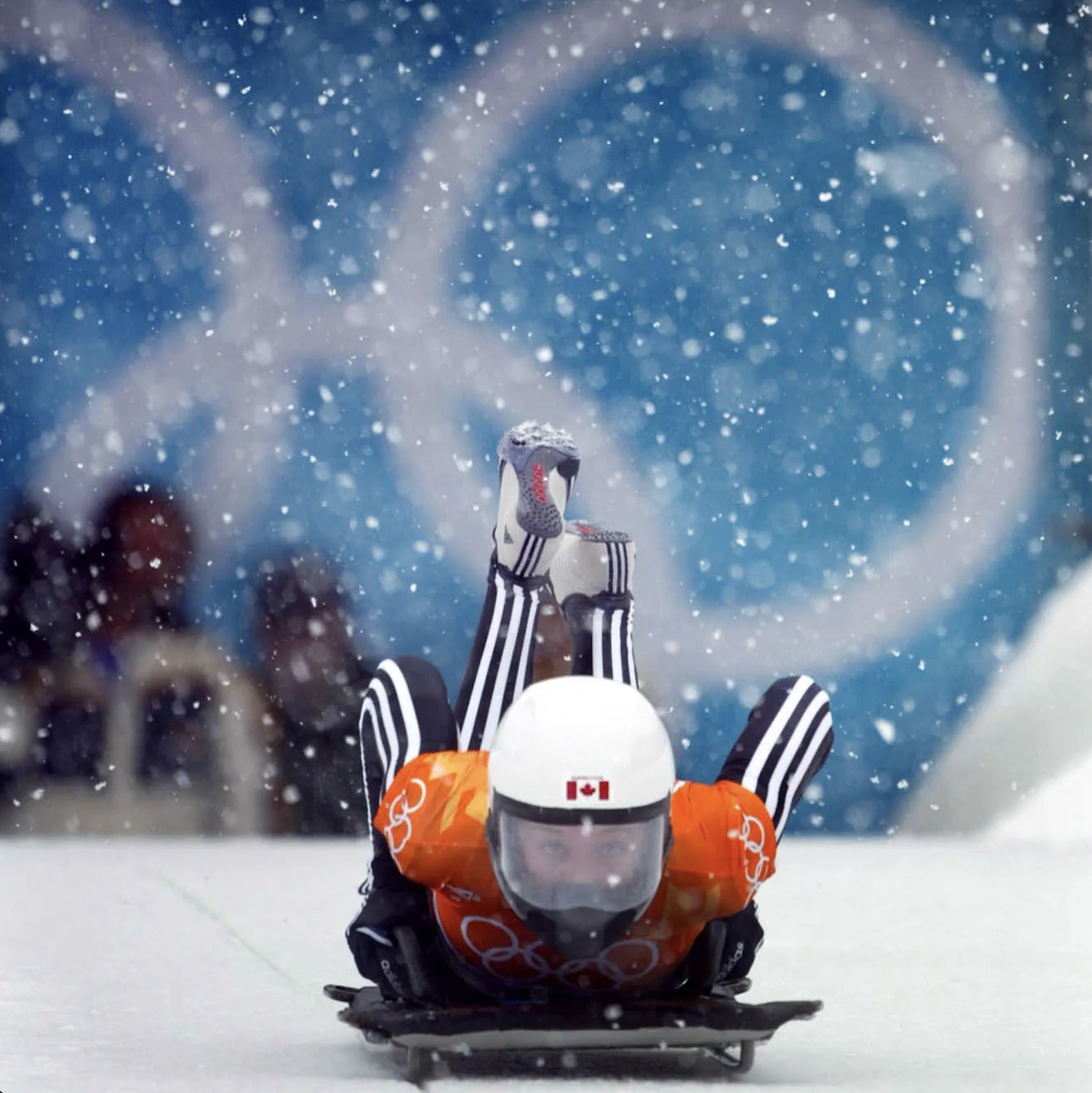
Alcock competing at the 2006 Olympic Winter Games. Photo retrieved from the Canadian Olympic Committee website.

Rising through the Canadian skeleton ranks quickly, within two years of that intro-to-skeleton experience, Alcock qualified to represent Canada on the America’s Cup and then the World Cup teams. While competing internationally, Alcock secured enough top six placements in 2001-2002 that she qualified for her first of two Olympic Winter Games, just four years after being introduced to the sport! At the 2002 Games in Salt Lake City, she finished in sixth place. In the 2003-2004 season, Alcock won the overall Women’s Skeleton World Cup title. She continued to train, with eyes set on the 2006 Olympics, which were being held in Italy.

In the late 1990s, Alcock began coming out to family and friends, and in the early 2000s to teammates and others within the sport, and later more publicly. This made her one of only a few queer Canadian athletes actively competing in elite sport while open about their sexuality; Nancy Drolet, a national team ice hockey standout, and wheelchair basketball star Danielle Peers were others.[1] Alcock describes the support she received from the vast majority of teammates in a positive way. For example, she noted that she would bring the boxset of The L Word on tour, and some of her teammates would sit down and watch episodes with her. They’d also take her, when feasible, to queer villages in various cities on the tour. Alcock also began training and racing with a Pride sticker on her sled, visible to teammates, competitors, spectators, and television cameras. At the same time, she did experience indirect and direct homophobia while on the circuit, and so was grateful for the solidarity experienced with the majority. This allowed her to remain steadfast in being her authentic self after she had come out.

There were still challenges, however. Alcock shared one story about attaining a sponsorship deal—a rarity for skeleton and for women athletes at the time—with a local company:

“I remember signing the contract for this sponsorship, which was a really big deal. It was quite a bit of money. And it was meaningful for my everyday life. I literally had the pen in hand and then I finally just…I put it down and I said, ‘you just need to know, I’m not gonna hide this. I’m a lesbian. I’m in a relationship with a woman. Is that gonna be a problem?’ And he said, ‘No. Are you gonna sign or what?’”

While it was a positive experience of allyship in that moment, not long after signing on, Alcock, as one of their sponsored athletes, had to participate in an event organized by the company.

“I had to sit beside Bishop Frederick Henry. It was a golf tournament, and they put me in the same golf cart with him. For 18 holes, I had to sit beside him! And I was like, ‘how did they not know that?’ That’s not okay.”

{For context, Bishop Henry had a long and public history of opposing 2SLGBTQIA+ rights, including same-sex marriage in the early 2000s and, more recently, gay-straight alliances in schools and, more generally, the provincial NDP’s gender and sexual diversity inclusion guidelines implemented when they were in power.}

Alcock qualified for the 2006 Olympic Winter Games. Based on her performances in the years leading to those Games, including a silver medal at the 2004 World Championships, Alcock was considered a medal favourite but, in her own words, the Olympics didn’t go nearly as well as she hoped. She finished 10th. The disappointment of the finish wasn’t the only thing Alcock was dealing with; the following scenario reflects the still-pervasive heteronormativity in high-performance sport:

“One story I tell quite often is about what happened at the finish line in Torino [2006 Olympic Winter Games]. When I finished the race, I didn’t perform the way I had expected of myself. My wife was at the finish line, and I remember at that moment thinking, ‘So do I kiss her? Do I hug her? Do I… The camera’s on. I can feel it. I can feel it.’ It was burning into me. ‘What do I do?’ And I’m dealing with being really upset with how I did at this event. But I don’t wanna show shame. Like, I’m proud of who I am, and of this marriage, you know? And, so, the fact that I was thinking about that at the Olympic finish line was ridiculous. And I honestly don’t know what I did. I couldn’t tell you now how that went. It’s a total blur.”

Alcock would continue to compete in skeleton for two more years, ultimately retiring in 2008 to pursue a chiropractic degree in California. She once again resides in Calgary with her wife, Heather. Reflecting on her incredible athletic career, Alcock had this to say:

I’m most proud of how I was able to continue competing and to be who I was. It was quite a journey to get there.

Dr. Lindsay Alcock. Olympian. World Champion. Trailblazer. Calgarian.

{WB}


[1] This statement reflects what I’ve been able to uncover in my research to date, based on media stories and personal communications. I’m happy to be corrected if others know differently!

From the Calgary Winter Club to Olympic Ice

{This is part one in our Winter Olympic Series, written by William Bridel. Enjoy!}

Brian James Pockar was born in Calgary on October 27, 1959. He began skating as a young boy at the Calgary Winter Club. According to Skate Guard, a figure skating history blog, in his early days on Winter Club ice, a coach, Winnie Silverthorne, approached Pockar’s parents after noticing his “daredevil-ness” and natural athleticism. While initially interested in ice hockey, Pockar chose to focus on figure skating and quickly rose through the competitive ranks within Canada.

At the age of 12, Pockar competed at his first national championships. Four years later, he won bronze at the 1976 World Junior Figure Skating Championships, and two years after that, became the national men’s champion of Canada for the first time. At the completion of his amateur competitive career, Pockar was a three-time national champion. He had also won several international medals, most notably the bronze at the 1982 World Figure Skating Championships. Pockar’s third-place finish in 1982 launched a 14-year medal-winning streak by Canadians in the men’s event at the global competition.

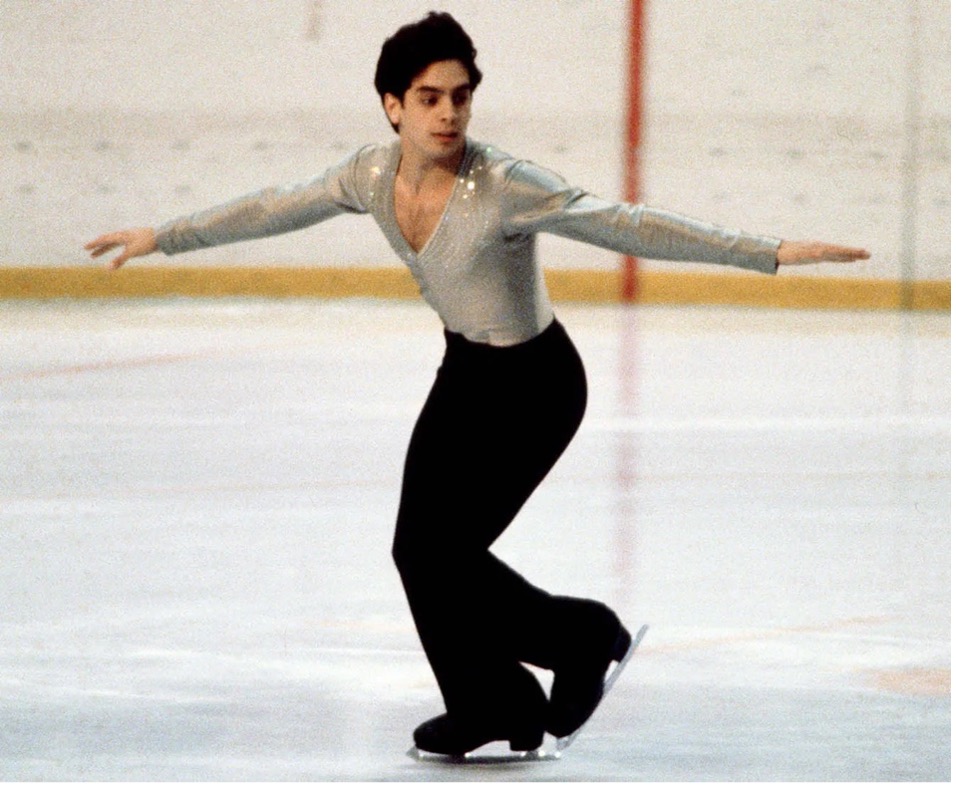
Pockar competing at the 1980 Olympic Winter Games. Photo retrieved from the Canadian Olympic Committee’s website.

Pockar was the lone Canadian entry in the men’s event at the 1980 Olympic Winter Games in Lake Placid, New York, a place he earned having won his third national title earlier that year. He finished 12th in all portions of the Olympic competition, an event won by the incomparable Robin Cousins of Great Britain. Pockar remains the last male from Calgary to compete in the Olympic Winter Games in figure skating. Pockar was also involved in the 1988 Calgary Olympics, credited as the artistic director of figure skating performances in the Closing Ceremonies.

As a young boy in the sport at the time of Pockar’s greatest successes, Brian was my idol. I marvelled at his technical abilities, but even more so, I loved his musicality, his style, his flair. I was nine when he finished third at the 1982 World Championships. I could execute his entire medal-winning performance in the basement of my family home in my sock-feet. The many triples he completed in his program? Well, those were only imagined in my rendition…but I knew the order of elements by memory and believed I “was” Brian Pockar in those moments. I also most certainly had a crush on him. He was a beautiful man. As Ryan Stevens of Skate Guard described him, he was “like the romantic lead in a silent movie.”

Frequently described as a private person, Pockar never declared his sexuality publicly, which was not unusual in the 1970s and ‘80s in sport generally, and in figure skating specifically. Only Great Britain’s John Curry, the 1976 Olympic champion in the men’s event, had discussed his sexuality in mainstream media at the time. According to sociologist and historian Dr. Mary Louise Adams, the first time Pockar’s sexuality was likely specifically mentioned publicly was in a media story published in 1998 about Brian Orser, another great Canadian figure skater. Orser was quoted as saying he was concerned about his own sexuality impacting professional opportunities in and outside of skating and used Pockar as an example. According to Orser, Pockar was fired from his broadcasting position with CTV—a role he held for several years after he retired from amateur competition—when network executives learned he was gay.

Pockar died of AIDS-related illness in Calgary on April 28, 1992. He was 32 years old. According to a statement issued by a family friend at the time of his passing, “Brian wanted to be remembered for his accomplishments in life and not for the cause of his death” (Maki & Toneguzzi, 1992, p. D1). Honouring that statement here, in addition to his many achievements in the sport noted above, Pockar is also credited with landing the first-ever one-foot triple Salchow/double flip combination in international competition—which is wildly difficult! He was inducted into the Alberta Sport Hall of Fame in 1989 and posthumously into the Skate Canada Hall of Fame in 2012. Per one of Pockar’s final wishes, a bursary was established in his name to help support young male figure skaters in the province—a bursary still given out annually.

Brian Pockar: Olympian. World medalist. Choreographer. Broadcaster. Calgarian.

{WB}

Sources

Adams, M. L. (2011). Artistic impressions: Figure skating, masculinity, and the limits of sport. University of Toronto Press.

Skate Alberta/Northwest Territories/Nunavut. (n.d.). About: Athlete Awards. https://skateabnwtnun.ca/about/awards-2/athlete-awards-athlete-funding/

Maki, A., & Toneguzzi, M. (1992, April 30). Friends mourn death of Pockar. Calgary Herald, D1.

Stevens, R. (n.d.) Brian Pockar. Skate Guard: Figure Skating History Blog. https://www.skateguardblog.com/p/brian-pockar.html?m=0