Tag Archives: AIDS

Full Court Press decades on in YYC

{Our sympathies go out to the friends and family of David Crosson, a lovely, witty man who passed away this week. A successful interior designer, he was also pivotal in the city’s gay media history through his work as editor of Outlooks Magazine from 1997 – 2005. He will be missed. – Kevin}

No other gay organization in Calgary has the long and storied history of the Imperial Sovereign Court of the Chinook Arch (ISCCA). A chapter in the International Court System, the ISCCA hosts many drag events throughout the year as well as their signature coronation ball which elects a new Empress and Emperor annually. ISCCA events are dependably fabulous and fun. They often are also fundraisers for important community causes.

The Court System started in 1965 in San Francisco, and the first Canadian chapter began in Vancouver in 1971.  In the early 70s, a handful of gay friends from Calgary who were active at Club Carousel escaped to Spokane, Washington for a long weekend road trip. By chance, they encountered a drag ball hosted by the Imperial Court of Spokane. Not only did they have a terrific time, but they met other gays from all over North America who were also in attendance. The Calgarians were hooked: in the next couple of years, they travelled to other Court events in Seattle, Portland, Vancouver, and Anchorage.
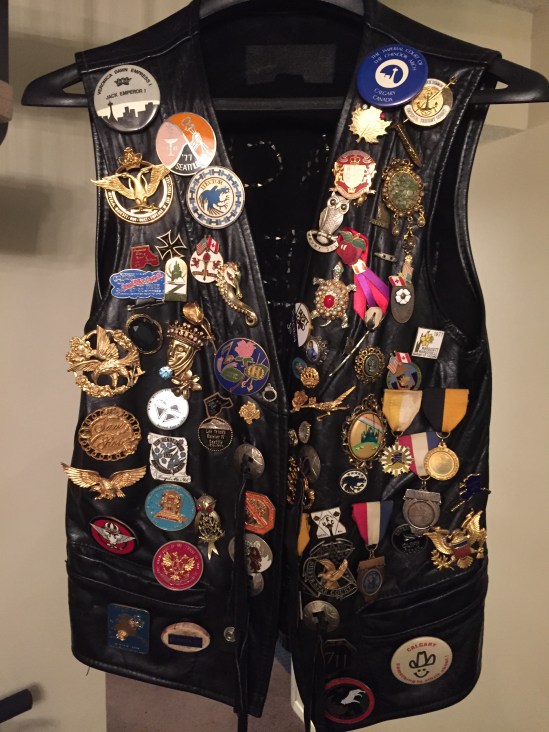
Jack's vest for ISCCA post

Court organizer and First Emperor, Jack Loenen, owned a leather vest with souvenir pins from Court events he travelled to.

Organization of the Calgary court began in April 1976. An application was made to the Mother Court of Canada in Vancouver, and by June of that year, Calgary’s charter was granted. The organizers looked for local inspiration in naming their court, settling on “Chinook Arch” as an iconic Calgary phenomenon. Legally they registered themselves as a daughter group of the Scarth Street Society which also operated Club Carousel. Their first major function was the coronation ball held in January 1977 at the Holiday Inn. With a small loan of $500 from the Club, they hosted an event that made history. It was one of the most elaborate balls the Court system had seen to date, featuring a sit-down dinner and the crowning of Calgary’s first Empress Veronica Dawn and first Emperor Jack. Representatives from Courts in San Francisco, Seattle, and Alaska were in attendance.

In the first year of operations, the Calgary Court had paid back their loan and ended the year $1700 in the black. Generally speaking, any profits the Court makes from their activities are donated to worthy causes. However, in the 70s it was sometimes difficult to find charities who would accept support from the gay community. Emperor Jack, in an Outlooks interview, remembered that the children’s hospital rejected their potential donation then because it came from a gay group. In contrast, the Children’s Wish Foundation was a group who early on did accept gay monies and consequently has been a recipient of ISCCA’s philanthropy ever since.
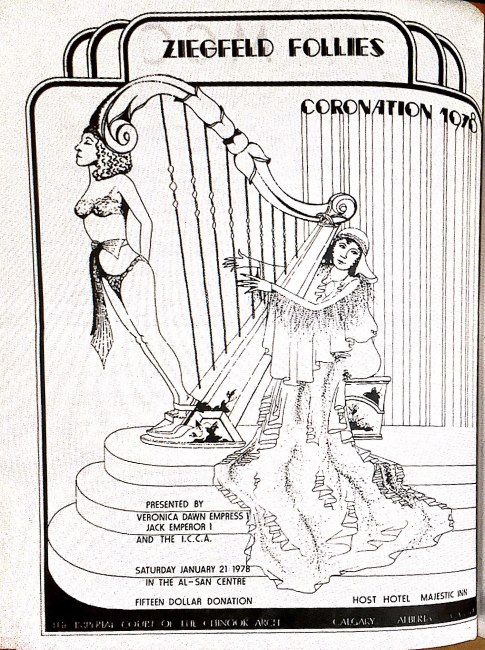
Ziegfield

Coronation ’78 Advertisement in Gay Moods Magazine (GIRC)

In the Court’s fourth year of operations, it decided to become independent of the Scarth Street Society and go its own way. There were some communication issues between the two groups, and Club Carousel itself had come to a natural end as members migrated to the more popular commercial gay bars which had emerged in Calgary.

Like the police/pride debate of this summer, Calgary’s LGBTQ2 community has been polarized before. In 1980, the community was extremely divided on the idea of having a gay rights march as part of the national conference of the Canadian Lesbian and Gay Rights Coalition which the city was hosting. A representative from the Court said to the Calgary Herald: “the minute you start flaunting yourself, you’ve got a problem [The march] is an embarrassment to the entire community.”

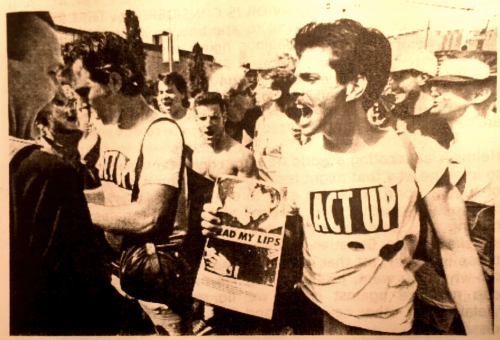
However, feelings changed. 11 years later at Calgary’s first Pride Parade, Calgary’s 15th Empress, Tiffany (Lawrence Steedman), led the parade in a purple beaded gown and confidently faced down protesters who spat and cursed. Tiffany said: “I’m proud to represent my community. Every drag queen wants to be empress, it’s an honour.” Member of Parliament Svend Robinson, who spoke at that event gave the nod to the Court explaining that it had been drag queens who bravely were the vanguard of the gay rights movement in North America.
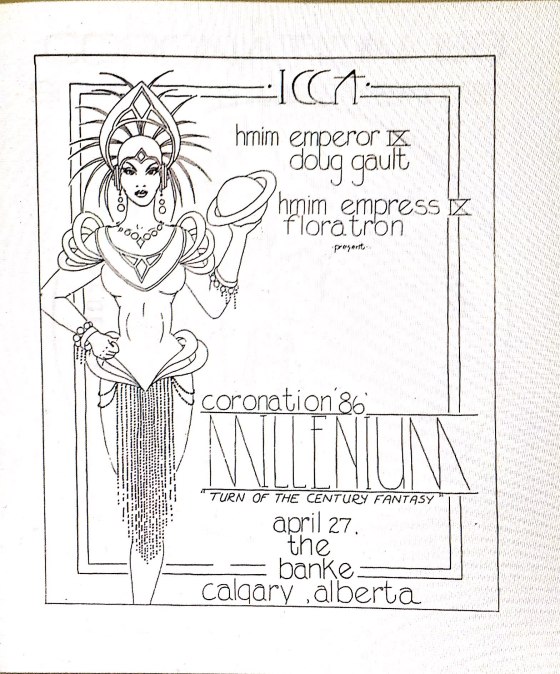
Coronation 86

Coronation ’86 Poster from the Broach Magazine

Toronto writers from The Body Politic were bemused by the Court when they wrote an in-depth feature about Calgary’s gay community published in September 1980:

“The court system seems to be a purely western phenomenon, and rather bizarre to most easterners. Most gay activists, even western ones, seem slightly embarrassed by the whole thing and tend to react as if they’re being forced to talk about a tribal custom they really wish the anthropologists hadn’t discovered. [The Court] simply throws the biggest gay parties Calgary gets to see, and the intrigue behind who gets elected Emperor and Empress probably makes a run at the Calgary mayoralty seems rather tame.”

Ironically, a Toronto Court would form later in that decade holding its first coronation ball in November 1987.

Other notable Calgary Court events include Mayor Ralph Klein’s famous impromptu speech at the 5th annual coronation ball in 1981. The speech, in support of the gay community, proved ground-breaking and those in attendance gave him a three-minute standing ovation. Sadly, he recanted his sentiments in the controversy that quickly followed.

In 1989, Court members ended up in a court of the legal kind, over a tiara snatching incident. The crown was stolen as a ransom for an outstanding debt on ball gowns which allegedly was owed by the queen who had won it.  The judge eventually acquitted the five accused of stealing the headpiece “due to an honest misunderstanding.”

Empresses

Empress XIII Justine Tyme and Empress XIV Ty Morgan on the cover of AGLP.

The ISCCA also has sponsored daughter Courts into existence.  In September 1990 they were instrumental in granting a charter to Regina’s Court: the Imperial Sovereign Court of the Governing Body, Golden Wheat Sheaf Empire.

However in Calgary, perhaps the ISCCA’s biggest impact has been philanthropy. The Court took a leadership role during the AIDS crisis in Calgary, advocating for HIV prevention and conducting pivotal fundraising for AIDS research and housing of people with AIDS. Since its inception more than 40 years ago, the Court has raised and donated hundreds of thousands of dollars for causes close to their heart. Good work we can all celebrate.

{KA}

Angels in America in Calgary

On September 19, 1996, Alberta Theatre Projects (ATP) premiered Tony Kushner’s Pulitzer Prize-winning play, Angels in America. Before even opening, the play attracted a wagon load of controversy. “Why are taxpayers still having to hand over hundreds of thousands of dollars to a company that stages a self-indulgent production many feel is abhorrent? It is simply not right,” expressed the Calgary Sun.

Screen Shot 2017-06-21 at 3.03.33 PM

Image from ATP Theatre Program: Photographer Jason Stang

A number of Alberta MLAs were also on the record questioning provincial funding of ATP, which was $550,000 that year, about 1/6th of its operating budget. Calgary-Shaw Tory MLA Jon Havelock suggested that plays offending community standards should not receive public funding. He added, “It seems to me that in some instances people confuse sexual expression with artistic expression.”

Calgary-Fish Creek Tory MLA Heather Forsyth called Angels obscene and about ATP said: “If they can’t come up with better shows than this, maybe they shouldn’t be getting funding.”

Screen Shot 2017-06-21 at 3.04.30 PM

Edmonton Sun Editorial Cartoon: September 15, 1996

ATP’s producing director, Michael Dobbin, rejoindered that MLAs were wrong to attack the play without seeing it first, and he criticized their community standards argument. At the theatre company’s Annual General Meeting, just days before the play opened, he expressed equal outrage: “I say, back off! I say, let the ballots be counted at the box office! That’s the only censorship that I’m prepared to accept.”

Calgary’s reactions to the controversy were polarized; there were dozens of articles and editorials in the Calgary dailies extremely for or against. A conservative radio call-in show buzzed with furor, and ATP itself fielded a number of strange or hostile phone calls, including one who pledged to “shut the show down – we are not going to stand for it in this City.”

There were heartfelt published defenses of Angels in America too. A well-known educator, Dariel Bateman, wrote a guest column in the Calgary Herald on September 13th. She described the play as: “a glorious opportunity to stare down despair, to make sense of things, as we must.”

On of the most fascinating developments was when the Calgary Herald’s Don Martin managed to get protesting MLA Havelock to actually see the play with him. He summarized the experience in an article titled: Angels in America: The sequel: It’s easy to be a critic before the house lights dim, published on September 27th. As the play progressed, surprisingly Havelock became engrossed. At one point he felt compelled to spontaneously applaud; he loved it. He wrote, “thoroughly enjoyable” on a comment card before he left.

Alberta Report Cover, October 7, 1996.

The conservative and sometimes inflammatory publication, Alberta Report, made Angels in America its cover story on October 7th. It took the ATP promotional image of an angel and altered it for its cover, making it sickly: thinning muscles and adding skin legions.* Alberta Report writer Kevin Grace opined that Angels “is an artistic failure but it bears a powerful revolutionary message. While it elevates the belief current in the ‘AIDS community’ that victims of the disease are holy martyrs, homosexuals and AIDS victims are only one division of Mr. Kushner’s vaster army: one that seeks to destroy the very concept of the law – on earth and in heaven.”

He sensationally concluded his three-page article with: “those who see Angels in America as mere entertaining, diverting theatre, should know what they are getting into. In hell, the Marquis de Sade is smiling.”

Ultimately, ATP found themselves smiling. The controversy put extra bums in seats and attracted almost $50,000 in individual “Angels Consortium” donations. The play doubled expected ticket revenues and was sold out in its final weeks – setting audience records for the company.

{KA)

* Photographer Jason Stang filed a lawsuit against Alberta Report for altering his image claiming the publication: distorted, defaced and mutilated his work.


World AIDS Day & Anger

World AIDS Day began in 1988, when an international meeting of health ministers in London, England declared December 1st a day to highlight the enormity of the AIDS pandemic. Today in Canada, men who have sex with men* still make up the majority of new HIV infections annually: 57% or about 1400 new infections/year. Men who have sex with men are 131 times more likely to get HIV than men who do not. Pause to consider that.

screen-shot-2016-12-01-at-12-44-46-pm

The world is an angry place today. Foreign national events such as Brexit and the U.S. Election were notable in their antagonistic rhetoric. But even at the most local level, Calgarians are bellicose over reasonably low stake issues such as cycle tracks, public art, and election line-ups (issues I am personally connected to, which have given me lots of practice with wrath management technique).

Recently, I came upon a manifesto in zine form called Queers Read This. It was distributed at the June 1990 Pride March in New York City, and “published anonymously by queers.” It is a concentrated distillation of rage at a time when the stakes could not have been higher. AIDS, at the time, was a growing epidemic and for most, an almost certain death sentence.

The publication has exhortations to “bash back,” meet hatred with hatred, and give no inch to straights. It very much defended the word Queer as a militant signifier of strength which galvanized and branded the generation of activists who came of age then.

Calgary was part of this movement. 1990 was the year of the first Pride Rally in the city. It was also a time of tragic AIDS deaths, frequent gay bashings and other forms of homophobic backlash. Yet it was this anger which helped us stand our ground and ultimately win our human rights battles.

So I am reframing my relationship to anger. Anger can affect social change. Anger can be something positive – like the 1400 Canadian men who have sex with men who will get infected with HIV this year.

*{Men who have sex with men is a term that refers to behaviour rather than identity; it captures not only gay and bisexual men but also those who do not identify themselves based on their sexual practices.}

ANGER (An Essay from Queers Read This)

“The strong sisters told the brothers that there were two important things to remember about the coming revolutions, the first is that we will get our asses kicked. The second, is that we will win.”

I’m angry. I’m angry for being condemned to death by strangers saying, “You deserve to die” and “AIDS is the cure.” Fury erupts when a Republican woman wearing thousands of dollars of garments and jewelry minces by the police lines shaking her head, chuckling and wagging her finger at us like we are recalcitrant children making absurd demands and throwing a temper tantrum when they aren’t met. Angry while Joseph agonizes over $8,000 for AZT which might keep him alive a little longer and which makes him sicker than the disease he is diagnosed with. Angry as I listen to a man tell me that after changing his will five times he’s running out of people to leave things to. All of his best friends are dead. Angry when I stand in a sea of quilt panels, or go to a candlelight march or attend yet another memorial service. I will not march silently with a fucking candle and I want to take that goddamned quilt and wrap myself in it and furiously rend it and my hair and curse every god religion ever created. I refuse to accept a creation that cuts people down in the third decade of their life.

It is cruel and vile and meaningless and everything I have in me rails against the absurdity and I raise my face to the clouds and a ragged laugh that sounds more demonic than joyous erupts from my throat and tears stream down my face and if this disease doesn’t kill me, I may just die of frustration. My feet pound the streets and Peter’s hands are chained to a pharmaceutical company’s reception desk while the receptionist looks on in horror and Eric’s body lies rotting in a Brooklyn cemetery and I’ll never hear his flute resounding off the walls of the meeting house again. And I see the old people in Tompkins Square Park huddled in their long wool coats in June to keep out the cold they perceive is there and to cling to whatever little life has left to offer them. I’m reminded of the people who strip and stand before a mirror each night before they go to bed and search their bodies for any mark that might not have been there yesterday. A mark that this scourge has visited them.

And I’m angry when the newspapers call us “victims” and sound alarms that “it” might soon spread to the “general population.” And I want to scream “Who the fuck am I?” And I want to scream at New York Hospital with its yellow plastic bags marked “isolation linen”, “ropa infecciosa” and its orderlies in latex gloves and surgical masks skirting the bed as if its occupant will suddenly leap out and douse them with blood and semen giving them too the plague.

And I’m angry at straight people who sit smugly wrapped in their self-protective coat of monogamy and heterosexuality confident that this disease has nothing to do with them because “it” only happens to “them.” And the teenage boys who upon spotting my Silence=Death button begin chanting “Faggot’s gonna die” and I wonder, who taught them this? Enveloped in fury and fear, I remain silent while my button mocks me every step of the way.

And the anger I feel when a television program on the quilt gives profiles of the dead and the list begins with a baby, a teenage girl who got a blood transfusion, an elderly baptist minister and his wife and when they finally show a gay man, he’s described as someone who knowingly infected teenage male prostitutes with the virus. What else can you expect from a faggot?

I’m angry.

screen-shot-2016-12-01-at-12-38-50-pm

Photo: Queers Read This published anonymously by queers.

{KA}