Borderland: Gay Iranian Fringe Show comes to Calgary

Izad Etemadi, a 23-year old Iranian-Canadian, will be featured at this year’s Calgary Fringe Festival with his one-man play, Borderland, August 3 – 10th.

Borderland Image

Contemporary Iran is a dangerous place for queer people.  It is one of a handful of countries currently with the death penalty for being a convicted homosexual, and has conducted widely condemned public executions in recent history.  Not surprisingly, homosexuality is driven deeply underground in Iran, and many flee the country to seek refugee status in the West.

Although Izad grew up in Canada, he grew curious about how his life might have been in Iran.  “My parents often remind me how lucky I am to live in Canada, not only being gay but even working as an artist would not have been possible,” he explains.

Borderland tells the story of Navid, a gay Iranian man running from himself and his home. He arrives at Borderland – a secret hiding place – in search of acceptance. There he meets Leila and Zia (also played by Izad) and the drama unfolds.  Borderland has received critical acclaim, described as a Tour De Force in its current run at the Hamilton Fringe Festival.

“Many audience members have been quite moved by the play, at least the ones I have talked to.  When I started researching the play online, I found people living like me in Iran had really horrifying lives.  Yet many people do not realize how scary and dangerous it is over there,” Izad remarks.

Although Canadian audiences might feel relief that they do not suffer these indignities, similar threats, incarceration and legalized discrimination of homosexuals is part of our collective past as late as the 1960s.  Similarly there were executions of gay men in the British common law system, which included the Dominion of Canada until the death penalty was removed in 1861.

Izad remains hopeful that progressive social change can spread, noting the changes that are occurring in the United States.  He also wants to sensitize his audiences to the fact that Canada is playing an important role in the resettling of those who are fleeing Iran.

A Toronto-based charity, the Iranian Railroad for Queer Refugees (IRQR), exists to support Iranian queers around the world.   The organization supports Iranian queer refugees from when they decide to leave Iran until they resettle in a safe country, and have affected the outcomes of hundreds of lives.  IRQR’s name is inspired by the underground railroad: an informal network of secret routes and safe houses used by 19th century black slaves in the United States to escape to Canada with the aid of abolitionists who were sympathetic to their cause.

Izad says, “One of my biggest fears was the response to my play from the Iranian-Canadian community, but I have been overwhelmed by their support and their pride in my work.  One day, I would love to go to Iran myself, but currently it is not possible: I would have to do three years military service and if [the government] Googled me they probably would not like what they’d see.”

He concludes, “This has been my first time writing anything, and I have produced and put together the whole play myself.  It has been the biggest growing experience for me as a person – and one of the coolest summers I have had.”

[KA]
Canada’s Shameful Harvest of Queers in the 60s

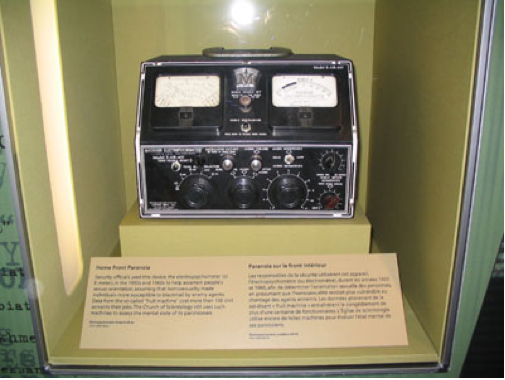
Fruit Machine 2

The Fruit Machine at the War Museum in Ottawa (Picture – Fran Rilley)

In the 1950s and 1960s, gay men and lesbians were seen as more than just a social problem, they were also viewed by the Royal Canadian Mounted Police (RCMP) as a national security threat. Cold War paranoia was high in Canada, and anything that resembled ‘otherness’ was deemed a threat to security. Homosexuals were labeled as such because of their ‘character weakness’. This weakness, according to the RCMP, was that they were unstable, self-deceiving, defiant towards society, and should not be entrusted with any government work which required secrecy. Therefore, homosexuals working with the federal government were easy targets to blackmail by Soviet agents, and could potentially reveal state secrets to the enemy.

This translated into reporting on men and women in the civil service, the majority being in Ottawa. The RCMP were looking for a more thorough way to detect homosexuals, or in the old slang ‘fruits’. In 1962, Professor F. Robert Wake, of Carleton University, created a report on a “fruit machine” said to be an efficient and scientific way of detecting homosexuals. The machine would detect the pupil response, breath and heart rates of a subject viewing naked or semi-naked images of women or men. Based on arousal levels, the participant was determined to be either gay or straight.

It was hoped that this would become part of a myriad of homosexual detecting tests for those applying to the government. Starting in 1963, it was used on unsuspecting volunteers who were told it was part of a research study. It was a failure: there were few volunteer test subjects, and the machine was hard to use as it has to be adapted for people with different heights, as well as differently sized pupils and eyeballs. Information about what the test was actually for was leaked and volunteering stopped all together. The “fruit machine” project was ultimately abandoned in 1967.

However, the anti-homosexuality campaign continued, and the negative effects on gays and lesbians cannot be overly stressed. Over 9000 People, including gays, lesbians and some straight civil servants, were harassed, questioned and targeted by the RCMP. Many lost their jobs in government or were demoted. Others were blackmailed into revealing others who were gay or lesbian.  They lost friends and respect from co-workers, or worse.   The Fruit Machine is a relic now of our nation’s shameful treatment towards a group of its own people.

[TM]

Further Information:

Gary Kinsman, “Character Weaknesses” and “Fruit Machines”: Towards an Analysis of the Anti-Homosexual Security Campaign in the Canadian Civil Service, Labour / Le Travail, Vol. 35, (Spring, 1995), pp. 133-161.
Article Stable URL: http://www.jstor.org/stable/25143914

CBC archives: http://www.cbc.ca/archives/categories/society/crime-justice/mounties-on-duty-a-history-of-the-rcmp/rcmps-fruit-machine-to-detect-gays.html

Gary Kinsman and Patrizia Gentile. The Canadian War on Queers: National Security as Sexual Regulation Vancouver: UBC Press, 2010

A summer of Queer Calgary History

We at Calgary Gay History took the month of June mostly off, due to both work and high waters!  Our hearts go out to our colleagues who were affected by the flooding in Southern Alberta – I lost a storage office myself, which drowned in a basement near the river.  Fortunately no archival materials were lost!

If you would specifically like to help the arts community get back on its feet – you can make a donation to the Alberta Arts Flood Rebuild fund.  The Suncor Energy Foundation is currently matching the first $50,000 of public donations.

Now it’s July, and we will have a new post coming to you every Thursday up to and including Pride Week in Calgary, August 24 – September 2, 2013!

In the mail recently, I received my own personal copy of Homosexuality: An Annotated Bibliography, published in 1972.  This is a treasure trove summarizing early research about the gay community.

Homosexuality - An Annotated Biography

Authored by the Kinsey Institute’s, Martin S. Weinberg and Alan P. Bell, this tome surveys non-fiction literature on homosexuality published in English between 1940 and 1968.  They cite 1265 different books and articles, providing brief and pertinent descriptions of them.  The content of course, is very dated, but gives one an illuminating historical context on how homosexuality was viewed and understood in the 40s, 50s and 60s.

I first came across the book at the Canadian Lesbian and Gay Archives in Toronto, but could not digest it all in one go.  This book will be part of my (not-so-light) summer reading plan.

Thus, check back here every Thursday this summer for new content as well as Calgary Gay History project developments, and we wish you a restful season.

[KA]