
On March 31st 2026, I attended the annual flag raising for Transgender Day of Visibility (TDoV) at Calgary City Hall. I attend this flag raising almost every year, and while listening to this year’s speakers, I felt compelled to write about this event’s local history.
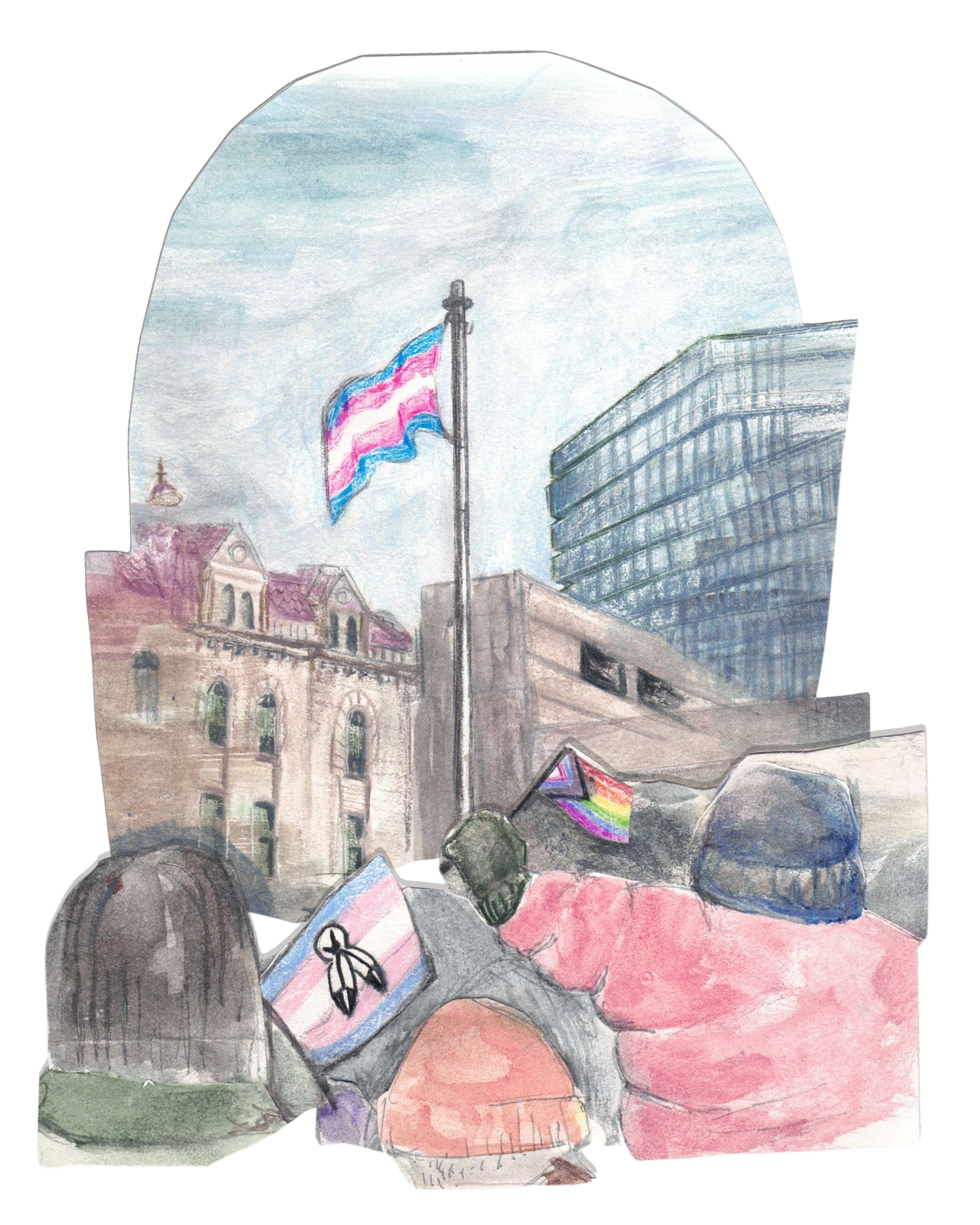
Trans Day of Visibility was first conceptualized in 2009 by Michigan trans activist Rachel Crandall Crocker as a way to acknowledge and celebrate trans people. The creation of TDoV came about, in part, as a reaction to transgender people’s lack of recognition in LGBTQ+ culture and spaces. At the time, the only widely recognized day that centred trans people was Trans Day of Remembrance (TDoR), a day of mourning the loss of trans people due to violence. Deeming it necessary to have an occasion to celebrate, a handful of cities in the USA marked the first ever TDoV that same year, hosting community organised rallies, events, and flag raisings.
As word spread about this day, events celebrating TDoV started popping up internationally. In 2013, Naheed Nenshi, as Calgary’s then-mayor, proclaimed March 31st as Trans Day of Visibility in the city. This came at the same time in Edmonton, where the mayor had proclaimed the day and subsequent days as Trans Awareness Week. This proclamation undoubtedly reflected ongoing discussions between local trans community members, as well as the work and resource sharing that the Trans Equality Society of Alberta (TESA) was doing at the time.
One of the speakers at this year’s event was Amelia Newbert, Co-Founder and current Co-Executive Director of Skipping Stone Foundation. During this year’s event, Newbert recalled her experience being involved with the first large-scale Trans Day of Visibility event in the city, which took place “right across the street,” at the Jack Singer Concert Hall in 2016.
When the 2016 event was covered in the Calgary Herald, Newbert expressed excitement about growing public support for LGBTQ+ rights in the province, particularly the guidelines introduced by the province in Bill 7 to “ensure respect for gender diversity in Alberta schools.” Ten years later, a different story is being told in the legislature. In the past few years, TDoV has continued to be celebrated by our community alongside our growing fears that the provincial government may implement legislation targeting trans youth. This has now become a reality.
When I think of my own experience attempting to access gender-affirming care as a teenager living in Calgary in the same year as this first TDoV event, I recall just how meaningful and important it felt that these strides were being made provincially at the same time. It made the process of coming out less lonely – I talked openly to my teachers, friends, classmates, counsellors, and medical professionals about my concerns. At the time, it felt empowering and hopeful to know that there was growing support for trans people in the province at a provincial level. Now, I feel there’s a growing need to define empowerment and hope on our own terms.
Reflecting on a speech she made during the 2016 TDoV event, Amelia Newbert remarked, “ten years ago, I said that our stories as trans people are triumphant. And if you’re not feeling particularly triumphant today, it’s just because our story isn’t over.”
Just as our story isn’t over, it’s also worth noting that trans stories can not and should not be defined only by harm and suffering. In the spirit of TDoV, community organiser and director of TransAction Alberta, Dr. Victoria Bucholtz asked us to use our time and energy on March 31, 2026 to celebrate the trans people in our lives, instead of giving more attention to the provincial government’s violations of healthcare and attacks upon trans youth. (Of course, these remain issues that absolutely warrant our continued attention and action at other times.)
As of 2026, TDoV celebrations in the city seem to grow larger each year. Speakers encouraged those at the flag raising to attend a drag show with an all-trans cast later that evening. The flag raising was attended by over one hundred community members, support organisations, union reps, and more. It was also attended by almost all city councillors, including Mayor Jeromy Farkas, who decided to break from their council meeting to be present.
Speakers included trans elder and Lakota Two-Spirit knowledge keeper Karrie-Lynn, who candidly discussed stories from her childhood, and experiences which led her to coming out in 2021. She also expressed that being “comfortable, open and honest with not just the world, but ourselves” is what trans people are “truly fighting for and towards.” Other speakers included local drag artists, a parent of a trans child, Queer Momentum’s Executive Director Faye Johnstone, NDP member and local organiser Beau Shaw, alongside Mayor Farkas and MLA Court Ellington.
The final speaker of the day was James Demers, who finished his words by listing the names and contributions from trans people across history. Including Wendy Carlos, Alan Hart, Lynn Conway, and the Wichowski sisters, among many others.
I’d like to conclude this piece in the same way, by mentioning the names of people who have been pivotal to our local trans history. This includes Rupert Raj, a nationally recognized trans activist who started the Federation for the Advancement of Canadian Transsexuals (F.A.C.T.), and the publication Gender Review: A FACTual Journal, while living in Calgary in the late 1970s.
This also includes Mardi Pieronik, who was born in Calgary in the 1960s. After living “stealth” for the majority of her adult life, Pieronik started talking publicly about what it was like to be trans in her teens and early twenties in Calgary and Vancouver. Now 64 years old, she tells these stories via social media and on her podcast A Life Lived Trans (which you can listen to and support here).
As well as Anna Murphy, whose passionate political involvement and community activism I’ve looked up to since coming out in the 2010s.
Prominent figures in Calgary’s trans history also include many of the speakers at the 2026 TDoV event, representing decades and years of experiences as organisers, artists, and activists that have shaped this city’s trans history and will continue to shape its trans futures.
{LI}


 Calgary Gay History
Thanks Kevin ,
Thanks for the great article. I am sorry to be missing so many events But happy to hear what others are doing Take care, Lois
i was late b/c appmnt w/therapist but it was a good if cold day , kevin , levin , amelia i so need to talk to each of you more 🙂