Tag Archives: Windi Earthworm

Anita Bryant’s legacy—up for grabs?

Anita Bryant, a famous and outspoken anti-LGBTQ+ crusader, died last month at the age of 84.

In the 70s, Anita was a former American beauty pageant winner and minor pop star. In 1977, her campaign coined “Save Our Children,” led to the repeal of an anti-discrimination ordinance in Dade County, Florida. Galvanized by her win, she travelled across the U.S. and Canada and was able to roll back human rights gains in several other American states in addition to getting a legislated ban on gay adoption in Florida (this ban was only overturned in 2008). 

She said during the campaign, “For several years I have been praying for God to revive America. And when word came that there was an ordinance in Miami that would allow known homosexuals to teach my children—God help us as a nation to stand in these dark days. There are many evil things that would claim—under the disguise of discrimination and under civil rights—would claim the civil rights of our children.”

Anita in Miami Beach announcing her campaign. Source: Miami Herald.

Bryant’s crusade cost her dearly. By 1980, she was divorced, her sponsorship contracts dried up, and her career as an entertainer tanked. Ironically, many gay activists noted that Anita did more for their cause than anyone who had come before her. The Globe and Mail cheekily then concluded: “Closet doors open on Anita.”

A 2021 SLATE Podcast delved deeply into Anita Bryant’s war on gay rights. A new reveal was that Anita’s granddaughter Sarah is gay and had come out to her grandmother. Sarah said: “My partner and I have talked a lot about whether we want to invite her to our wedding. I think I probably will eventually just call her and ask if she even wants an invitation because I genuinely do not know how she would respond. I don’t know if she would be offended if I didn’t invite her. I really genuinely don’t know if she will come or not. I guess I’ll just say that I don’t hate my grandma. I just kind of feel bad for her. And I think as much as she hopes that I will figure things out and come back to God, I kind of hope that she’ll figure things out.”

In the same podcast, renowned lesbian historian Lillian Faderman said, “I think before Dade County, most gays and lesbians did not want to be political. Dade County woke us up. Dade County made us realize that we all had to be political. We all had to learn to fight homophobia. And I think that that really solidified the gay rights movement. Anita’s campaign galvanized the gay community….”

We noticed a wrinkle in the coverage after reading articles of her passing in several newspapers. Some modern-day culture warriors are changing the historical narrative about Anita’s crusade, declaring her a hero posthumously rather than a villain. Albert Mohler, president of Southern Baptist Theological Seminary, was quoted in Kentucky Today.

He said: “One of the techniques used to marginalize Anita Bryant was to treat her as a freak show, and that’s the threat that same movement would try to apply to every single person who would stand in its way. And if you dare to stand in opposition to that movement, guess what. You will end up on the front page of The New York Times as an obituary and the movement will claim that you deserve the ridicule. But let’s remember this …: the LBGTQ movement is not going to have the last say.”

Well, the Calgary Gay History Project intends to have the last say about Anita’s ignominious crusade stop in Alberta and the Calgary activists who challenged her. Our Past Matters!
Screen Shot 2018-06-14 at 6.34.53 PM
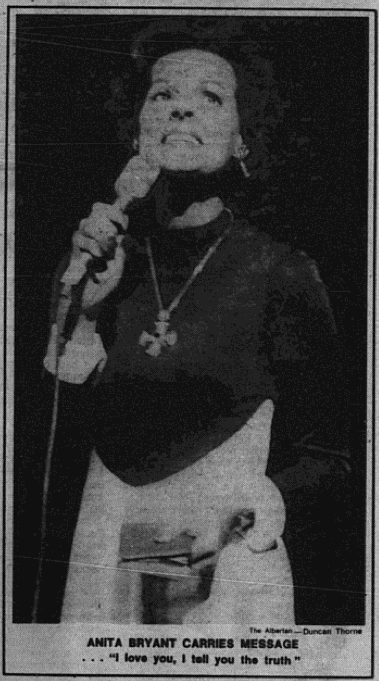
Anita Bryant in the May 1, 1978 edition of The Albertan

In 1978, Anita swung through Canada as part of Renaissance International’s Christian Liberation Crusade. She made a tour stop in Edmonton on April 29th. Forty Calgary activists hurried north, joining activists there, to protest her cross-Canada tour.

A flyer posted at the Old Y

The Coalition to Answer Anita Bryant (CAAB), which included feminist and labour groups, fired up the 300 protesters who marched to the Legislature: the most substantial pro-gay demonstration that Alberta had ever seen to that point. The Body Politic reported, “Bryant hits Canada; Canada hits back.”

Cover of GIRCs Gay Calgary Newspaper, September 1978

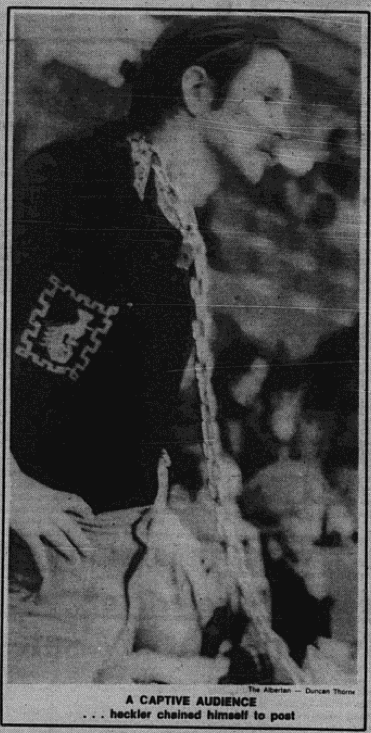
Two Calgary activists, windi earthworm {he preferred lowercase letters when spelling his name} and Myra “My” Lipton, went independently of the loosely organized “Calgarians against Anita” delegation. They decided direct action was required to disrupt Bryant’s auditorium of 6000 supporters. My remembered: “We got in under the guise that we were students doing a study about the spaces people meet in. We scoped out the stage and decided on our spot. I helped Windi chain and lock himself.”

My then went into the seats to find a spot to generate a call and response disturbance with windi, but she turned back when she noticed audience members hassling him. She asked windi if he was OK. He replied, “Yeah, except these really kind Christian folk are ready to hang me,” by the chain around his neck.
Screen Shot 2018-06-14 at 6.34.36 PM
Windi Earthworm in the May 1, 1978 edition of The Albertan

Anita eventually appeared at the Northlands Coliseum under heavy police escort. windi screamed: “You have me in shackles, Anita!” She replied, “I love you, and I know enough to tell you the truth so you will not go to eternal damnation.” windi called back, “You love me so much you want me in prison.” The heckling continued intermittently throughout the event. The courageous Calgarians were detained briefly afterwards for questioning by police and were permitted to leave.

{KA}
50 years of peer support in YYC!

2023 marks the 50th anniversary of the first queer peer support organization in Calgary: the People’s Liberation Coalition (PLC).

Started in January 1973, the People’s Liberation Coalition served the Calgary gay community by offering information and counselling using a peer support model. The PLC office was located at the Old Y (CommunityWise) in room 314, and they attempted to have office hours from 7-11 p.m., seven days a week.

The group was an evolution of the Gay Liberation Front (GLF), which had begun meeting in September 1972, spearheaded by University of Calgary grad student Rick Sullivan.

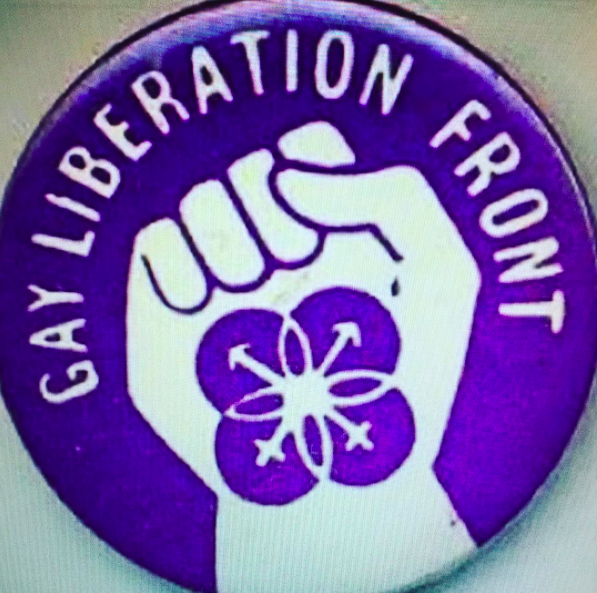
GLF Button from the early 1970s

Lesbian activist, My (Myra) Lipton attended these early GLF meetings. She and Rick would attend Human Sexuality classes at the U of C as guest speakers. According to a student journalist, My called for women’s freedom to control their bodies and “engage in whatever sexual activities they prefer.” She also stated that the “greatest threat to the male role is solidarity among women, and lesbianism epitomized that solidarity.”

Biweekly consciousness-raising meetings of the GLF were held in the Beltline. Doug Jameson, a university student then, remembered the meetings in rundown apartments. He said, “people talked about the place we were at and trying to get petitions going to give to the government. There were about a dozen of us, and we were known to the RCMP.”

In fact, the RCMP came to Rick Sullivan’s apartment one night to question him about his activities with the GLF and The Gauntlet, attempting to intimidate him. The RCMP even requisitioned his student record from the University of Calgary, but the Registrar refused to cooperate.

Meanwhile, the GLF brainstormed the idea of a peer support organization. My Lipton cheekily wanted to call it, “Does Your Mother Know?” a phrase she often asked those who were coming out. However, to the larger group, the name People’s Liberation Coalition stuck, and they found a space at the Old Y and a roster of volunteers to offer peer support. Shortly after its inception, the PLC announced their intention to sponsor “a mixed boogie” at a local community hall.

My remembered: “the PLC was breaking new ground in Calgary. The immediate need that we had to convey to people who were coming out was that they were OK—it was society that had the problem.”

Mount Royal College student Rex Leonard saw a poster for PLC at his on-campus guidance centre. He headed to the Old Y that night and surprised PLC volunteer Joanne, who was answering the phone that night—there were not many drop-in visits! Rex’s world expanded as he was introduced to more gays and lesbians. He appreciated that the organization was centred around social activism, not just a place to find a romantic partner. Rex became a dedicated PLC volunteer.

An Australian gay activist named Brian Lindberg, who travelled through Western Canada later in 1973, described the movement in Calgary as going through a difficult period. He wrote:

“The gay information centre was staffed by only a few people (one in particular) who continued to maintain the service even though little assistance could be obtained. Considering the population size of Calgary, I was surprised not to find a well-organized gay liberation movement.”

The PLC ran out of steam as key members moved away from the city, and no replacements were found. Keeping the office open seven days a week proved challenging, and after about a year of operating, the PLC faded away.

Queer peer support was resurrected in June 1975 as Gay Information and Resources Calgary (GIRC) by My Lipton and Windi Earthworm. There has been a more or less continuous peer support service at the Old Y for 50 years. This legacy is continued by the esteemed Calgary Outlink today.


Leaping Lesbians at the Old Y, 1985

{KA}

Music for a windi weekend

Gay rights activist windi earthworm died in 1993, but his music remains. A handful of recorded public performances give us access to his colourful personality and deeply-felt political convictions.

windi earthworm in 1970’s Calgary at his Thomson Brothers Block Apartment: photo Rex Leonard

On the memorial website: “There’s a Fire Truck on My Ceiling: Windi Earthworm Remembered,” one can download three albums worth of music and spoken word performances. windi whoops, trills, and yowls in his songs; his compositions are energetic and attention-grabbing.

An active participant in the politics of the day, windi’s compositions are combative, inspired, and filled with stories of repression from state actors who have targeted “the earthworm” as enemy. windi’s cross-dressing made him both a memorable and transgressive street musician—he had a following in every city he blew into, including 1970s Calgary. windi had a keen sense of injustice, which fuelled most of his lyrics.

Lover’s Laughter by windi earthworm

His friend, Rex Leonard, remembers windi as a complete extravert seeking cultural influence through his music. Rex mused as much as windi was an anti-establishment activist, he also was in awe of the rock scene and one day hoped to be a star: “I’m not Boy George,” windi quips in a performance in Montreal, “I’m Boy Worm.” windi has particular animus for the glam rocker, David Bowie, who he feels betrayed by. “Is it true you’re not gay, what’s a matter Bowie—don’t it pay?” he sings.

We’ve previously written about windi and Anita Bryant. You can listen to windi’s own recollection of meeting Anita in the preamble to his song Jumper in the Metro.

Jumper in the Metro by windi earthworm

In 2014, an episode of Montreal’s CKUT Queer Corps radio show featured interviews, news clips, and the music of windi earthworm. Now a podcast on Soundcloud, the episode illuminates windi’s impact on Montreal and his legacy there.

{KA}