Tag Archives: transgender

No Straights Allowed

Many groups struggling against bigotry clamour at some point in their history for segregated spaces. The feminist community in the 80s started experimenting with womyn-only spaces. Calgary in the 90s had the Of Colour Collective, which was constituted by queers who were not white. And in the early 70s, Club Carousel, our first community space had an explicit policy of “NO STRAIGHTS ALLOWED.”

Despite the then, recent decriminalization of homosexuality in 1969, being an out gay man or woman remained fraught with difficulties and real consequences. Club Carousel’s origin story was the foundation for this exclusionary policy. Its predecessor, the 1207, was a mixed gay and straight disco, but when the gay community found out that they were the entertaining freak show which was bringing in the straights, they boycotted the club. The 1207 was out of business in less than a month. The Club Carousel founders then convinced landlord Henry Libin to let them take over the 1207 lease.
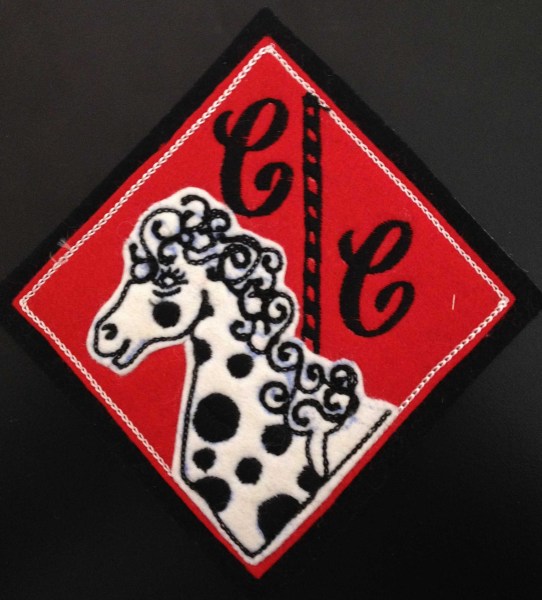
CC image2

Club Carousel Logo

They incorporated as a charitable private members club in 1970, and this is primarily how they controlled who got in the door. Club Carousel had layers of screening to ensure their space remained gay. Firstly, to join the club, one had to provide three pieces of ID, list three sponsors who were members in good standing, and pledge to adhere to Club rules. Secondly, a membership committee would vet all applications for approval (they reserved the option to interview applicants in person for those the committee was unsure of). And finally, the door person ensured that only members with membership cards could get in. Guests could be signed in, but there was also a suite of rules regulating their entrance.

Despite these barriers the Club proved popular, and membership had grown to 650 by 1972. It was a place that gay men and lesbians could let their hair down, socialize, and be surrounded by peers. Lois Szabo, one of the Club founders, remembers how much she enjoyed the Club in those early years and what fun it was.

It was a place to forget the straight world for a while with its culture of bigotry and intimidation that existed just up the stairs, and out the door of the underground club. Members of Club Carousel had significant fears of being outed; they did not want to run into anyone they might know in the straight world.

Making sure the Club remained a safe space, was a common refrain in the pages of Carousel Capers, the Club’s monthly newsletter. In April 1973, Ruth Simkin, wrote a strongly worded letter to the Club’s Executive Committee:

It is with great regret that I can no longer continue with my membership and support of Club Carousel. The reason for this is the Executive’s decision of hiring a straight band for the Anniversary Party.  I feel this is merely a first step in the total demolition of an all-gay club…..

I personally feel that a consolidated gay community is more important than a well-played guitar, at the only place in Calgary we have.  When policy changes back (if it ever does), I would be honored to once more be associated with what could be the best gay club around.

{Ruth would go on to be one of the founders of the important Calgary Lesbian and Gay Political Action Guild (CLAGPAG).}

The Executive responded in the pages of Carousel Capers that the band had been a last minute substitution when their previously booked gay talent had had to cancel, and emphatically confirmed their commitment to the no straights policy.
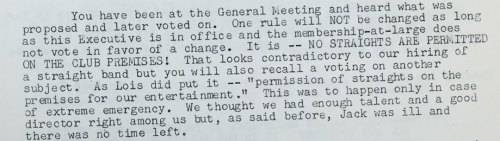
screen-shot-2016-11-17-at-10-56-09-am

April 1973 Editorial in Carousel Capers

Later that year, the Executive firmly noted that the newsletter itself should carefully be restricted from Straights.

screen-shot-2016-11-16-at-4-41-55-pm

June 1973 Notice in Carousel Capers

“Out of the closets and into the streets is a great battle cry for gays who don’t have too much to lose but then – there are the rest of us” referencing the generational divide as young gay liberationists were agitating publicly for social change (particularly at the University of Calgary).

As the 70s progressed the Club’s membership drifted to commercial gay bars which were flashier and less regulated, causing the Club’s eventual demise. Yet, it was Club Carousel which created the firmament for all sorts of gay spaces to flourish in Calgary.

{KA}


The Calgary Police Archives

The police and the gay community have had a conflicted past across North America for most of the 20th Century. We see this former reality resonating in 2016 as the LGBTQ community debated how police participated in Pride Parades across Canada.

Locally, the Calgary Police have been in the news due to a recently released, unflattering, 2013 internal audit of workplace culture. The Police are one of many state institutions that are grappling with societal change, and increasingly, with reconciliation for prior stigmatization of the LGBTQ community.

police-flag

A research trip to Police HQ, one week after the Orlando shooting. We were surprised to see the Pride Flag flying at half mast…

A positive development, amidst this troubling news, is that the Calgary Police archives staff have been assisting the Calgary Gay History Project: combing through files looking for references to their relationship with the LGBTQ community in previous decades. The material is far from flattering.

Some samples:

In May 1946, Constable F.C. Shipley was awarded an entry in the merit book and an accelerated promotion due to catching Alfred V. Andrew in an act of gross indecency with another man at the Alexandra Hotel.  Andrew subsequently pleaded guilty and was sentenced to six months hard labour.

In November 1960, the Calgary Police fired one of their own employees, Charles Pippard, because, “it would appear that Pippard suffers from homosexual tendencies, but nothing can be uncovered to confirm this.”

And in Sept 1963, an editorial in the Police’s internal magazine, Patrol, gleefully announced:

Hats off to those members of the Detective Division whose resourceful and perseverance, coupled with a new and revolutionary scientific aid to criminal investigations, closed circuit television, were successful in exposing and subsequently convicting a group of men practicing acts of gross indecency in a public washroom.

The hue and cry that heralded the use of these so called ‘Big Brother tactis’ [sic] by the force, displayed as usual a lack of awareness and understanding of this dangerous trend which prompted the use of this device.

Homosexuality and the perversion it breeds is a social problem that is always with is. When, however, such perverts meet and practice various acts of indecency in any place to which the public have access, then there is no other course open to the Police than to use every means at their disposal to safeguard innocent citizens from this type of environment and ensure that these establishments are protected from such defilement.

It is unfortunate that to gain the evidence required to subject several innocent and unsuspecting citizens using the toilets in question, to the scrutiny of television cameras while engaged in a most fundamental act of nature.  That, it has been claimed, was a gross invasion of privacy.  Surely we are not such prudes that in the interests of public decency and morality, we cannot accept a little humiliation of this kind and in doing so perhaps prevent a child or young person from becoming the victim of the insatiable lust of some of these mentally sick individuals.

It is important that society-at-large comes to terms with our LGBTQ past, and stares at it unflinchingly, to prepare a space for reconciliation.  I thank the Calgary Police for opening up its history to the Project and allowing itself to be stared at.

{KA}

Corporate Calgary & Gay Rights

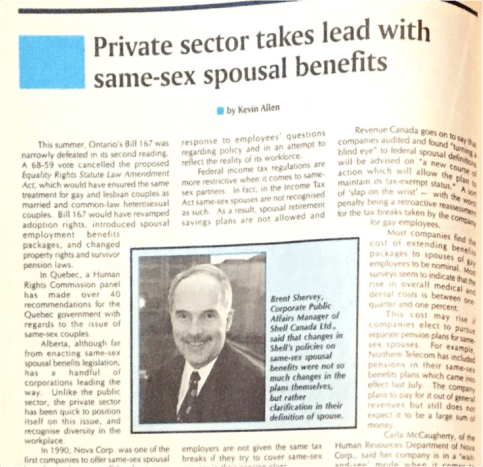
Back in the early 90s, I was a volunteer writer at CLUE! Magazine. One of the most challenging articles I wrote was: Private sector takes lead with same-sex spousal benefits (January 1995). The reason – I had to cold call more than a dozen of Calgary’s largest companies and ask them about their HR policies: were they gay friendly, and how did they accommodate their LGBTQ employees?

jan-95-clue

CLUE! Magazine January 1995

I remember that several HR managers were surprised by the question, and some companies registered no comment. It felt a little bit like journalism activism. Some companies were interested in discussing the idea, having never really considered it before, and others were proud to say they already offered same-sex benefits despite complications with the Federal Income Tax Act and Provincial employment legislation.

Nova Corporation led the way here in 1990, and a handful of other Calgary companies had followed their lead by 1995. It was interesting to note that even if same-sex benefits were offered, often very few employees would claim them.

The issue was a high-profile one due to Ontario’s Bill 167, the Equality Rights Statute Law Amendment Act, defeated narrowly in the summer of 1994.  Bill 167 promised to revamp adoption right, spousal employment benefits, property rights and survivor pensions for LGBTQ couples, and received national attention.

A June 1994 Angus Reid poll showed that 54% of Canadians opposed the bill – 64% in Ontario – although it was determined that the adoption rights portion of the bill was more frowned upon then same-sex employee benefits.

Corporate culture however was in turmoil, independent of public discourse, with activist gay employees taking their employers to task.  At Imperial Oil, a gay chemical engineer named David Mitges, who had been working for the company since 1980, started attending his company’s annual shareholders meeting in 1993.  For eight sequential years he asked Imperial to offer same-sex benefits, despite the booing and harassment from the audience present.  The national press described Mitges’ protracted tussle as “David vs. the Energy Goliath.”  In 2000, Imperial capitulated and began offering same-sex benefits, which by that time had become more normative in corporate culture.

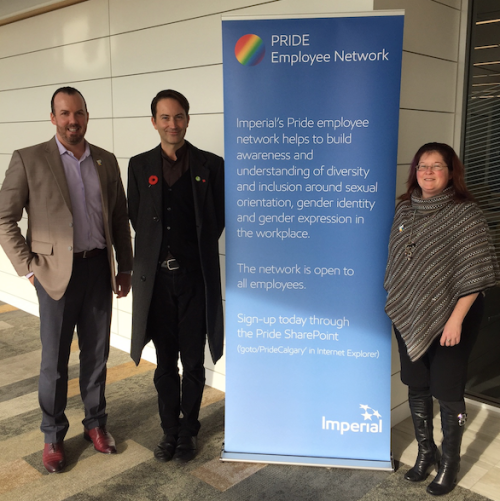
Coming full circle this week, the Pride Employee network of Imperial, invited The Calgary Gay History Project to their corporate headquarters to talk about the city’s gay history. About 40 employees came to a lunch-hour presentation at which the company’s management concluded with their expressed commitment to diversity at Imperial.

screen-shot-2016-11-03-at-11-47-11-am

Greg Cashin and Lisa Fahey of Imperial’s Pride Employee Network with Calgary Gay History Project’s Kevin Allen (centre).

{KA}