Tag Archives: queer

Treaty 7’s Nio’kskatapi

Nio’kskatapi in Siksiká (Blackfoot) means “Three-Persons” in English. It was a name of honour given to the explorer, outcast and infamously known homosexual, Jean L’Heureux. Born around 1830 near Montreal, L’Heureux had ambitions of becoming a Catholic priest but was kicked out of seminary “for serious misconduct.”

He fled west ending up in St. Albert where he affiliated himself with the Oblates’ mission there. Caught in the act of sodomy he was cast out of the precinct. He made his way to Montana where he found Jesuits engaged in the building of a mission. Successfully impersonating a priest for a time, he was eventually busted and sent away. L’Heureux found sanctuary with the Blackfoot who, unlike the settlers and missionaries, were comfortable with his sexual preferences.

He became fluent in Blackfoot and a trusted friend and advisor to the First Nations in the region. L’Heureux preferred the company of indigenous peoples to other settlers he encountered. He also had a conflicted relationship with the Catholic clergy who were proselytising in the territory. The missionaries widely condemned his homosexuality as well as his clerical appropriations. Yet, after saving the life of one stricken Father Albert Lacombe and nursing him back to health in 1865, his status improved amongst the Catholic brethren.

Living and travelling in the Siksiká camps, L’Heureux preached that the First Nations spiritual beliefs were similar to his own: the primary difference being that the Christian God was composed of three persons in one. An amusing concept for the Siksiká, L’Heureux was forever renamed “Three-Persons.”
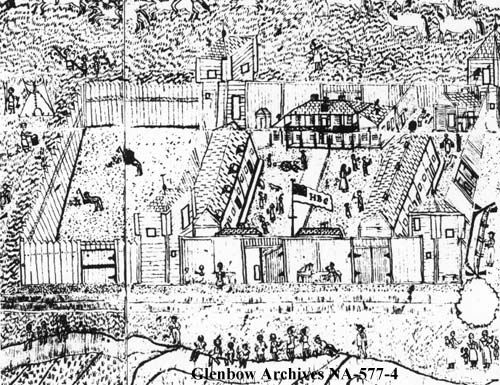
HBC

Jean L’Heureux’s hand-drawn 1873 map of the Hudson’s Bay Company Fort at Rocky Mountain House, Alberta. Source: National Archives of Canada via the Glenbow Archives.

In the 1870s, L’Heureux wrote and mapped a geography of Blackfoot lands as well as created a Blackfoot-English dictionary which was used by traders at Fort Calgary. Leading up to the Treaty 7 negotiations, the Lieutenant Governor of the North-West Territories, David Laird, wished for L’Heureux to act as interpreter for the Crown. However, L’Heureux declined as he already had committed to translate for Isapo-muxika (Crowfoot), the Siksiká head chief who was his personal friend.

The Treaty 7 negotiations took place on September 22, 1877. L’Heureux was the official spokesperson for the Siksiká leaders with the Government representatives. During the negotiations, he explained the terms of the treaty to the Blackfoot delegates and provided them with advice. One observer commented that L’Heureux “stood unswervingly with the Indians as an Indian.” When the negotiations concluded, L’Heureux inscribed the names of the Chiefs on the treaty document, validated each of their marks and signed it himself, as a witness. Through L’Heureux, the Chiefs thanked the representatives of the Government of Canada.
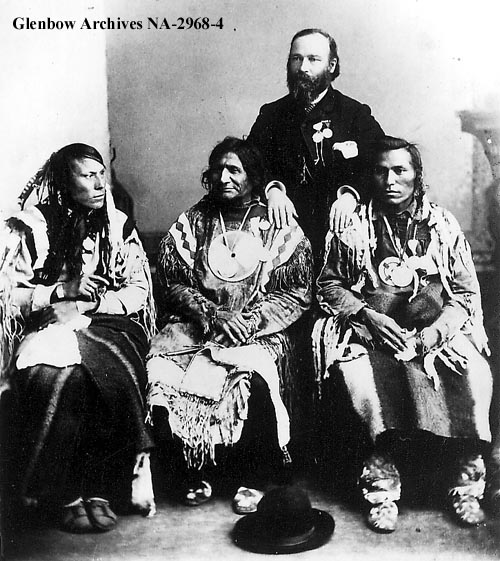
Jean L'Heureux

Jean L’Heureux with Blackfoot Confederacy Members: (L to R) One Spot, Blood; Red Crow, Blood; North Axe, Peigan; circa the 1880s. Source: Glenbow Archives.

For the remainder of his life, L’Heureux often interceded on behalf of First Nations people and their struggles with the Government. He was hired by the Department of Indian Affairs in 1881 as an interpreter, a position he held for ten years.  L’Heureux gained the enmity of an Anglican missionary, John Tims, who claimed he showed Catholic favouritism in his work for the Department. When nothing happened with that assertion, Tims accused L’Heureux of immorality on the reserve; he was quickly sacked. No investigation was ever conducted into the allegation.

Destitute and in ill health, L’Heureux lived a nomadic existence for many years. He moved to Father Lacombe’s hermitage at Pincher Creek for a time and then retreated to the foothills where he became a known recluse. Meanwhile, Father Lacombe had built a home for the poor and indigent in Midnapore. After repeated attempts, he managed to convince L’Heureux to move there in 1912. Jean L’Heureux died of old age at the Lacombe Home in 1919 and was buried in its grounds. He is listed in the church records as “a lay missionary.”

{KA}

Note: Treaty 7, the original document, is currently being displayed at Fort Calgary until October 2017: on loan from Library and Archives Canada.

YYC Gay History Input & Walking Tours

Gay History is important.  The new YYC’s LGBTQ2S+ Legacy Project is looking for community input. What do you imagine a permanent commemoration of our history could be? CALGARY NEEDS YOUR STORY × SHARE IT WITH US.

Also, Pride will be here in no time. The Calgary Gay History Project is offering two history walks again this year. The event is free and for all ages. Everyone welcome.

Thursday, August 31st, 7:00 – 8:30 pm

Downtown Gay History Walking Tour

Downtown History Walk

Join the Calgary Gay History Project’s Kevin Allen on a walk through the city centre. We will highlight significant political and social events that affected the gay community. On the way, we will pass by several former watering holes where Calgary’s LGBTQ community gathered.

Meet: Hyatt Regency Calgary (700 Centre Street SE) specifically at their 8th Avenue Entrance.

Saturday, Sept. 2nd, 2:00 – 3:30 pm

Beltline Gay History Walking Tour

Jane's Walk 1

Join the Calgary Gay History Project’s Kevin Allen on a walk through the Beltline. We will travel to significant historical gathering spots for the LGBTQ community in this inner city neighbourhood, including Calgary’s first gay bar, Club Carousel.

Meet: CommunityWise (The Former Old Y) 223 12 Avenue SW

{KA}

Our History with the Police

This week’s announcement by Calgary Pride, editing the presence of the Calgary Police in the Pride Parade, has stirred deep waters. Calgary’s LGBTQ community has a decidedly conflicted history with the city’s police: ignoring that fact or conflating the past with the present is equally unhelpful. Mayor Nenshi says: “Blaming current people for historical oppression would be like saying: ‘previous mayors of Calgary have refused to proclaim Pride Week, therefore the current mayor of Calgary isn’t invited to the parade.’ I have a challenge with that.”

Yet, as an analogy of the situation, his response is far too superficial.

Redistribution of power is the existential issue of our generation. At every level in society, we see social justice combating social conservatism. There has been a lot of fallout. Although Canada seems to be managing this redistribution slightly better than other places, dealing with atonement, integration and resistance to change has been a weary-making struggle for everyone.

One of the strategies in progressing forward is to know our history and to look at it unflinchingly.

Fact: We were surveilled and incarcerated in large numbers, particularly in the period between World War II and 1969. In 1967, Everett Klippert, a Calgary bus driver received a life sentence just for being gay which triggered a change in the laws around the criminalization of homosexuality in 1969. Calgary leaders, including our politicians, were vehemently opposed to decriminalization. Then police chief Ken McIver described homosexuality as a “horrible, vicious and terrible thing. We do not need this in our country.”

Ken McIver 1968

Police Chief Ken McIver examines police graduates in January 1968: Source Glenbow Archives.

Fact: Calgary Police tracked gay student activists in the 70s, asking the University of Calgary for their records (the University courageously refused), showing up at their apartments and purposefully intimidating them.

Fact: Calgary Police routinely harassed gay men in Central Memorial Park in the 70s and 80s and would sometimes incarcerate them overnight without cause. This was not challenged until 1981 when gay University of Calgary Law Student, Henry Berg, filed a formal complaint against Calgary Police regarding abuse of police power after he spent a night in the drunk tank when he was not inebriated.

Fact: I (Kevin), personally, was stopped by a Calgary Police Officer in the summer of 1996 walking home after work in the late afternoon.  The male officer kept me for 15 minutes, and it became evident during his interrogation that the only reason I had been targeted was for my sexual orientation which he identified by the “funny way I was walking.” Although defiant at the time, I regrettably never pursued a complaint.

Fact: Goliath’s, a gay bathhouse in Calgary was raided for being a common bawdy house in 2002 with both found-ins and operators charged. The Crown eventually stayed the charges citing changed community standards.

Notwithstanding these facts, the Calgary Police have made great strides in transforming their culture concerning sexual and gender diversity – which could not have been easy. The first gay/police liaison committee began in the early 80s and was not a sincere effort but a cynical, placating move. However, over time, the two historically opposing communities built more trust. The police were actively trying to prevent hate crimes against our community throughout the 90s. Now they have diversity officers and actively try to recruit LGBTQ individuals to their ranks. Most recently they courageously opened their archives to the Calgary Gay History Project. It was courageous because a peek in their closet wasn’t pretty.

police-flag

A visit to the Calgary Police Archives with the Pride Flag flying at half mast for the victims of the Pulse Nightclub shootings in Orlando, Florida.

We in minority communities have some unattractive things in our closets too. But I firmly believe that we need to seek and share empowerment as we are able. I am a fan of creating braver spaces, as opposed to safer spaces. The viral video of Michelle Obama’s 2016 university commencement address, “Living Without Privilege Makes You Stronger” resonated forcefully with me.

If I had to decide whether Calgary Police could march in the Pride Parade in full uniform this year, I would not know what to do.  I understand and sympathize with the arguments from both sides. I have met Calgary Police officers who are decent people and great allies.

Intellectually, I want to trust police: there are many good reasons to do so, but emotionally – because of my lived experiences – I cannot say that I do. My deepest reflex is to not trust them.

Can my feelings change?  I am not sure.  I earnestly hope so.

{KA}