Tag Archives: queer

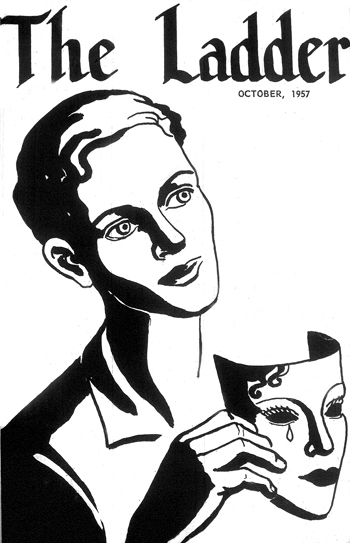
The Ladder

The Ladder was a monthly publication from 1956-1972 of the Daughters of Bilitis (DOB), the first Lesbian civil rights organization in the United States.
ladder

Calgary’s Dr. Carolyn Anderson in 2001 did her PhD social work thesis on The Voices of Older Lesbian Women: An Oral History (you can find it online at Library and Archives Canada: here).

Sue, one of the local lesbian voices featured in the thesis, recalls the publication:

“I did find out about the Ladder and subscribed to it. The Ladder was a lesbian newsletter that originated out of San Francisco and it came in a brown paper wrapper. When it came I devoured it and then hid it cause you know it was a lesbian magazine and you couldn’t just leave it lying out. I don’t know how I found about the Ladder but it became my lifeline. It meant that there were lesbians out there.”

In the 1950s and 1960s publications like The Ladder created the early foundations for gay liberation, through the development of a network of LGBTQ people who had previously been isolated.

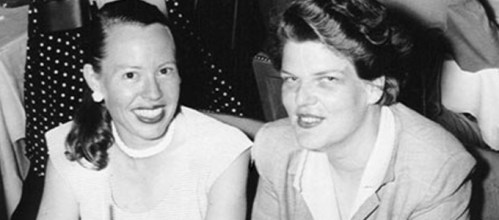
The DOB was founded in San Francisco in 1955, by lovers Phyllis Lyon and Del Martin, they initially started the organization as a social group to meet more lesbian couples.  It grew quickly, became more political over time, and developed chapters in many cities.  The Ladders’s very secret membership list had 3800 subscribers by 1970.
phyllis and del.jpg

Phyllis Lyon and Del Martin in the 1950s


Every issue of The Ladder stated the DOB Mission Statement in its inside cover:

  1. Education of the variant…to enable her to understand herself and make her adjustment to society…this to be accomplished by establishing…a library…on the sex deviant theme; by sponsoring public discussions…to be conducted by leading members of the legal psychiatric, religious and other professions; by advocating a mode of behavior and dress acceptable to society.
  2. Education of the public…leading to an eventual breakdown of erroneous taboos and prejudices…
  3. Participation in research projects by duly authorized and responsible psychologists, sociologists, and other such experts directed towards further knowledge of the homosexual.
  4. Investigation of the penal code as it pertain to the homosexual, proposal of changes,…and promotion of these changes through the due process of law in the state legislatures.

This past Sunday, The GLBT Historical Society of San Francisco marked the 60th anniversary of the DOB with a private reception.  The guest of honour was 91-year-old Phyllis Lyon, the surviving cofounder of the organization.  The Society’s Facebook page has posted some heartwarming photos of the celebration.

{KA}
 

Gay is Good

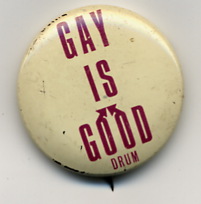
Gay_is_GoodThe rallying cry of gay liberation throughout the 1970s, was in fact coined in 1968 by pre-Stonewall American gay rights activist Frank Kameny. Frequently found on placards and buttons, the slogan also made its way into famous liberation manifestos. Lesbian activist, Martha Shelley’s 1972 booklet, “Gay is Good” was, and still is, radical and explosive:
Look out, straights. Here comes the Gay Liberation Front, springing up like warts all over the bland face of Amerika, causing shudders of indigestion in the delicately balanced bowels of the movement.”

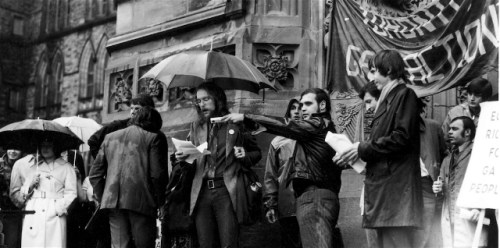
Gay is Good was heard in Canada also.  The country’s first large scale political demonstration on Parliament Hill was on August 28, 1971. Despite the rain, over 100 activists marched and picketed.  Toronto Gay Action’s Charlie Hill proclaimed Gay is Good during his historic speech in support of the “We Demand” brief submitted to the federal government a week prior.

We demand image

Charlie Hill delivering demands in 1971.  Click photo to see CBC footage of demonstration.  Photo credit: Canadian Lesbian and Gay Archives.


Gay liberation made its way to Calgary in 1972 with the short-lived formation of a local chapter of the Gay Liberation Front.  Calgary liberation activists mobilized around a more permanent organization in June 1976: the Gay Information Resource Centre (GIRC).  In 1980 GIRC organized the first gay rights political demonstration in Alberta, with our very own “placard-waving homosexuals” on the steps of Calgary City Hall.

Gay is good.

{KA}

Homos on the Range

{Calgary Gay History Project’s Tereasa Maillie is working on a memorable history event – one night only – Friday, December 4th at Loft 112 – read the press release below and we hope you can join us – Kevin}

Supposedly, lightning never strikes twice in the same spot. But after 21 years apart, Calgary actors Barry Thorson and Steve Gin are challenging that notion.

In 1994, Thorson and Gin self-produced Harry Rintoul’s searing AIDS drama Brave Hearts, set atypically in the back yard of a party in Saskatoon. Equally uncharacteristic for the time were the play’s blue collar characters: a bitter, closeted seismologist and an openly gay ranch hand.

“At the time, AIDS was still a white-collar crime,” reflects Gin, who played the wise-cracking, Glen

Campbell-loving ranch hand GW. “Most of the AIDS dramas at that time were about well-to-do White gay men who lived in New York, San Francisco or Fire Island. AIDS – let along gay men – were still an invisible presence on the prairies.”

“These (characters) are people that an Alberta or a prairie audience identify with readily and understand,” adds Thorson. “They’re so down-to-earth, which I think is very appealing.”

On the evening of December 4 as part of events honoring World AIDS Day, Brave Hearts receives a staged reading at Calgary’s Loft 112 in Calgary’s East Village, with Thorson and Gin back in the saddle as GW and Rafe. A panel discussion follows, with representatives from the Calgary Gay History Project, HIV Community Link and Chromatic Theatre participating.

Brave Hearts first opened at Toronto’s Buddies in Bad Times Theatre in 1991 at a time when a diagnosis of AIDS was still considered a death sentence for many. Three years later, the prognosis wasn’t much better when the play premiered in Calgary at The Pumphouse Theatres. The actors rehearsed at the AIDS Calgary offices, and resource personnel from the organization facilitated talkbacks after each performance. Critical response to the production was positive, with the Calgary Herald proclaiming it “an act of courage.”

teatro berdache

“AIDS claimed a lot of the people we got to know through that show,” remembers Gin. “But others we came to know, especially the ones who were just recently diagnosed, are still here. They’re fine. And that’s so encouraging.”

So why revisit the show two decades later?

First and foremost, it’s a great script, garnering a Dora Mavor Moore Award nomination in its Toronto production. And for both actors in the Calgary production, there’s a feeling that people need to be reminded of the impact of AIDS in the community, especially the younger generation of gay youth who never witnessed its devastation first-hand.

Gin went on to helm Teatro Berdache, which ran professional productions in Calgary, Vancouver, Toronto and Montreal from 2000 to 2008. This year, it re-emerged as an interdisciplinary arts facilitator, running the successful Warhol-inspired Factory 112 series at Loft 112.

“We’re definitely older and greyer than we were in 1994,” laughs Gin. “And there’s no damn way we could ever pull this off onstage, ‘cause the characters are 26 and 31. “

“But so much of this play is about loneliness, and the need to reconnect. And I think that’s gonna resonate even more now, especially when the audience has a chance to talk about it with us afterward in the intimate space of the reading.”

Factory 112: Lonesome Cowboys & Brave Hearts runs for one night only at #112, 535 – 8th Avenue SE on Friday, December 4, 2015. Doors open at 7 pm with a 7:30 pm start. Admission is by donation, with all proceeds going to support HIV Community Link. Find the Facebook Event: here.