Tag Archives: Medicine Hat

Dying Young

{This is our last post in 2025! We at the Calgary Gay History Project wish you a warm and festive holiday season – Kevin}

In the history of Calgary’s queer community, few figures loom as large—yet remain as quietly influential—as Doug Young. Born in 1950 near Taber, Alberta, and raised in both Taber and Medicine Hat, Young’s life was marked by a deep commitment to social justice and community building that helped shape the early gay rights movement in Calgary.

Young’s academic journey took him from Medicine Hat College to the University of Calgary, preparing him for a lifetime of advocacy and community service. Before his activism fully took hold, he worked with the Alberta Service Corps and Canada Customs—experiences that undoubtedly broadened his perspective on community needs.

But it was in the late 1970s and 1980s that Doug Young became one of Calgary’s most active voices for gay rights. At a time when queer communities were often hidden and marginalized, Young stepped forward into leadership roles that were both challenging and essential. He served as President of Gay Information and Resources Calgary (GIRC) from 1977 to 1979, and continued on its board through 1981. Under his stewardship, GIRC became a vital resource—offering support, outreach, peer counselling, and serving as one of the few community touchpoints for queer people in the city.
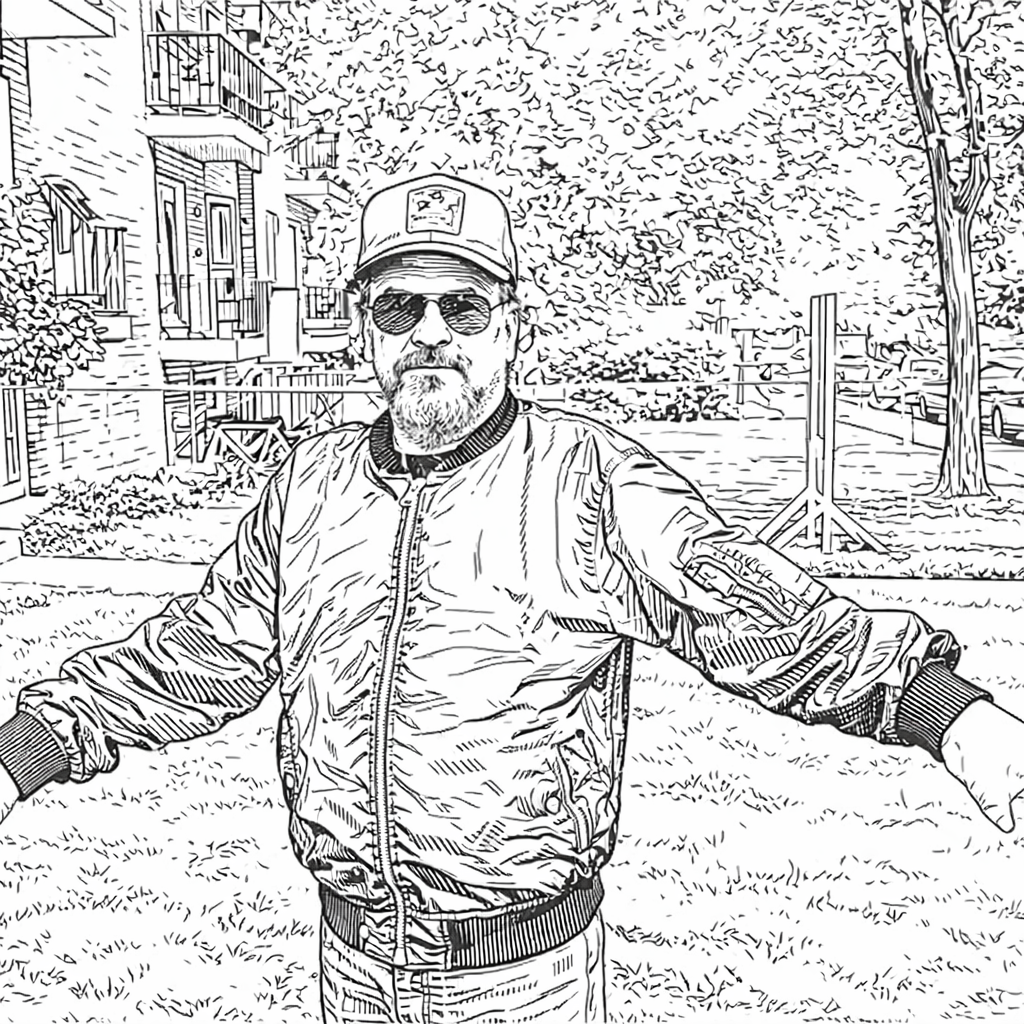
Line drawing of Doug Young derived from a photo in the Calgary Herald, June 14, 1994

Young didn’t limit his work to one organization. He was actively involved with the Alberta Lesbian and Gay Rights Association, AIDS Calgary, Gay and Lesbian Legal Advocates Calgary (GALLAC), the Right to Privacy Committee, and the Gay and Lesbian Community Police Liaison Committee—a network of groups focused on legal rights, health advocacy, safety, and community relations. This breadth of engagement speaks to both the urgency of the issues at the time and Young’s own drive to see real, sustained progress.

Young was an active spokesperson for the gay community and notably contributed to queer history through his extensive records. His personal papers were sorted and saved by Young’s friend John Cooper. They are now housed in the Glenbow Archives, which includes a remarkable hand-drawn map of gay spaces in the Beltline from the mid-1980s.
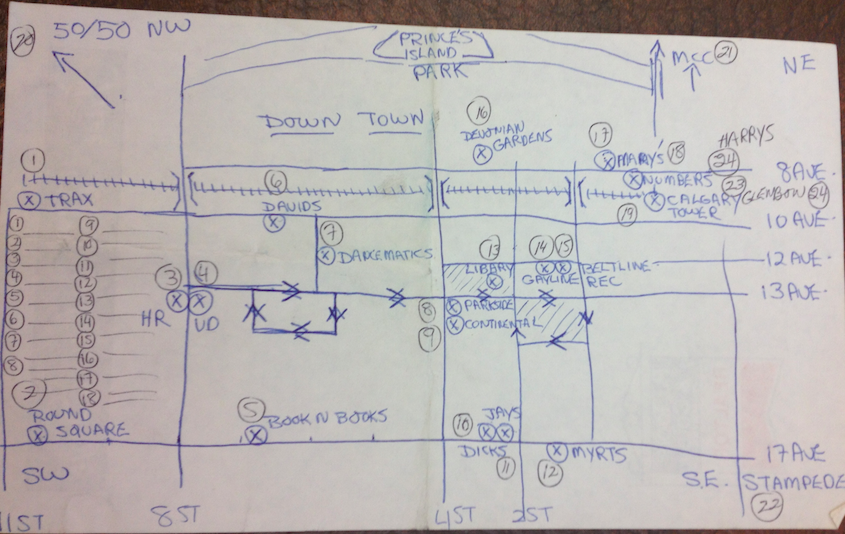
Doug Young personal papers, Glenbow Archives M-8397-1.

Perhaps most poignantly, Young’s leadership bridged the early gay rights era with the inevitable rise of the HIV/AIDS crisis. Community groups like AIDS Calgary grew out of activist networks in which Young was involved, helping mobilize volunteers, advocate, educate, and provide basic support during a time when fear and stigma often overshadowed empathy and action.

Doug Young passed away on April 15, 1994, from AIDS-related complications, a loss felt deeply across the community he helped nurture. While he did not live to see many of the legal protections and cultural shifts that came later, his efforts laid the necessary groundwork for Calgary’s queer organizations, public awareness efforts, and ongoing fights for equality.

At this dark time of year, I like to light candles to call back the light. I also light candles to remember those we’ve lost. Young would have been 75 in 2025 if he had lived, and I’m positive many other organizations would have benefited from his activism. The contributions of individuals like Doug Young are vital reminders of how far the community has come and how central grassroots leadership can make all the difference.

{KA}

Earning Toasters in “The Hat”

By the late 70s, Calgary’s gay community was fairly established and extensive. If you boldly came out of the closet as a gay activist then, you would find a network of organizations and businesses to both support you and your work. Seeking approval from the straight community was decidedly out of fashion and gay separation was a recurrent theme in GIRC’s Gay Calgary newspaper.

In April 1979, the Alberta Lesbian and Gay Rights Association (ALGRA) was founded with representation from the Province’s biggest cities: Calgary, Edmonton, and Red Deer. Rural outreach was a priority goal for ALGRA and Calgary gays found themselves on missions in Southern Alberta to connect with rural gays as well as to coax them out of the closet.

Screen Shot 2017-03-09 at 1.56.37 PM

However, “Medicine Hat had a few shocks in store for three Calgarians who are gay and accustomed to being ‘out’,” wrote Charlotte Rochon, in the December 1979 issue of Gay Horizons.

Not only did they have a hard time trying to find a distribution prospect for their newspaper – the newsstand proprietor called Gay Horizons, “that shit,” but also the purported gay meeting place in the Hat didn’t really exist.

Fortunately, the intrepid Calgarians had a local contact whom they met for tea. It turned out that there was a covert network of gays and lesbians who might be coaxed out that evening for dinner.

Rochon wrote: “Dinner turned out to be quite encouraging after an afternoon of frustrations. Two of the contacts who came turned out to be part of the elusive underground: lesbians and gay men who do indeed have a group that meets regularly in one Medicine Hat bar that does not intimidate them. Dinner was a celebration of gays coming together”

As the evening progressed, the Calgarians were less than thrilled when they were requested to play it straight: no same-sex dancing or displays of affection. As they grumblingly cooperated  – “the closet is despicable” – they acknowledged that coming out in Medicine Hat might prove to be a riskier, and less anonymous, venture than coming out in Calgary.

They also concluded that the existence of the gay underground in Medicine Hat was a great sign – the beginning of a gay liberation movement in the Southern Alberta city.

The expedition informed Rochon’s politics. In a separate editorial, she wrote:

The gay movement should divert [its] energies away from lobbying heterosexual institutions in order to concentrate on the development of its own community.

Such a move has the potential to give our gay community the strength its members need to really ‘come out’ to be neither offensive or defensive, to simply be gay, content, beautiful, as we know ourselves to be.

The implications of community building are clear: as we grow stronger, more of us will be openly gay, more people will know us, larger and larger segments of society will come to appreciate us…. Familiarity breeds consent.

*”Earning toasters” refers to the social conservative notion of gays recruiting straights into their filthy lifestyle.  The gay community turned the notion into a joke as in, “one more recruit and I will have earned a toaster”: a primordial reward points plan.

Postscript: Brooks turned out to be a more tolerant town; their newsstand accepted Gay Horizons on the Calgarians’ road trip adventure tour.

toaster

Vintage 70s Toaster, Image Source: eBay

{KA}