Tag Archives: lgbtq

Backlot Commemoration

The Backlot, a historic Calgary gay bar, will be moving (again). Founded in 1976, its current and third incarnation at 10th Avenue and 1st Street was established in 1996. However, the City has approved this site for redevelopment despite organized resistance last year called “Save Our Backlot.”

Interestingly, the developer is keen to acknowledge the history of the site—both its contemporary importance to the queer community as well as its location in Calgary’s second Chinatown from 1901-1910.

The queer history commemoration proposal (Brief) includes a commissioned mural at the site of the Backlot and an information panel and wayfinding bench.
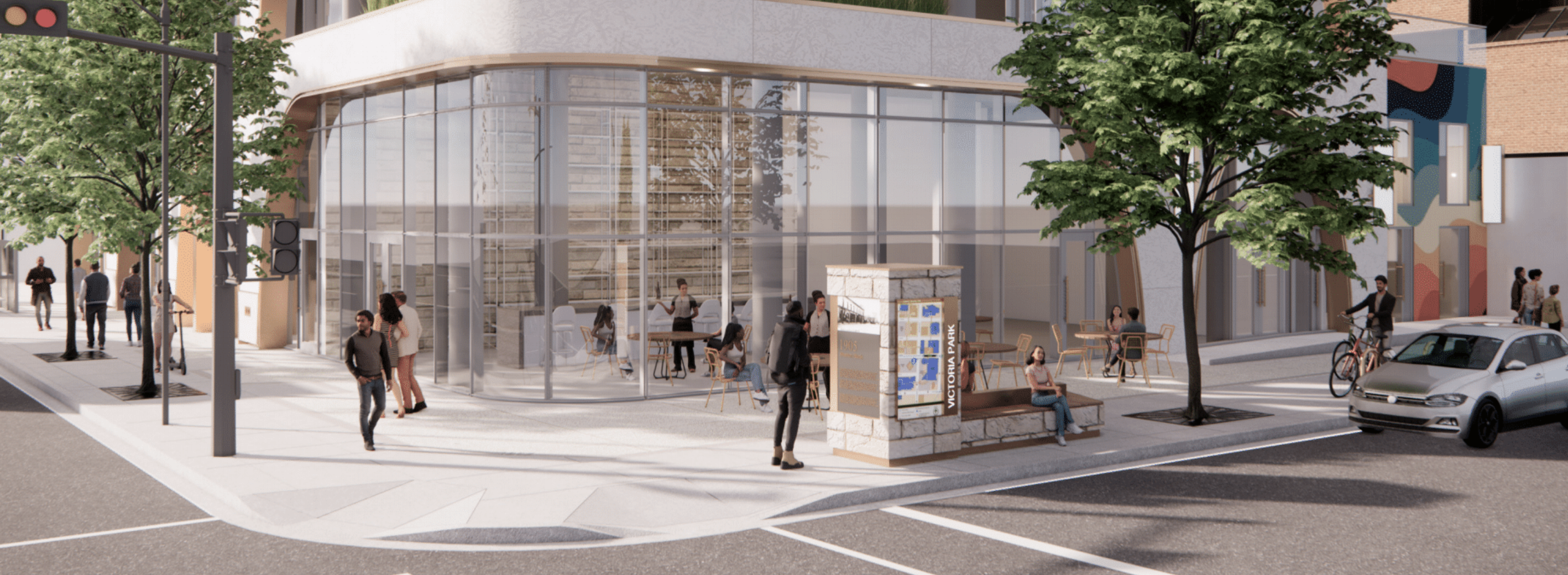
A rendering of the future intersection from the Brief.

Senior Urban Planner Zack Hoefs is looking for community feedback through a survey.

He writes:

On behalf of Truman Homes and in partnership with FAAS Architecture, I’m reaching out today to share an opportunity for discussion on a commissioned piece of art for a recently approved development called Gallery at 1001 1 ST SW and 209 10 AV SW.

The approved project involves redeveloping the Calgary Gas Co. Workshop building, which is significant to the Queer Calgarian community in its use as The Backlot and the significance of The Backlot’s name to Queer Calgarian history. There is a Brief that, on pages 16-17, outlines what our project team currently knows about the site from the perspective of Queer Calgarian History, links to documentation that we used in our research, and a description of the location of the art.

What we are missing in this work is valued feedback from the Queer Calgarian community and Backlot ownership on what they would like to see in this commissioned art. We are looking for your opinions and feedback! Our team will combine this feedback with the history we know to create a brief that future artists will interpret when bidding on the work. The main questions we will be asking are included in the Brief.

The survey will be available to complete until Friday, April 26.

The first Backlot bar at 808 9 Ave. SW circa 1980. Photo: Philip Hannan.

{KA}

With Downcast Gays Anniversary

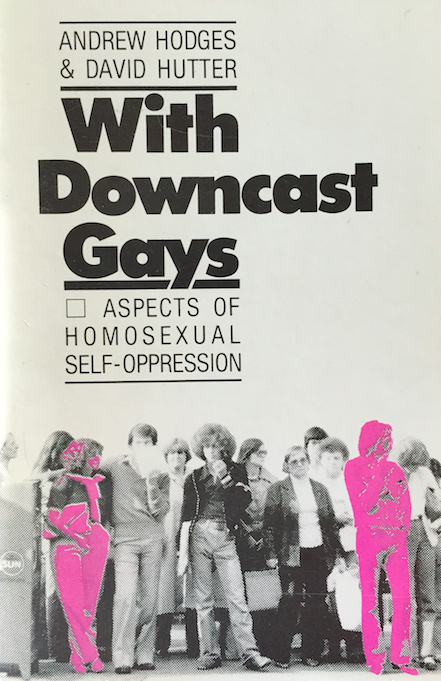
The gay liberation manifesto, With Downcast Gays: Aspects of Homosexual Self-Oppression, by Andrew Hodges and David Hutter turns 50 this month. You can read it online: here.

The slim 1974 treatise, first published in London, England, was reprinted multiple times in many countries. Pink Triangle Press, the publisher of Canada’s gay liberation newspaper, The Body Politic, produced the first North American edition in 1977, selling out its 6000 copies in less than two years. A second edition was printed in 1979.

Pink Triangle Press 2nd Edition Cover, 1979

With Downcast Gays is an articulated call to action for gays everywhere: You must fight for your pride and self-respect. The authors explain that self-disclosure (coming out) is essential in overcoming self-oppression. This message found an eager audience in its readers and paved the way for the outing movement and debate over its practice in the 1980s.

The authors make an example of the famous novelist and social commentator, E. M. Forster, whose gay novel Maurice (written in 1914) was only published posthumously in 1971. They write:

The novel which could have helped us find courage and self-esteem he only allowed to be published after his death, thereby confirming belief in the secret and disgraceful nature of homosexuality.  What other minority is so sunk in shame and self-oppression as to be proud of a traitor?

At times angry, and at times thoughtful, With Downcast Gays is still worth reading. Hodges asserts: “Gay people have no country.” Although many human rights have been gained since 1974, what spaces and places belong to us today? And which places do not?

Hodges concludes:

No homosexual is an island.  When gays say that they have to be ‘discreet’, they support the idea that homosexuality – our homosexuality – is offensive; when they describe themselves as “a typical case”, they label us as ‘cases’.  Oppression is as much the creature of self-oppression as the converse.  External oppression we can only fight against; self-oppression we can tear out and destroy.

{KA}

Postscript: In 1992, Andrew Hodges wrote a book about Alan Turing, which became the basis for the 2015 Academy Award-winning film The Imitation Game.

Club Carousel now a YYC Heritage Site!

Last week, on the City of Calgary’s social media, their Throwback Thursday post was about Club Carousel and its inclusion on its official heritage site list. We couldn’t be more thrilled! The Calgary Gay History Project has written extensively about the Club and founder Lois Szabo, who had a City Park named after her.

The inventory of heritage sites is curated and maintained by Heritage Calgary. Their CEO, Josh Traptow, told us:

“Heritage Calgary is always looking for stories that tell the history of our city. Sites of historic significance aren’t always architectural masterpieces or iconic landmarks; we’re also looking for the untold stories. Club Carousel has a history of major importance to Calgary’s 2SLGBTQ+ community, which is why we recently researched and added Club Carousel to the Inventory of Evaluated Historic Resources. Club Carousel is also symbolic of the historic streetscapes established along Calgary’s downtown Beltline streetcar system in the pre-World War One era.”

Here is what the City of Calgary shared:

“{On Throwback Thursday}, we’re looking at a building that is symbolic for commercial development and activity along 1 Street SW as well as being significant to Calgary’s folk music scene and then to the 2SLGBTQ+ community – The Club Carousel building.

Built in 1905, The Club Carousel building was one of the earliest buildings constructed on the 1200 block and established 1 ST SW as a commercial main street south of the downtown commercial core.

The Depression Coffee House was founded by John Uren from Toronto in 1963 in the basement of the Club Carousel building. At that time, Calgary had a reputation of lacking culture, which inspired Uren’s vision to establish the Depression Coffee House for chess, poetry, folk music, and other performances by local musicians. The coffee house was the first one in Calgary and established the city’s folk music scene, launching Joni Mitchell’s music career in 1963. Joni Mitchell (Joni Anderson at that time), a young Calgary art student, was the club’s opening night act and, John Uren became known as the grandfather of folk music in Calgary through the coffee house’s success.

The Depression Coffee House era

In October 1969, the building supported the city’s first chartered private gay members club which represents an important milestone in Calgary’s 2SLGBTQ+ community history. After opening, challenges getting a business licence and the club’s original owner allowing non-members to attend resulted in members boycotting the basement club. An executive committee was formed, and donations were solicited to establish a non-profit charitable society, the Scarth Street Society (the historic name of 1 St SW), to mitigate police pressure and license challenges. The Society took over the lease of the basement space and in March 1970, the club’s executive committee, with a Theatre Calgary set designer, prepared the space to reopen as Club Carousel.

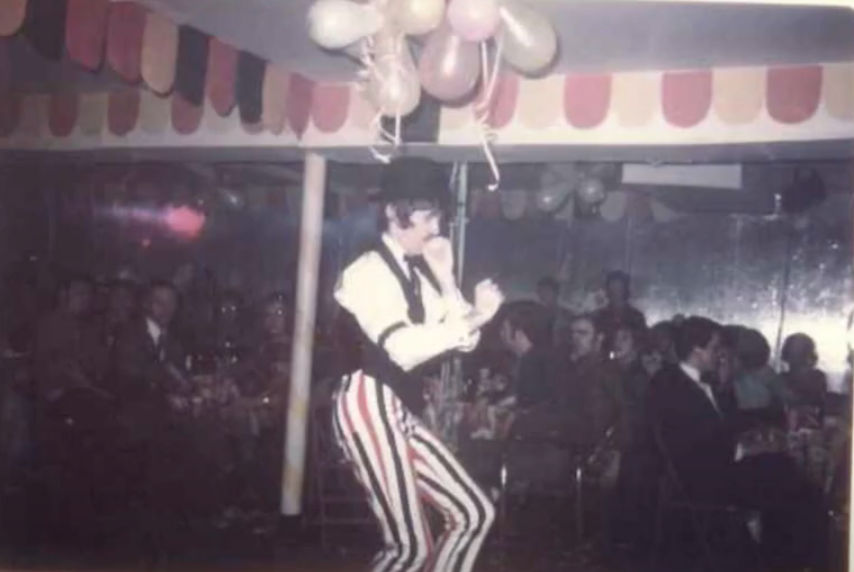
Roger Perkins performing at New Year’s Eve at the Club

The Club Carousel community donated surplus proceeds to charities and supported social activities outside the club. As an established non-profit club, the basement became too small and Club Carousel moved to the Sidorsky’s Furniture Store at 16 Avenue and Centre Street N in 1972. Due to declining membership and competition, the club closed its doors in March 1978.”

The building in the 1990s
The building in 2024: sports bar Home & Away

{KA}