Tag Archives: human-rights

The Ladder

The Ladder was a monthly publication from 1956-1972 of the Daughters of Bilitis (DOB), the first Lesbian civil rights organization in the United States.
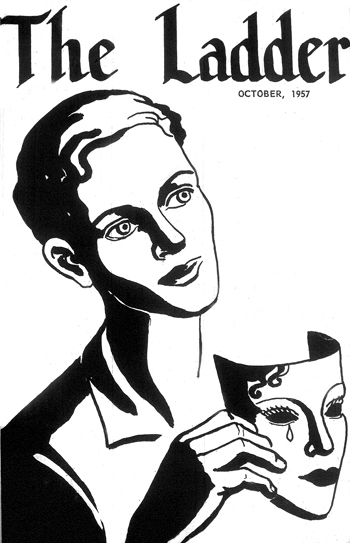
ladder

Calgary’s Dr. Carolyn Anderson in 2001 did her PhD social work thesis on The Voices of Older Lesbian Women: An Oral History (you can find it online at Library and Archives Canada: here).

Sue, one of the local lesbian voices featured in the thesis, recalls the publication:

“I did find out about the Ladder and subscribed to it. The Ladder was a lesbian newsletter that originated out of San Francisco and it came in a brown paper wrapper. When it came I devoured it and then hid it cause you know it was a lesbian magazine and you couldn’t just leave it lying out. I don’t know how I found about the Ladder but it became my lifeline. It meant that there were lesbians out there.”

In the 1950s and 1960s publications like The Ladder created the early foundations for gay liberation, through the development of a network of LGBTQ people who had previously been isolated.

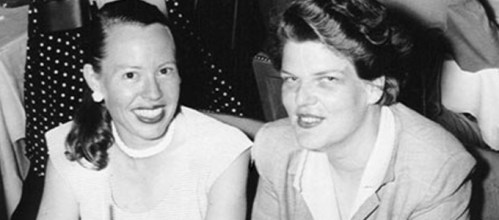
The DOB was founded in San Francisco in 1955, by lovers Phyllis Lyon and Del Martin, they initially started the organization as a social group to meet more lesbian couples.  It grew quickly, became more political over time, and developed chapters in many cities.  The Ladders’s very secret membership list had 3800 subscribers by 1970.
phyllis and del.jpg

Phyllis Lyon and Del Martin in the 1950s


Every issue of The Ladder stated the DOB Mission Statement in its inside cover:

  1. Education of the variant…to enable her to understand herself and make her adjustment to society…this to be accomplished by establishing…a library…on the sex deviant theme; by sponsoring public discussions…to be conducted by leading members of the legal psychiatric, religious and other professions; by advocating a mode of behavior and dress acceptable to society.
  2. Education of the public…leading to an eventual breakdown of erroneous taboos and prejudices…
  3. Participation in research projects by duly authorized and responsible psychologists, sociologists, and other such experts directed towards further knowledge of the homosexual.
  4. Investigation of the penal code as it pertain to the homosexual, proposal of changes,…and promotion of these changes through the due process of law in the state legislatures.

This past Sunday, The GLBT Historical Society of San Francisco marked the 60th anniversary of the DOB with a private reception.  The guest of honour was 91-year-old Phyllis Lyon, the surviving cofounder of the organization.  The Society’s Facebook page has posted some heartwarming photos of the celebration.

{KA}


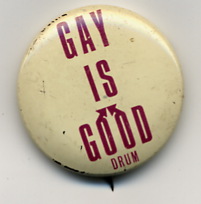
Gay is Good

Gay_is_GoodThe rallying cry of gay liberation throughout the 1970s, was in fact coined in 1968 by pre-Stonewall American gay rights activist Frank Kameny. Frequently found on placards and buttons, the slogan also made its way into famous liberation manifestos. Lesbian activist, Martha Shelley’s 1972 booklet, “Gay is Good” was, and still is, radical and explosive:
Look out, straights. Here comes the Gay Liberation Front, springing up like warts all over the bland face of Amerika, causing shudders of indigestion in the delicately balanced bowels of the movement.”

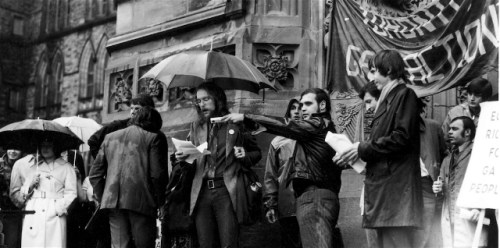
Gay is Good was heard in Canada also.  The country’s first large scale political demonstration on Parliament Hill was on August 28, 1971. Despite the rain, over 100 activists marched and picketed.  Toronto Gay Action’s Charlie Hill proclaimed Gay is Good during his historic speech in support of the “We Demand” brief submitted to the federal government a week prior.

We demand image

Charlie Hill delivering demands in 1971.  Click photo to see CBC footage of demonstration.  Photo credit: Canadian Lesbian and Gay Archives.


Gay liberation made its way to Calgary in 1972 with the short-lived formation of a local chapter of the Gay Liberation Front.  Calgary liberation activists mobilized around a more permanent organization in June 1976: the Gay Information Resource Centre (GIRC).  In 1980 GIRC organized the first gay rights political demonstration in Alberta, with our very own “placard-waving homosexuals” on the steps of Calgary City Hall.

Gay is good.

{KA}

A Not So Gay World

“What does the future hold for Canada’s homosexuals?  Will the time ever come when a gay couple can mix as freely in society as their heterosexual counterparts?”

These were questions posed in the epilogue of A Not So Gay World:
Homosexuality in Canada
 published in 1972 by McClelland and Stewart.  The book, was the first non-fiction work about homosexuality published in Canada. Tellingly the authors “Marion Foster” and “Kent Murray” were pseudonyms for the real authors, a lesbian and gay man who remain unknown throughout the text except as good friends and social commentators.

A Not So Gay World Eyes

Cover Image from: A Not So Gay World: Homosexuality in Canada

The book received scathing reviews from gay activists at the time.   Rick Bébout’s review in Canadian Reader exclaimed: “This is a work worthy of bug eyed tourists in a foreign country. The authors do well to keep their real names to themselves.”  Ed Jackson, in issue #7 of the Body Politic wrote: “what we don’t need is yet another book delineating the ‘giant shadow’ of loneliness haunting the life of the homosexual.”

However, in hindsight the book has proved to be a critical time-capsule: capturing a transition in Canadian society with a depth that few other sources can match.  A Not So Gay World explores the gay community on both sides of the 1969 ‘decriminalization of homosexuality’ in Canada.  As correctly pointed out by interviewed activist George Hislop, the Criminal Code amendments were not all that dramatic, “when in fact it never was illegal to be a homosexual.”  Yet they were hugely symbolic and greatly affected public attitudes, in a similar way that legalizing same-sex marriage has done in our generation.

One sees the clash of gay cultures between the homophile movement of the 60s and the gay liberation movement in the 70s which flowed from University campuses.  The authors clearly feel some camaraderie with the former and write nostalgically about seedy bars, outrageous characters, and just-under-the-radar shenanigans.  Ironically, these same high spirited characters and their more socially conservative peers are described as antagonists to the emerging gay liberationists.  University of Toronto gay activist Charlie Hill explains that he gets mostly indifference from the campus community, but “I think we get more hostility from gay people themselves, because we are a threat to their anonymity, their carefully structured lives.  They do not want to change because they are afraid of change.”

Canadian society did change thankfully, because of those stubbornly proud activists, and consequently we can answer Marion and Kent’s epilogue question: YES, our time has come.

{KA}