Tag Archives: Glenbow

Dying Young

{This is our last post in 2025! We at the Calgary Gay History Project wish you a warm and festive holiday season – Kevin}

In the history of Calgary’s queer community, few figures loom as large—yet remain as quietly influential—as Doug Young. Born in 1950 near Taber, Alberta, and raised in both Taber and Medicine Hat, Young’s life was marked by a deep commitment to social justice and community building that helped shape the early gay rights movement in Calgary.

Young’s academic journey took him from Medicine Hat College to the University of Calgary, preparing him for a lifetime of advocacy and community service. Before his activism fully took hold, he worked with the Alberta Service Corps and Canada Customs—experiences that undoubtedly broadened his perspective on community needs.

But it was in the late 1970s and 1980s that Doug Young became one of Calgary’s most active voices for gay rights. At a time when queer communities were often hidden and marginalized, Young stepped forward into leadership roles that were both challenging and essential. He served as President of Gay Information and Resources Calgary (GIRC) from 1977 to 1979, and continued on its board through 1981. Under his stewardship, GIRC became a vital resource—offering support, outreach, peer counselling, and serving as one of the few community touchpoints for queer people in the city.
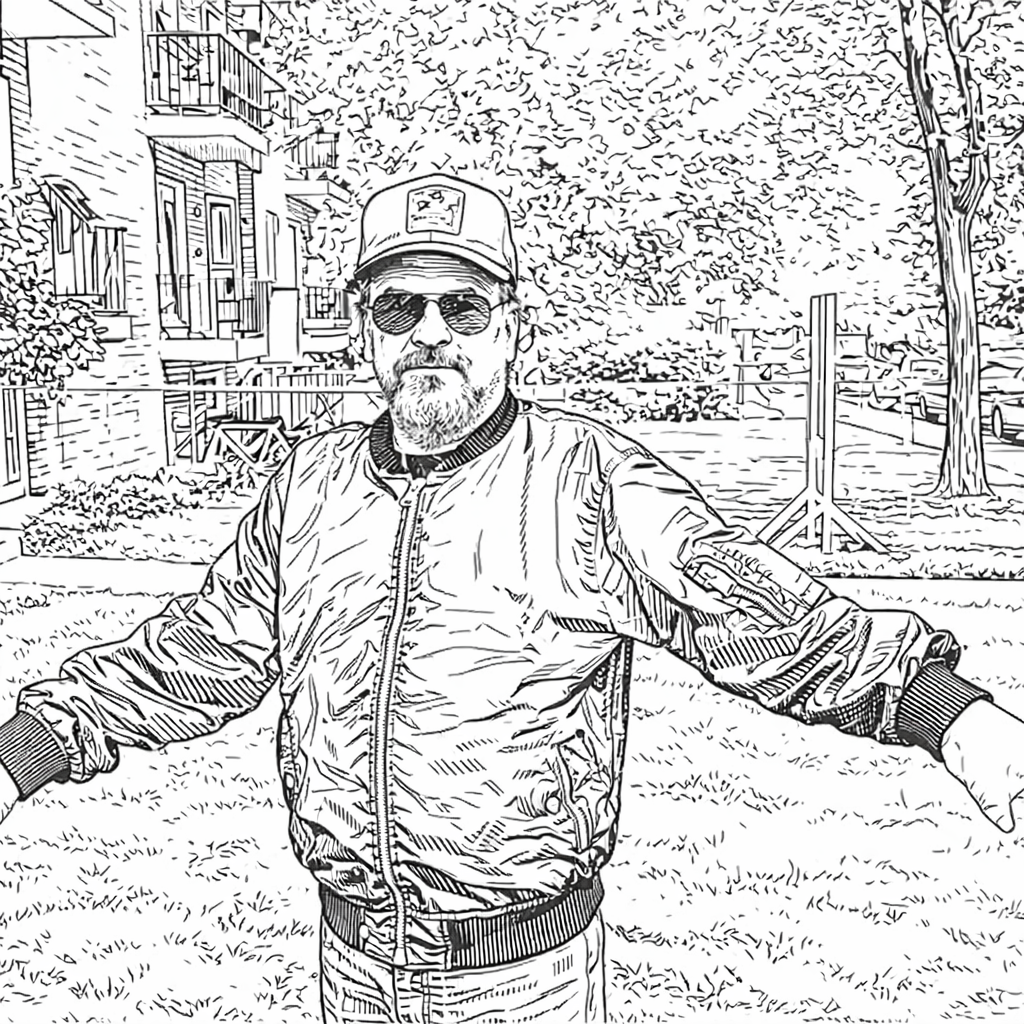
Line drawing of Doug Young derived from a photo in the Calgary Herald, June 14, 1994

Young didn’t limit his work to one organization. He was actively involved with the Alberta Lesbian and Gay Rights Association, AIDS Calgary, Gay and Lesbian Legal Advocates Calgary (GALLAC), the Right to Privacy Committee, and the Gay and Lesbian Community Police Liaison Committee—a network of groups focused on legal rights, health advocacy, safety, and community relations. This breadth of engagement speaks to both the urgency of the issues at the time and Young’s own drive to see real, sustained progress.

Young was an active spokesperson for the gay community and notably contributed to queer history through his extensive records. His personal papers were sorted and saved by Young’s friend John Cooper. They are now housed in the Glenbow Archives, which includes a remarkable hand-drawn map of gay spaces in the Beltline from the mid-1980s.
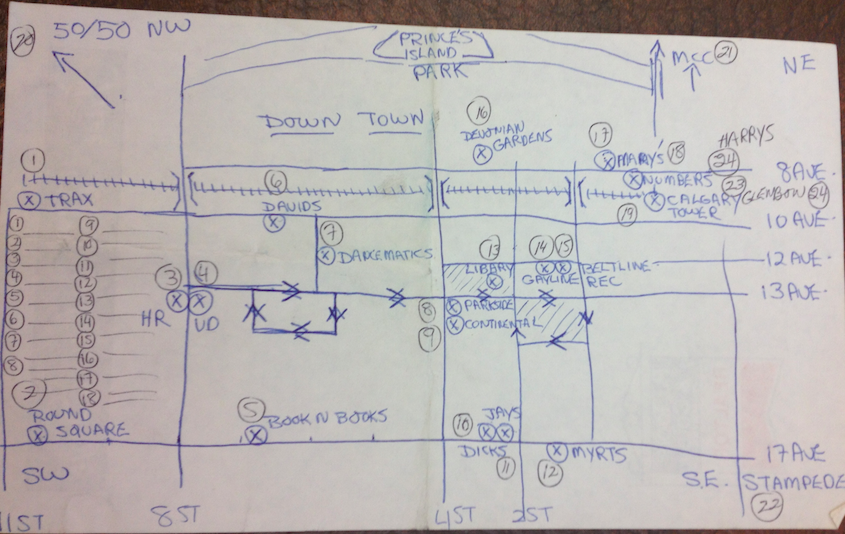
Doug Young personal papers, Glenbow Archives M-8397-1.

Perhaps most poignantly, Young’s leadership bridged the early gay rights era with the inevitable rise of the HIV/AIDS crisis. Community groups like AIDS Calgary grew out of activist networks in which Young was involved, helping mobilize volunteers, advocate, educate, and provide basic support during a time when fear and stigma often overshadowed empathy and action.

Doug Young passed away on April 15, 1994, from AIDS-related complications, a loss felt deeply across the community he helped nurture. While he did not live to see many of the legal protections and cultural shifts that came later, his efforts laid the necessary groundwork for Calgary’s queer organizations, public awareness efforts, and ongoing fights for equality.

At this dark time of year, I like to light candles to call back the light. I also light candles to remember those we’ve lost. Young would have been 75 in 2025 if he had lived, and I’m positive many other organizations would have benefited from his activism. The contributions of individuals like Doug Young are vital reminders of how far the community has come and how central grassroots leadership can make all the difference.

{KA}
Historic Calgary Week

July is one of our favourite times of year—not for the über-famous Calgary Stampede happening currently, but for Historic Calgary Week, running July 23-August 2, 2021. It is the signature event for the Chinook Country Historical Society, who program engaging history events all year long. An incredible number of volunteer hours go into making Historic Calgary Week happen; the 2021 iteration is cleverly subtitled: Unmasking Our History.

The Calgary Gay History Project’s Kevin Allen was invited on a mapmakers panel discussion on Tuesday, July 27 at 7:00 PM.

Behind the Scenes with the Mapmakers will tackle how one maps a city’s unknown histories. Kevin is joined by Calgary Through the Eyes of Writers Author Shaun Hunter and the Calgary Atlas Project’s Jim Ellis. They will chatter about charting the city’s cultural landscape, using maps to (sometimes literally) pin down the past. The panel will be moderated by Heritage Calgary’s Asia Walker and hosted online by the Calgary Public Library.

Register for Behind the Scenes with the Mapmakers: here. Registration is free, but spaces are limited.

Gay Activist Doug Young’s map of the 1980s Beltline: Glenbow Archives M-8397-1.

{KA}

Rocky Mountain Singers—Beginnings

Thanks to One Voice Chorus, the Calgary Gay History Project recently hosted a live presentation on the history of Calgary’s first LGBTQ2 chorus, the Rocky Mountain Singers. At a well-attended zoom event on April 19th, former choristers shared poignant memories and together we created a history narrative of the choir.

Attendees then spent an extra hour visiting and are even considering a reunion concert—if we Calgarians are so lucky! This is the first of several blog posts recounting some of the history we uncovered as part of this commissioned research project.

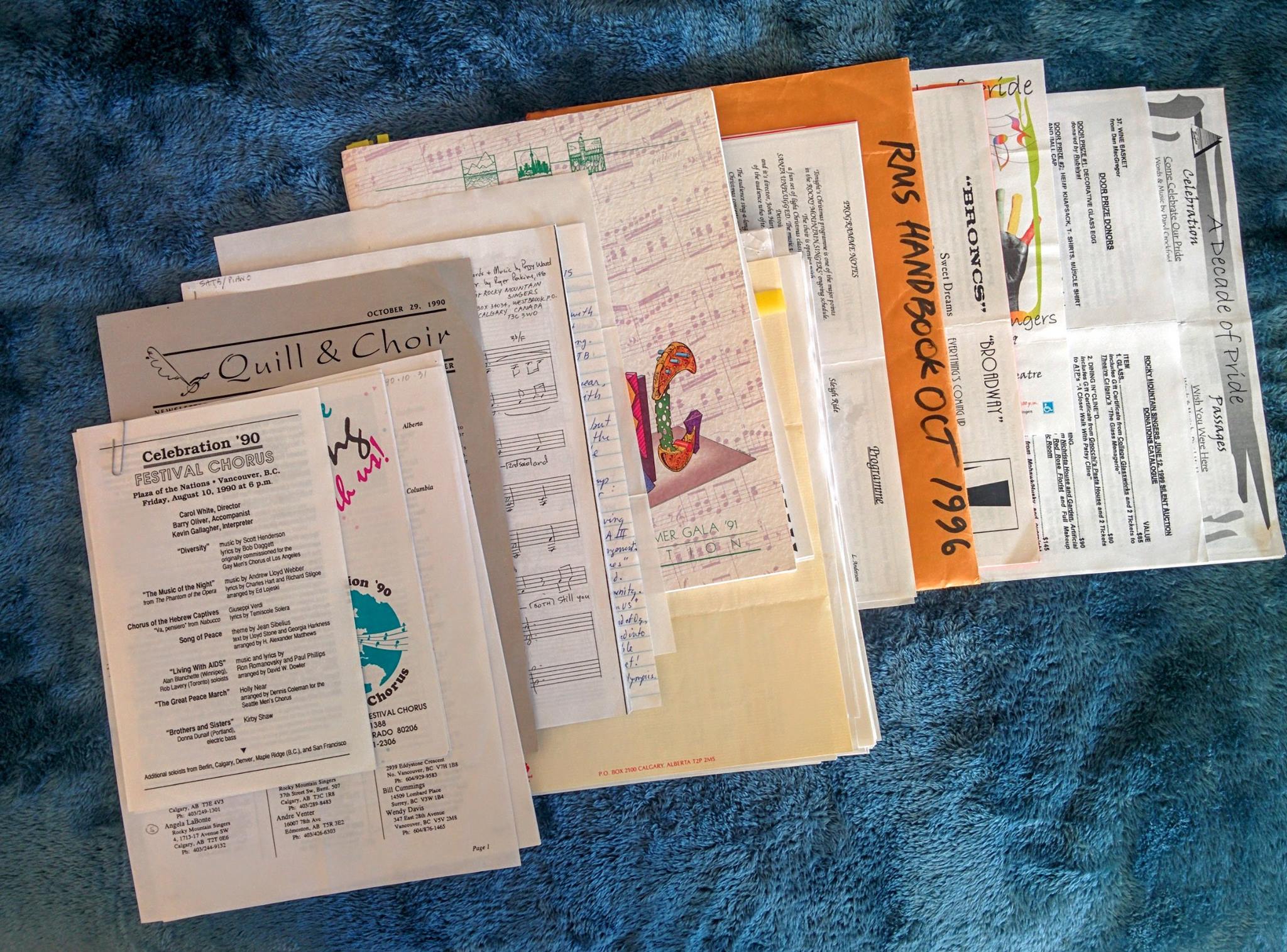
RMS papers in the Glenbow Archives

The Rocky Mountain Singers (RMS), 1989-2002, became an important focus of artistic expression in Calgary’s LGBTQ2 community. We conducted interviews with 12 former members; everyone expressed very fond and cherished memories of RMS. The chorus actively built and strengthened the LGBTQ2 community in Calgary and through their participation choristers created enduring friendships that have lasted into the present.

RMS had a well-known public presence and performed regularly; they were musical ambassadors for many gay community organizations including Calgary Pride. The chorus participated actively in the growing gay choral movement of the 1990s and represented both Calgary and Canada at the Gay and Lesbian Association of Choruses (GALA) Festivals. RMS paved the way for future LGBTQ2 choral organizations in the city, including the contemporary Calgary Men’s Chorus and One Voice Chorus.

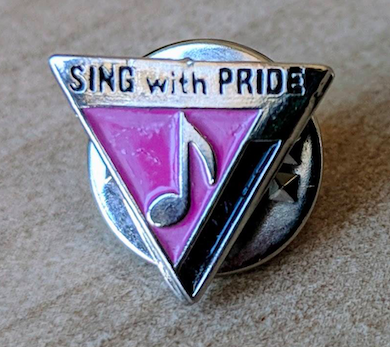
RMS Pin (1992)

Luke Shwart, an RMS founder, recounted his memories of the origins of the choir.

“When my Vancouver Men’s Chorus buddy Dan Worsley insisted that I attend the 1989 GALA Chorus Festival in Seattle, I had no idea what to expect. But, countless individuals will tell you how GALA Festivals have a powerful way of transforming people through music. Imagine a world of black and white suddenly turned to colour; or the sound of a vinyl record turned into the experience of a concert. Everything was like before, but different, better, filled with promise. It happened to me. GALA demonstrated that the world is filled with gay people who love to sing. I realized that people like that lived in my city and province too.

I made a few decisions on the flight home from Seattle:

1.To attend the next GALA festival, in Denver in 1992

2.To attend with a chorus from Calgary, because that was the only possible way to have a better experience than I had in Seattle.

3.The choir’s name would be Rocky Mountain Singers.

I spent the summer networking, and met Karl Siegfried – who was trying to get a group of Calgary singers to go to Gay Games in Vancouver in 1990. We joined forces, and recognized that we had a few small problems – neither of us could conduct or play piano, other than the two of us we didn’t have any other singers, and if we ever did find some, we didn’t have any music, nor a place to practise.

We worked hard, and one by one resolved the issues. On October 3, 1989, at the MCC (Unitarian) Church on 16th Avenue NW, eight singers joined together with our first music director Bill Bradley—who conducted from the piano, and we started learning Christmas music. The choir grew from those humble beginnings.”

Michael Wright remembers that their very first concert was at Columbia House, a seniors’ residence in Bridgeland, noting, “they were a pretty generous audience.”

Suzanne Dextraze went to an RMS Christmas concert in 1989 at the Unitarian church and immediately felt the need to join: “I thought it was so cool and I wanted to sing there too.”

The choir was incorporated as a non-profit society on January 23, 1990. By then, they had found a critical mass of singers and a purpose. 1990 would prove a crucible year for RMS as they sorted through issues of gender, being open about their sexual orientation, AIDS, and the Gay Games—all to be explored in the next RMS history post.

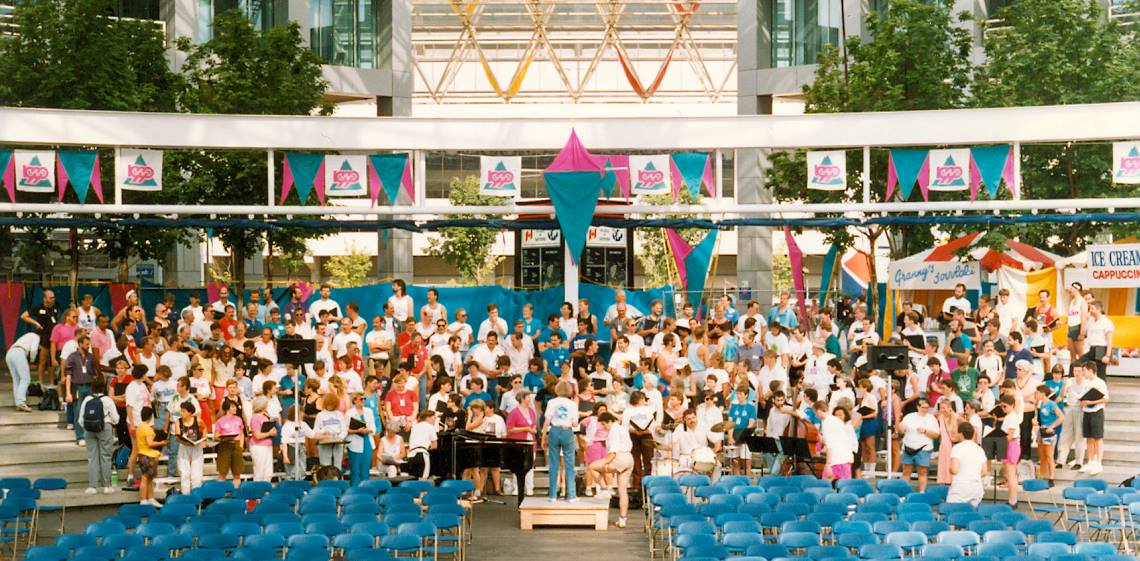
Festival Chorus at the 1990 Gay Games in Vancouver

{KA}