Tag Archives: gay

World AIDS Day & Anger

World AIDS Day began in 1988, when an international meeting of health ministers in London, England declared December 1st a day to highlight the enormity of the AIDS pandemic. Today in Canada, men who have sex with men* still make up the majority of new HIV infections annually: 57% or about 1400 new infections/year. Men who have sex with men are 131 times more likely to get HIV than men who do not. Pause to consider that.
screen-shot-2016-12-01-at-12-44-46-pm

The world is an angry place today. Foreign national events such as Brexit and the U.S. Election were notable in their antagonistic rhetoric. But even at the most local level, Calgarians are bellicose over reasonably low stake issues such as cycle tracks, public art, and election line-ups (issues I am personally connected to, which have given me lots of practice with wrath management technique).

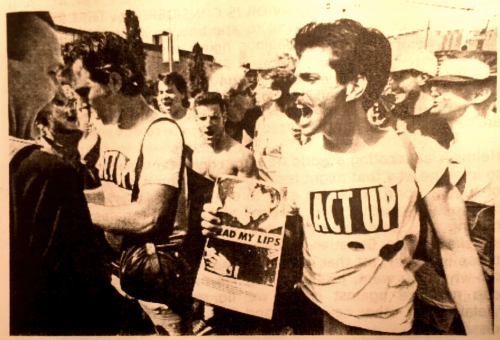
Recently, I came upon a manifesto in zine form called Queers Read This. It was distributed at the June 1990 Pride March in New York City, and “published anonymously by queers.” It is a concentrated distillation of rage at a time when the stakes could not have been higher. AIDS, at the time, was a growing epidemic and for most, an almost certain death sentence.

The publication has exhortations to “bash back,” meet hatred with hatred, and give no inch to straights. It very much defended the word Queer as a militant signifier of strength which galvanized and branded the generation of activists who came of age then.

Calgary was part of this movement. 1990 was the year of the first Pride Rally in the city. It was also a time of tragic AIDS deaths, frequent gay bashings and other forms of homophobic backlash. Yet it was this anger which helped us stand our ground and ultimately win our human rights battles.

So I am reframing my relationship to anger. Anger can affect social change. Anger can be something positive – like the 1400 Canadian men who have sex with men who will get infected with HIV this year.

*{Men who have sex with men is a term that refers to behaviour rather than identity; it captures not only gay and bisexual men but also those who do not identify themselves based on their sexual practices.}

ANGER (An Essay from Queers Read This)

“The strong sisters told the brothers that there were two important things to remember about the coming revolutions, the first is that we will get our asses kicked. The second, is that we will win.”

I’m angry. I’m angry for being condemned to death by strangers saying, “You deserve to die” and “AIDS is the cure.” Fury erupts when a Republican woman wearing thousands of dollars of garments and jewelry minces by the police lines shaking her head, chuckling and wagging her finger at us like we are recalcitrant children making absurd demands and throwing a temper tantrum when they aren’t met. Angry while Joseph agonizes over $8,000 for AZT which might keep him alive a little longer and which makes him sicker than the disease he is diagnosed with. Angry as I listen to a man tell me that after changing his will five times he’s running out of people to leave things to. All of his best friends are dead. Angry when I stand in a sea of quilt panels, or go to a candlelight march or attend yet another memorial service. I will not march silently with a fucking candle and I want to take that goddamned quilt and wrap myself in it and furiously rend it and my hair and curse every god religion ever created. I refuse to accept a creation that cuts people down in the third decade of their life.

It is cruel and vile and meaningless and everything I have in me rails against the absurdity and I raise my face to the clouds and a ragged laugh that sounds more demonic than joyous erupts from my throat and tears stream down my face and if this disease doesn’t kill me, I may just die of frustration. My feet pound the streets and Peter’s hands are chained to a pharmaceutical company’s reception desk while the receptionist looks on in horror and Eric’s body lies rotting in a Brooklyn cemetery and I’ll never hear his flute resounding off the walls of the meeting house again. And I see the old people in Tompkins Square Park huddled in their long wool coats in June to keep out the cold they perceive is there and to cling to whatever little life has left to offer them. I’m reminded of the people who strip and stand before a mirror each night before they go to bed and search their bodies for any mark that might not have been there yesterday. A mark that this scourge has visited them.

And I’m angry when the newspapers call us “victims” and sound alarms that “it” might soon spread to the “general population.” And I want to scream “Who the fuck am I?” And I want to scream at New York Hospital with its yellow plastic bags marked “isolation linen”, “ropa infecciosa” and its orderlies in latex gloves and surgical masks skirting the bed as if its occupant will suddenly leap out and douse them with blood and semen giving them too the plague.

And I’m angry at straight people who sit smugly wrapped in their self-protective coat of monogamy and heterosexuality confident that this disease has nothing to do with them because “it” only happens to “them.” And the teenage boys who upon spotting my Silence=Death button begin chanting “Faggot’s gonna die” and I wonder, who taught them this? Enveloped in fury and fear, I remain silent while my button mocks me every step of the way.

And the anger I feel when a television program on the quilt gives profiles of the dead and the list begins with a baby, a teenage girl who got a blood transfusion, an elderly baptist minister and his wife and when they finally show a gay man, he’s described as someone who knowingly infected teenage male prostitutes with the virus. What else can you expect from a faggot?

I’m angry.
screen-shot-2016-12-01-at-12-38-50-pm

Photo: Queers Read This published anonymously by queers.

{KA}


No Straights Allowed

Many groups struggling against bigotry clamour at some point in their history for segregated spaces. The feminist community in the 80s started experimenting with womyn-only spaces. Calgary in the 90s had the Of Colour Collective, which was constituted by queers who were not white. And in the early 70s, Club Carousel, our first community space had an explicit policy of “NO STRAIGHTS ALLOWED.”

Despite the then, recent decriminalization of homosexuality in 1969, being an out gay man or woman remained fraught with difficulties and real consequences. Club Carousel’s origin story was the foundation for this exclusionary policy. Its predecessor, the 1207, was a mixed gay and straight disco, but when the gay community found out that they were the entertaining freak show which was bringing in the straights, they boycotted the club. The 1207 was out of business in less than a month. The Club Carousel founders then convinced landlord Henry Libin to let them take over the 1207 lease.

CC image2

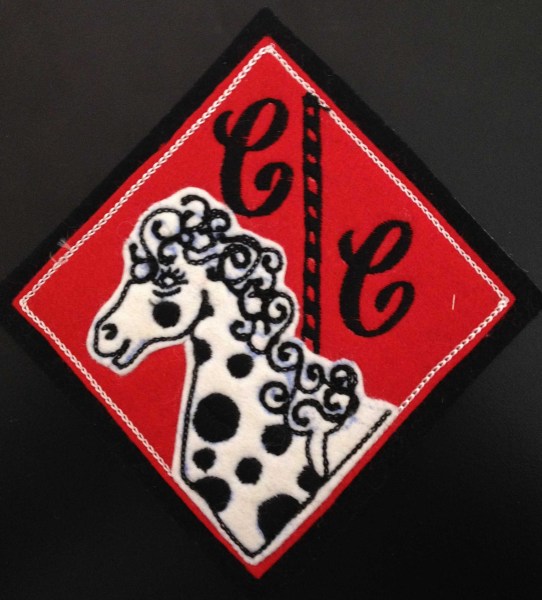
Club Carousel Logo

They incorporated as a charitable private members club in 1970, and this is primarily how they controlled who got in the door. Club Carousel had layers of screening to ensure their space remained gay. Firstly, to join the club, one had to provide three pieces of ID, list three sponsors who were members in good standing, and pledge to adhere to Club rules. Secondly, a membership committee would vet all applications for approval (they reserved the option to interview applicants in person for those the committee was unsure of). And finally, the door person ensured that only members with membership cards could get in. Guests could be signed in, but there was also a suite of rules regulating their entrance.

Despite these barriers the Club proved popular, and membership had grown to 650 by 1972. It was a place that gay men and lesbians could let their hair down, socialize, and be surrounded by peers. Lois Szabo, one of the Club founders, remembers how much she enjoyed the Club in those early years and what fun it was.

It was a place to forget the straight world for a while with its culture of bigotry and intimidation that existed just up the stairs, and out the door of the underground club. Members of Club Carousel had significant fears of being outed; they did not want to run into anyone they might know in the straight world.

Making sure the Club remained a safe space, was a common refrain in the pages of Carousel Capers, the Club’s monthly newsletter. In April 1973, Ruth Simkin, wrote a strongly worded letter to the Club’s Executive Committee:

It is with great regret that I can no longer continue with my membership and support of Club Carousel. The reason for this is the Executive’s decision of hiring a straight band for the Anniversary Party.  I feel this is merely a first step in the total demolition of an all-gay club…..

I personally feel that a consolidated gay community is more important than a well-played guitar, at the only place in Calgary we have.  When policy changes back (if it ever does), I would be honored to once more be associated with what could be the best gay club around.

{Ruth would go on to be one of the founders of the important Calgary Lesbian and Gay Political Action Guild (CLAGPAG).}

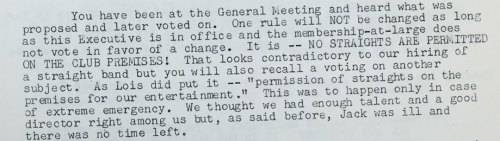
The Executive responded in the pages of Carousel Capers that the band had been a last minute substitution when their previously booked gay talent had had to cancel, and emphatically confirmed their commitment to the no straights policy.

screen-shot-2016-11-17-at-10-56-09-am

April 1973 Editorial in Carousel Capers

Later that year, the Executive firmly noted that the newsletter itself should carefully be restricted from Straights.

screen-shot-2016-11-16-at-4-41-55-pm

June 1973 Notice in Carousel Capers

“Out of the closets and into the streets is a great battle cry for gays who don’t have too much to lose but then – there are the rest of us” referencing the generational divide as young gay liberationists were agitating publicly for social change (particularly at the University of Calgary).

As the 70s progressed the Club’s membership drifted to commercial gay bars which were flashier and less regulated, causing the Club’s eventual demise. Yet, it was Club Carousel which created the firmament for all sorts of gay spaces to flourish in Calgary.

{KA}


The Calgary Police Archives

The police and the gay community have had a conflicted past across North America for most of the 20th Century. We see this former reality resonating in 2016 as the LGBTQ community debated how police participated in Pride Parades across Canada.

Locally, the Calgary Police have been in the news due to a recently released, unflattering, 2013 internal audit of workplace culture. The Police are one of many state institutions that are grappling with societal change, and increasingly, with reconciliation for prior stigmatization of the LGBTQ community.

police-flag

A research trip to Police HQ, one week after the Orlando shooting. We were surprised to see the Pride Flag flying at half mast…

A positive development, amidst this troubling news, is that the Calgary Police archives staff have been assisting the Calgary Gay History Project: combing through files looking for references to their relationship with the LGBTQ community in previous decades. The material is far from flattering.

Some samples:

In May 1946, Constable F.C. Shipley was awarded an entry in the merit book and an accelerated promotion due to catching Alfred V. Andrew in an act of gross indecency with another man at the Alexandra Hotel.  Andrew subsequently pleaded guilty and was sentenced to six months hard labour.

In November 1960, the Calgary Police fired one of their own employees, Charles Pippard, because, “it would appear that Pippard suffers from homosexual tendencies, but nothing can be uncovered to confirm this.”

And in Sept 1963, an editorial in the Police’s internal magazine, Patrol, gleefully announced:

Hats off to those members of the Detective Division whose resourceful and perseverance, coupled with a new and revolutionary scientific aid to criminal investigations, closed circuit television, were successful in exposing and subsequently convicting a group of men practicing acts of gross indecency in a public washroom.

The hue and cry that heralded the use of these so called ‘Big Brother tactis’ [sic] by the force, displayed as usual a lack of awareness and understanding of this dangerous trend which prompted the use of this device.

Homosexuality and the perversion it breeds is a social problem that is always with is. When, however, such perverts meet and practice various acts of indecency in any place to which the public have access, then there is no other course open to the Police than to use every means at their disposal to safeguard innocent citizens from this type of environment and ensure that these establishments are protected from such defilement.

It is unfortunate that to gain the evidence required to subject several innocent and unsuspecting citizens using the toilets in question, to the scrutiny of television cameras while engaged in a most fundamental act of nature.  That, it has been claimed, was a gross invasion of privacy.  Surely we are not such prudes that in the interests of public decency and morality, we cannot accept a little humiliation of this kind and in doing so perhaps prevent a child or young person from becoming the victim of the insatiable lust of some of these mentally sick individuals.

It is important that society-at-large comes to terms with our LGBTQ past, and stares at it unflinchingly, to prepare a space for reconciliation.  I thank the Calgary Police for opening up its history to the Project and allowing itself to be stared at.

{KA}