Tag Archives: Everett Klippert

Klippert Month – Week 1

We at the Calgary Gay History Project hope the Federal Government is still working on a posthumous pardon or equivalent for Calgarian Everett Klippert (1926-1996). November 7th, 2017, will be the 50th anniversary of the landmark Supreme Court ruling, which fully criminalized gays, and precipitated the legislated decriminalization of homosexuality.

So to recognize that milestone in Canadian LGBTQ2 history, we are posting Everett articles all month!

One of the facts presented in his defence, at virtually all of his court cases, was his steadiness as an employee. Everett left school after grade 8 to work and to support his family. His older sister Leah ran their household and he and his eight brothers were required to hand over their wages to Leah for expenses.

Everett’s father operated a grocery store in Bridgeland, and Everett’s first job was working in the shop along with some of his older brothers. By the time he was 17, he was working at Crystal Dairy, the ice cream division of Calgary’s Union Milk Company. He said that it was when he started working there that he became sexually active with other men.
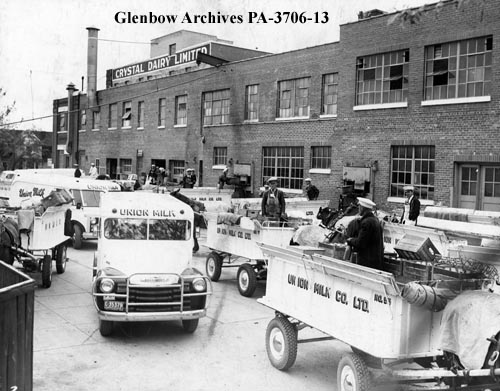
Crystle Dairy

The Union Milk Company at 130 – 5th Avenue SE in June 1950. Source: Glenbow Archives.

After nine years employed at the dairy, he got a job he loved more, driving buses for Calgary Transit. He was a favourite bus driver too. There are stories of his regular passengers skipping earlier buses to specifically ride home with him due to his friendly, congenial nature.

bus break
Everett Klippert used to go attend bus driver coffee brakes like this one in Eau Claire. Source City Archives via Calgary Metro.

At his first trial in Calgary in 1960 his defence lawyer, W. P. Maguire noted that Klippert “had been steadily employed for 17 years and but for his weakness (sex with men) he would be, at 33, a normal run of the mill man, married with children.” For that reason, he urged a punishment of probation only and not incarceration

Sadly, he was sentenced and served a four-year jail term. When Everett was released in 1964, he quickly departed town both to start over and to spare his family any more shame. He made his way to a job in Pine Point, North West Territories on a lead from a friend and secured a position as a garage mechanic’s helper at the Consolidated Mining and Smelting Company of Canada, Limited (which was renamed Cominco Ltd. in 1966).
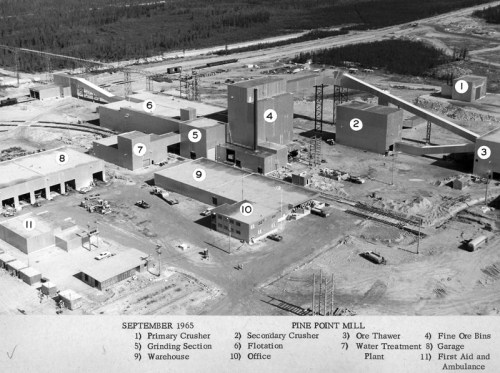
N-1987-021-0063

Everett Klippert worked in the garage at Pine Point from May 1964 until he was arrested in August 1965. Photo: Pine Point Revisited.

He was arrested and tried again for homosexual activity in 1965. At his trial, Everett’s garage foreman, Melvin Logan, was called as a witness on behalf of the defence. When asked about Everett’s performance, the foreman said: “He was very good, a very willing worker, hard worker, easy to get along with, very cooperative. He got along with everyone in the shop very well – no trouble at all.” Furthermore, it was revealed that Everett was friendly with the Logan family. He would go over for supper occasionally and was trusted to babysit the two small Logan children.

During both times Everett was in the penitentiary, he worked in the shoe shop. One of the psychiatrists who interviewed Klippert in 1965 reported:

“I talked to the man in the shoe shop with whom Mr. Klippert worked, and he gave an excellent report; that he is a good worker; that he minded his own business; that he is a sensitive man. He spoke very highly of him. He also informed me that he found life in the penitentiary extremely painful to him because I think he is a sensitive man and some of his colleagues are, well less than that and I think they made life a little bit, considerably rough and difficult for him.”

Klippert copy

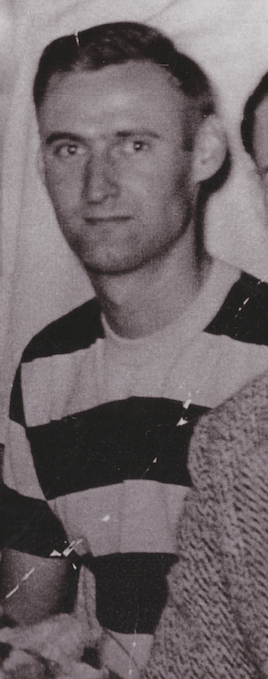
Everett Klippert in stripes. Source: Klippert Family Photo.

Tragically, this difficulty would be long-lived. Klippert would remain in jail until 1971 for no known reason, even though Parliament decriminalized homosexuality in 1969 as a result of his unjust prison sentences.

{KA}

Our History with the Police

This week’s announcement by Calgary Pride, editing the presence of the Calgary Police in the Pride Parade, has stirred deep waters. Calgary’s LGBTQ community has a decidedly conflicted history with the city’s police: ignoring that fact or conflating the past with the present is equally unhelpful. Mayor Nenshi says: “Blaming current people for historical oppression would be like saying: ‘previous mayors of Calgary have refused to proclaim Pride Week, therefore the current mayor of Calgary isn’t invited to the parade.’ I have a challenge with that.”

Yet, as an analogy of the situation, his response is far too superficial.

Redistribution of power is the existential issue of our generation. At every level in society, we see social justice combating social conservatism. There has been a lot of fallout. Although Canada seems to be managing this redistribution slightly better than other places, dealing with atonement, integration and resistance to change has been a weary-making struggle for everyone.

One of the strategies in progressing forward is to know our history and to look at it unflinchingly.

Fact: We were surveilled and incarcerated in large numbers, particularly in the period between World War II and 1969. In 1967, Everett Klippert, a Calgary bus driver received a life sentence just for being gay which triggered a change in the laws around the criminalization of homosexuality in 1969. Calgary leaders, including our politicians, were vehemently opposed to decriminalization. Then police chief Ken McIver described homosexuality as a “horrible, vicious and terrible thing. We do not need this in our country.”

Ken McIver 1968

Police Chief Ken McIver examines police graduates in January 1968: Source Glenbow Archives.

Fact: Calgary Police tracked gay student activists in the 70s, asking the University of Calgary for their records (the University courageously refused), showing up at their apartments and purposefully intimidating them.

Fact: Calgary Police routinely harassed gay men in Central Memorial Park in the 70s and 80s and would sometimes incarcerate them overnight without cause. This was not challenged until 1981 when gay University of Calgary Law Student, Henry Berg, filed a formal complaint against Calgary Police regarding abuse of police power after he spent a night in the drunk tank when he was not inebriated.

Fact: I (Kevin), personally, was stopped by a Calgary Police Officer in the summer of 1996 walking home after work in the late afternoon.  The male officer kept me for 15 minutes, and it became evident during his interrogation that the only reason I had been targeted was for my sexual orientation which he identified by the “funny way I was walking.” Although defiant at the time, I regrettably never pursued a complaint.

Fact: Goliath’s, a gay bathhouse in Calgary was raided for being a common bawdy house in 2002 with both found-ins and operators charged. The Crown eventually stayed the charges citing changed community standards.

Notwithstanding these facts, the Calgary Police have made great strides in transforming their culture concerning sexual and gender diversity – which could not have been easy. The first gay/police liaison committee began in the early 80s and was not a sincere effort but a cynical, placating move. However, over time, the two historically opposing communities built more trust. The police were actively trying to prevent hate crimes against our community throughout the 90s. Now they have diversity officers and actively try to recruit LGBTQ individuals to their ranks. Most recently they courageously opened their archives to the Calgary Gay History Project. It was courageous because a peek in their closet wasn’t pretty.

police-flag

A visit to the Calgary Police Archives with the Pride Flag flying at half mast for the victims of the Pulse Nightclub shootings in Orlando, Florida.

We in minority communities have some unattractive things in our closets too. But I firmly believe that we need to seek and share empowerment as we are able. I am a fan of creating braver spaces, as opposed to safer spaces. The viral video of Michelle Obama’s 2016 university commencement address, “Living Without Privilege Makes You Stronger” resonated forcefully with me.

If I had to decide whether Calgary Police could march in the Pride Parade in full uniform this year, I would not know what to do.  I understand and sympathize with the arguments from both sides. I have met Calgary Police officers who are decent people and great allies.

Intellectually, I want to trust police: there are many good reasons to do so, but emotionally – because of my lived experiences – I cannot say that I do. My deepest reflex is to not trust them.

Can my feelings change?  I am not sure.  I earnestly hope so.

{KA}


Where are Canada’s Gay Pardons?

Good news came out of the United Kingdom this week as Turing’s law received royal assent. It was named after the now famous mathematician Alan Turing, who broke the German Enigma codes in World War II. He sadly committed suicide at the age of 41 after being convicted of gross indecency – the charge under which homosexuals were prosecuted in both the UK and Canada.

turing

Alan Turing. Photo: Sherborne school/AFP/Getty from The Guardian Jan 31, 2017.

Although Turing received a royal pardon in 2013, this bill extends to thousands of men formerly convicted of homosexual offences. They have been posthumously pardoned under a new law. Most of these men are dead now, but the UK gay community is heralding it as a significant victory. It also has been declared an anodyne to family members and descendants of those convicted.

We have a martyr here in Canada: Everett George Klippert, the Calgary Bus Driver who was unjustly jailed for most of the 1960s for being gay. The Globe and Mail’s John Ibbitson revived national interest in Klippert in February 2016, eliciting a pledge from Prime Minister Justin Trudeau to grant a posthumous pardon.  In addition, we have our own thousands who were convicted under Canada’s gross indecency laws.

screen-shot-2017-02-02-at-5-16-07-pm

Everett George Klippert – Family Photo

Edmonton Member of Parliament, Randy Boissonnault, was appointed last fall as special adviser to the Prime Minister on LGBTQ2 issues, and an apology is part of his mandate. Perhaps they need some inspiration?

In January, Brandon Lewis, UK Minister of State at the Ministry of Justice, issued a formal apology on behalf of the government:

I want to take the opportunity to apologise unreservedly, on behalf of the Government, to all those men who will receive a pardon. The legislation under which they were convicted and cautioned was discriminatory and homophobic. I want to make sure that all who were criminalised in this way and had to suffer society’s opprobrium, and the many more who lived in fear of being so criminalised because they were being treated in a very different way from heterosexual couples, actually understand that we offer this full apology. Their treatment was entirely unfair. What happened to these men is a matter of the greatest regret, and it should be so to all of us. I am sure it is to Members across the House. For this, we are today deeply sorry.

{KA}