{Welcome to part two in our Winter Olympic Series, written by William Bridel!}
I am frequently reminded of Dr. Lindsay Alcock’s humility, despite an incredible athletic career and her many accomplishments in other spheres of life. Just over a year ago, I was interviewing Lindsay for my project exploring the role of sport in Calgary’s queer history, and while we’d known each other since 2014 (not long after I moved to the city, we were both on a panel addressing homophobia in sport and became friends), I found myself learning more and more about her that day. I am proud to share part of her story here.
Born in Bearspaw, Alberta, in 1977, Alcock’s family relocated to Cochrane soon after. With limited sports opportunities for girls at the time, Alcock played soccer on boys’ teams and participated in many school sports. She and her family were also avid downhill skiers, though—as she was quick to point out—only recreationally. Still, the 1988 Olympic Winter Games left an indelible mark on Alcock, as she and her family took in many of the events. As a university student, Alcock joined the University of Calgary’s track and field team as a sprinter and also began working at Canada Olympic Park during the summers—an experience that would change her athletic trajectory.
“I had a tourist ask me one day: ‘Why don’t you do any of these sports?’ I didn’t really have a good answer. So, I thought, well, if anything, I can maybe help my tours by telling them exactly what it feels like to go headfirst on a sled down an ice track, an ice chute. I toyed between ski jumping and doing skeleton. And ultimately skeleton was the most kamikaze in my mind. So based on that tourist’s feedback, I decided to sign up and pay $50 to take a ‘discover skeleton’ class. This would’ve been in the fall of 1998.”
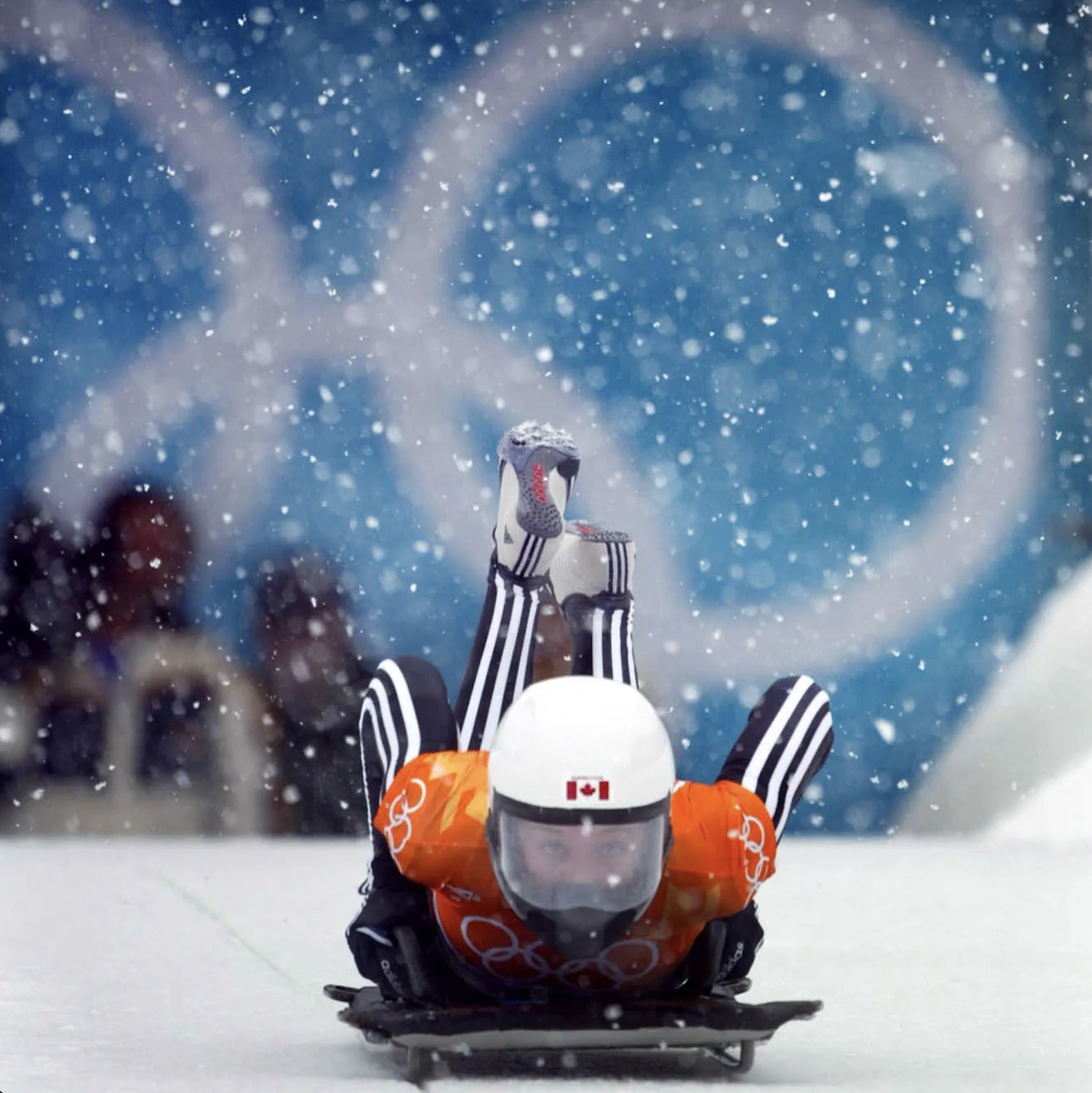
Rising through the Canadian skeleton ranks quickly, within two years of that intro-to-skeleton experience, Alcock qualified to represent Canada on the America’s Cup and then the World Cup teams. While competing internationally, Alcock secured enough top six placements in 2001-2002 that she qualified for her first of two Olympic Winter Games, just four years after being introduced to the sport! At the 2002 Games in Salt Lake City, she finished in sixth place. In the 2003-2004 season, Alcock won the overall Women’s Skeleton World Cup title. She continued to train, with eyes set on the 2006 Olympics, which were being held in Italy.
In the late 1990s, Alcock began coming out to family and friends, and in the early 2000s to teammates and others within the sport, and later more publicly. This made her one of only a few queer Canadian athletes actively competing in elite sport while open about their sexuality; Nancy Drolet, a national team ice hockey standout, and wheelchair basketball star Danielle Peers were others.[1] Alcock describes the support she received from the vast majority of teammates in a positive way. For example, she noted that she would bring the boxset of The L Word on tour, and some of her teammates would sit down and watch episodes with her. They’d also take her, when feasible, to queer villages in various cities on the tour. Alcock also began training and racing with a Pride sticker on her sled, visible to teammates, competitors, spectators, and television cameras. At the same time, she did experience indirect and direct homophobia while on the circuit, and so was grateful for the solidarity experienced with the majority. This allowed her to remain steadfast in being her authentic self after she had come out.
There were still challenges, however. Alcock shared one story about attaining a sponsorship deal—a rarity for skeleton and for women athletes at the time—with a local company:
“I remember signing the contract for this sponsorship, which was a really big deal. It was quite a bit of money. And it was meaningful for my everyday life. I literally had the pen in hand and then I finally just…I put it down and I said, ‘you just need to know, I’m not gonna hide this. I’m a lesbian. I’m in a relationship with a woman. Is that gonna be a problem?’ And he said, ‘No. Are you gonna sign or what?’”
While it was a positive experience of allyship in that moment, not long after signing on, Alcock, as one of their sponsored athletes, had to participate in an event organized by the company.
“I had to sit beside Bishop Frederick Henry. It was a golf tournament, and they put me in the same golf cart with him. For 18 holes, I had to sit beside him! And I was like, ‘how did they not know that?’ That’s not okay.”
{For context, Bishop Henry had a long and public history of opposing 2SLGBTQIA+ rights, including same-sex marriage in the early 2000s and, more recently, gay-straight alliances in schools and, more generally, the provincial NDP’s gender and sexual diversity inclusion guidelines implemented when they were in power.}
Alcock qualified for the 2006 Olympic Winter Games. Based on her performances in the years leading to those Games, including a silver medal at the 2004 World Championships, Alcock was considered a medal favourite but, in her own words, the Olympics didn’t go nearly as well as she hoped. She finished 10th. The disappointment of the finish wasn’t the only thing Alcock was dealing with; the following scenario reflects the still-pervasive heteronormativity in high-performance sport:
“One story I tell quite often is about what happened at the finish line in Torino [2006 Olympic Winter Games]. When I finished the race, I didn’t perform the way I had expected of myself. My wife was at the finish line, and I remember at that moment thinking, ‘So do I kiss her? Do I hug her? Do I… The camera’s on. I can feel it. I can feel it.’ It was burning into me. ‘What do I do?’ And I’m dealing with being really upset with how I did at this event. But I don’t wanna show shame. Like, I’m proud of who I am, and of this marriage, you know? And, so, the fact that I was thinking about that at the Olympic finish line was ridiculous. And I honestly don’t know what I did. I couldn’t tell you now how that went. It’s a total blur.”
Alcock would continue to compete in skeleton for two more years, ultimately retiring in 2008 to pursue a chiropractic degree in California. She once again resides in Calgary with her wife, Heather. Reflecting on her incredible athletic career, Alcock had this to say:
I’m most proud of how I was able to continue competing and to be who I was. It was quite a journey to get there.
Dr. Lindsay Alcock. Olympian. World Champion. Trailblazer. Calgarian.
{WB}
[1] This statement reflects what I’ve been able to uncover in my research to date, based on media stories and personal communications. I’m happy to be corrected if others know differently!