{This week, we have a guest post from emerging historian Jason Brooks. Digging in the archives, he discovered that the storied Memorial Park Library was saved from redevelopment due to the shady company it kept! – Kevin}
In 1962, Calgary City Council was divided over the creation of a new central public library. While all sides agreed that the growing population required a new library, the location for such a building was contested. Mayor Harry Hays advocated for a location across from City Hall on the corner of 7th Ave and 2nd Street (later Macleod Trail) SE. However, opponents of this plan suggested the replacement of the then 50-year-old Memorial Park Library.
In response, Mayor Hays used a police report to argue that the site was dangerous to children since, “more homosexuals hang out there than anywhere else.” Despite the Mayor’s argument, the report concluded that no assaults had occurred to children under the age of 16 within the vicinity of Memorial Park.
During February here, the chinook winds blow… In honour of this blustery month, the Calgary Gay History Project focuses on activist and musician Windi Earthworm (b. 1950) and his impact on our city. This week, we will update Windi’s story from Our Past Matters. Then, over the next few weeks, we will explore more about the activist’s life—details that have blown in since the book was published in 2018.
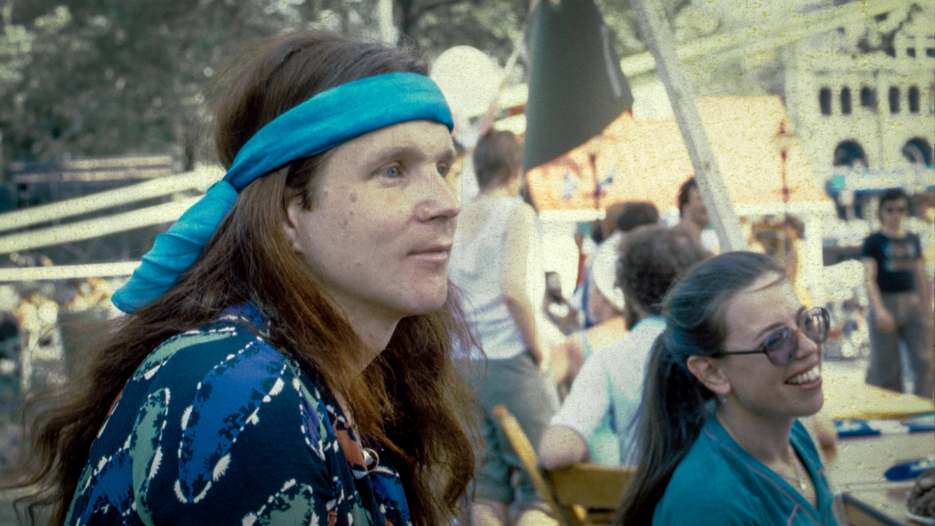
Windi Earthworm circa 1979. Photo: François Couture from kersplebedab.com
Windi Earthworm, an American gay artist and activist, moved to Calgary in 1973. He was notable for his gender non-conforming dress and street music. He also was a dedicated agitator who had the conviction of his beliefs. For example, Windi chained himself to a marble pillar in the Palliser Hotel during a Progressive Conservative party convention in 1976 to protest the absence of legislation protecting homosexuals from discrimination.
Windi grew up in Seattle and was filled with wanderlust. In the summer of 1973, he swept into Banff and got a job at the youth hostel. He began a relationship with his coworker, Calgary artist John Evans, who at the end of the season invited Windi to move back with him to Calgary. They lived in an apartment in the Thomson Brothers Block on Eighth Avenue. Through mutual friends, Windi met People’s Liberation Coalition’s Myra “My” Lipton in 1974, and they made a powerful connection. Despite both being gay, My married Windi the next year, so he could remain in Canada. After the ceremony, they went for falafels with their marriage witnesses to celebrate. My later moved into the Thomson Brothers Block herself, where she and Windi saucily broke the wall between their two apartments, creating a new internal doorway.
Windi sent this wedding photo to his friend Rex Leonard in 1975.
Later, Windi and My were part of a four-person protest group who took guerrilla action against an anti-gay skit. The sketch was included in the nightly performance of a band called The Dandies in the Four Seasons Hotel’s Scotch Room. One evening in June, when the skit was about to be unleashed, Windi and his friends rushed the stage; My took over the microphone. They explained to the surprised audience why they were offended. As the hotel bouncers dragged them away, they asked the manager if she had ever been to a gay bar. When she replied, “no,” they told her they were going to invite all of their friends and turn the Scotch Room into a gay bar the following night if the performance was not changed. It was changed.
The success of their intervention made them critically aware that Calgary needed a gay activist group, particularly since the People’s Liberation Coalition had gone dormant. Gay Information Resources Calgary (GIRC) started shortly thereafter. The group’s first chairperson (on paper) was Windi Earthworm.
Activist Doug Young (1950-1994), in a 1980 interview, remembered Windi hanging out in the Kings Arms Tavern in the mid-70s, and always thought him a bit strange with his long blue jean skirts. He noted that Windi did not stay long at GIRC as the other people who helped set it up thought he was crazy and eventually squeezed him out.
Quebec Filmmaker Claude Ouellet recalled meeting Windi in 1976 when he was a young person hitchhiking across the country. Finding himself in Calgary, without money, he ended up meeting the troubadour on the Eighth Avenue Mall. Windi at that time was taking in street kids who needed shelter. Windi sheltered Claude and his friend for the night in his apartment. Claude thought the denim skirt and cross-dressing flare was courageous for Calgary in 1976.
Later in the 1980s, when both lived in Montreal, Claude made a documentary about Windi as a year-end film school project. At that time, Windi was central to that city’s Anglo-anarchist left. He often was hassled by the Montreal police, or worse, for being a strolling musician, despite being licensed to be. He was also seen occasionally in press coverage being dragged away from peace demonstrations.
Claude Ouellet’s documentary about Windi: “Ragged Clown.”
Described as a caring, unique, and challenging person, Windi died from AIDS-related causes on July 16, 1993, in Victoria under the care of My Lipton. Windi’s courage and artistry are remembered fondly on a memorial website: “There’s a Fire Truck on My Ceiling: Windi Earthworm Remembered.”
January, in Calgary, can be a cold month. Bringing some warmth and frolicking good times in January 1977 was “Winter Wonderland,” the Imperial Court of the Chinook Arch’s first Coronation Ball.
The Calgary Gay History Project was fortunate to interview Dale Campbell this week. Active in the early years of Calgary’s court system—now called the Imperial Sovereign Court of the Chinook Arch (ISCCA)—he shared photos and memories of that first Coronation ball.
{Note: the ISCCA is still going strong and will be hosting Coronation 47 this April at the Hyatt. Click here to read a short history of the storied organization in Calgary.}
Dale, also known then as Countess Dixie Lee Ann, has fond memories of the parties (sometimes boozy) and the camaraderie of the 1970s gay community. Yet, soberingly, many individuals in these early Court photos would later be lost to AIDS.
Here are a few snapshots of those early years.
Countess Dixie Lee Ann with Empress 1 Veronica Dawn
Calgary’s first Coronation Ball
The Coronation of Emperor 1 Jack and Empress 1 Veronica Dawn
Emperor 1 Jack Loenen wearing his signature leather vest
Thank you, Dale, for sharing your memories and these images!




 Calgary Gay History