Tag Archives: Body Politic

With Downcast Gays Anniversary

The gay liberation manifesto, With Downcast Gays: Aspects of Homosexual Self-Oppression, by Andrew Hodges and David Hutter turns 50 this month. You can read it online: here.

The slim 1974 treatise, first published in London, England, was reprinted multiple times in many countries. Pink Triangle Press, the publisher of Canada’s gay liberation newspaper, The Body Politic, produced the first North American edition in 1977, selling out its 6000 copies in less than two years. A second edition was printed in 1979.
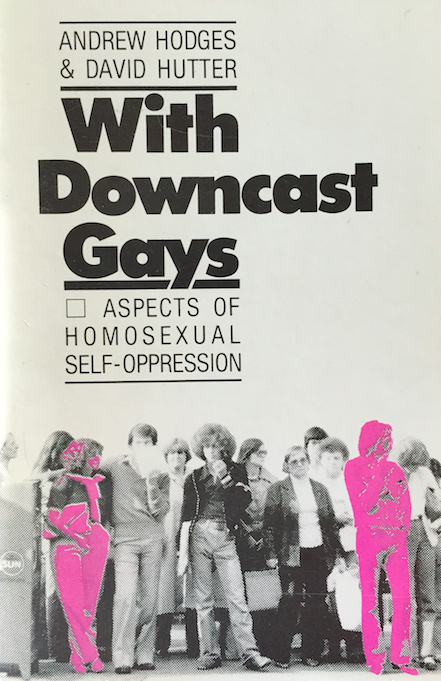
Pink Triangle Press 2nd Edition Cover, 1979

With Downcast Gays is an articulated call to action for gays everywhere: You must fight for your pride and self-respect. The authors explain that self-disclosure (coming out) is essential in overcoming self-oppression. This message found an eager audience in its readers and paved the way for the outing movement and debate over its practice in the 1980s.

The authors make an example of the famous novelist and social commentator, E. M. Forster, whose gay novel Maurice (written in 1914) was only published posthumously in 1971. They write:

The novel which could have helped us find courage and self-esteem he only allowed to be published after his death, thereby confirming belief in the secret and disgraceful nature of homosexuality.  What other minority is so sunk in shame and self-oppression as to be proud of a traitor?

At times angry, and at times thoughtful, With Downcast Gays is still worth reading. Hodges asserts: “Gay people have no country.” Although many human rights have been gained since 1974, what spaces and places belong to us today? And which places do not?

Hodges concludes:

No homosexual is an island.  When gays say that they have to be ‘discreet’, they support the idea that homosexuality – our homosexuality – is offensive; when they describe themselves as “a typical case”, they label us as ‘cases’.  Oppression is as much the creature of self-oppression as the converse.  External oppression we can only fight against; self-oppression we can tear out and destroy.

{KA}

Postscript: In 1992, Andrew Hodges wrote a book about Alan Turing, which became the basis for the 2015 Academy Award-winning film The Imitation Game.

The Pisces Bathhouse Raid @ 40

We just passed the 40th anniversary of the Pisces Bathhouse Raid in Edmonton on May 30, 1981.

Queer historian and esteemed colleague, Darrin Hagen, has plumbed this history extensively. For the anniversary, he has written a five-part series for the Edmonton City as Museum Project and produced a video titled: PISCES for Theatre Network.

Court Sketch
Court sketch. Image courtesy of Darrin Hagen.

PISCES reveals some never-before seen details of the undercover investigation, the actual raid, and the aftermath of the largest mass arrest in Edmonton’s history. These actual documents are read by young members of Edmonton’s Queer arts community. It also feature first-hand recollections from one of the only men arrested that night to ever speak on the record about the raid, Edmonton Queer icon Michael Phair.” —TheatreNetwork.ca

Screen Shot 2021-06-10 at 12.37.20 PM
Front page news that summer in the Body Politic

One of the most striking details in the sting operation was how methodical and intense it was. In February 1981, the Edmonton Police Service started sending pairs of young undercover police detectives to pose as members of the Pisces Spa. In total, there were nine officers who spent weekend nights mingling, watching, and making copious, detailed notes concerning the activities of the men who gathered there for the purpose of sex.

Darrin’s work is riveting and recounts an important flashpoint in our human rights struggle in Alberta. Looking for a Calgary connection, Darrin told us: “so far we have not discovered any Calgarians in the list of found-ins but after a year, we still don’t have all the names. Navigating the process or getting info is a whole separate story, and it’s far from over.”

Queer history fades without champions; we thank Darrin for this consequential work.

{KA} 

Social Distancing in 1985

{As part of a new series, the Calgary Gay History Project is writing about AIDS to explore how Calgarians and Canadians reacted to this earlier pandemic.}

In the early years of the AIDS pandemic, people didn’t know how it spread. The gay community was particularly fearful and reactions varied. In 1985, Brian Chittock of the AIDS Committee of Montreal reported that the friends of one person with AIDS summoned a police car when he fell sick in their house, sent him away and then discarded all his clothes and everything he touched. Social distancing made pariahs of many AIDS victims. A mobilizing fact for journalist June Callwood, who founded the first AIDS hospice in the world, Toronto’s Casey House.

By the mid-80s however, scientists had determined that casual touching was not transmitting the virus; it could only be transmitted by an exchange of bodily fluids.

Nonetheless, some gay and bisexual men were so terrified of contracting AIDS they became celibate and had physical intimacy problems ever after – call it “sexual distancing” or “sexual self-isolation” perhaps. Allan Pletcher, a Vancouver community college teacher who had tested positive, participated in a three-part panel show on CBC television that was watched by more than a million people each day. He declared: “I am chaste, and I will remain so until I am cured or I die. I assume that responsibility.”

The Body Politic, Canada’s gay newspaper founded on gay liberation principles, had an editorial approach to AIDS coverage that was skeptical of scientific and media authority. They wrote about: “the need to resist panic and hysteria both within and beyond the gay community; the need to seek information on which we can make informed judgments about sexual practices; and, most recently, the need to preserve what is best and most distinctive about gay erotic culture in the face of a disease which apparently threatens its very roots.”

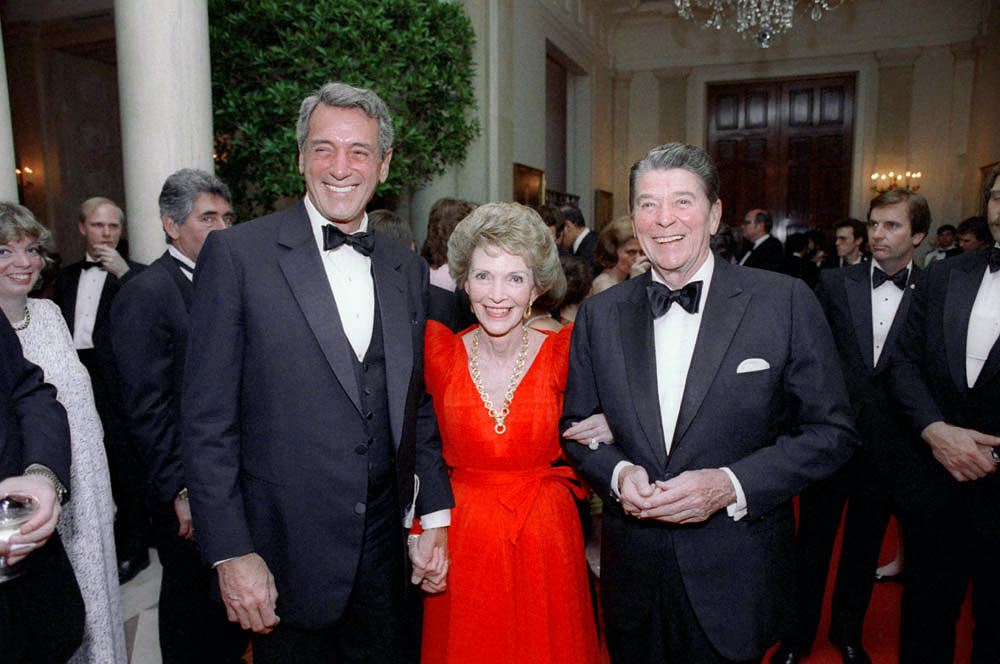
A telephone survey of 500 San Francisco gay and bisexual men in June 1985, found that eight out of 10 respondents said they had made dramatic changes in their sexual behaviour. Later that summer, celebrity actor Rock Hudson revealed he had AIDS; he was dead by October. Hudson’s plight had an immediate impact on the public profile of AIDS.

Reagans_with_Rock_Hudson

Rock Hudson with Nancy & Ronald Reagan in 1984: source, Wikipedia.

In Calgary, there was a “social coming together” of people concerned about AIDS and the deaths that were happening in the city. The first meeting for what was to become AIDS Calgary happened in September 1985.

{KA}