Tag Archives: bisexual

With Downcast Gays Anniversary

The gay liberation manifesto, With Downcast Gays: Aspects of Homosexual Self-Oppression, by Andrew Hodges and David Hutter turns 50 this month. You can read it online: here.

The slim 1974 treatise, first published in London, England, was reprinted multiple times in many countries. Pink Triangle Press, the publisher of Canada’s gay liberation newspaper, The Body Politic, produced the first North American edition in 1977, selling out its 6000 copies in less than two years. A second edition was printed in 1979.
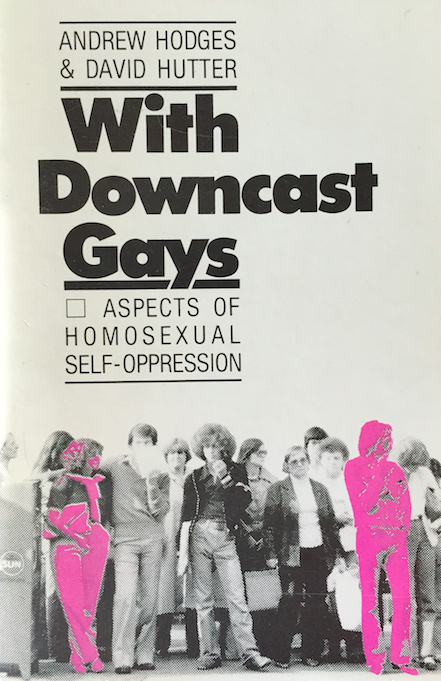
Pink Triangle Press 2nd Edition Cover, 1979

With Downcast Gays is an articulated call to action for gays everywhere: You must fight for your pride and self-respect. The authors explain that self-disclosure (coming out) is essential in overcoming self-oppression. This message found an eager audience in its readers and paved the way for the outing movement and debate over its practice in the 1980s.

The authors make an example of the famous novelist and social commentator, E. M. Forster, whose gay novel Maurice (written in 1914) was only published posthumously in 1971. They write:

The novel which could have helped us find courage and self-esteem he only allowed to be published after his death, thereby confirming belief in the secret and disgraceful nature of homosexuality.  What other minority is so sunk in shame and self-oppression as to be proud of a traitor?

At times angry, and at times thoughtful, With Downcast Gays is still worth reading. Hodges asserts: “Gay people have no country.” Although many human rights have been gained since 1974, what spaces and places belong to us today? And which places do not?

Hodges concludes:

No homosexual is an island.  When gays say that they have to be ‘discreet’, they support the idea that homosexuality – our homosexuality – is offensive; when they describe themselves as “a typical case”, they label us as ‘cases’.  Oppression is as much the creature of self-oppression as the converse.  External oppression we can only fight against; self-oppression we can tear out and destroy.

{KA}

Postscript: In 1992, Andrew Hodges wrote a book about Alan Turing, which became the basis for the 2015 Academy Award-winning film The Imitation Game.

Carousel Capers

In keeping with Club Carousel’s birthday theme this month, let’s focus on the Society’s handcrafted monthly newsletter, Carousel Capers.

Carousel Capers, the latest release (50 years ago)!

This publication, which ran from 1969 to at least 1975, was a hand-typed and drawn affair. In its heyday, it grew to 24+ pages with columns such as Chatter Box, Gertrude’s Gossip, and Cecil’s Secrets. Club business, including attendance figures, budgets, and meeting minutes, was presented—keeping the Club leaders accountable to their membership.

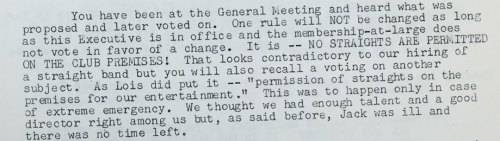
Members of Club Carousel had significant fears of being outed; they did not want to run into anyone they might know in the straight world. Ensuring the Club remained a safe space was a common refrain in the pages of Carousel Capers, the Club’s monthly newsletter. In April 1973, Ruth Simkin wrote a strongly worded letter to the Club’s Executive Committee:

It is with great regret that I can no longer continue with my membership and support of Club Carousel. The reason for this is the Executive’s decision of hiring a straight band for the Anniversary Party.  I feel this is merely a first step in the total demolition of an all-gay club…..

I personally feel that a consolidated gay community is more important than a well-played guitar, at the only place in Calgary we have.  When policy changes back (if it ever does), I would be honoured to once more be associated with what could be the best gay club around.

{Ruth would go on to be one of the founders of the important Calgary Lesbian and Gay Political Action Guild (CLAGPAG).}

The Executive responded in the pages of Carousel Capers that the band had been a last-minute substitution when their previously booked gay talent had had to cancel, and emphatically confirmed their commitment to the no straights policy.

screen-shot-2016-11-17-at-10-56-09-am
April 1973 Editorial in Carousel Capers

Later that year, the Executive firmly noted that the newsletter itself should carefully be restricted from Straights.

screen-shot-2016-11-16-at-4-41-55-pm
June 1973 Notice in Carousel Capers

“Out of the closets and into the streets is a great battle cry for gays who don’t have too much to lose but then – there are the rest of us,” referencing the generational divide as young gay liberationists were agitating publicly for social change (particularly at the University of Calgary).

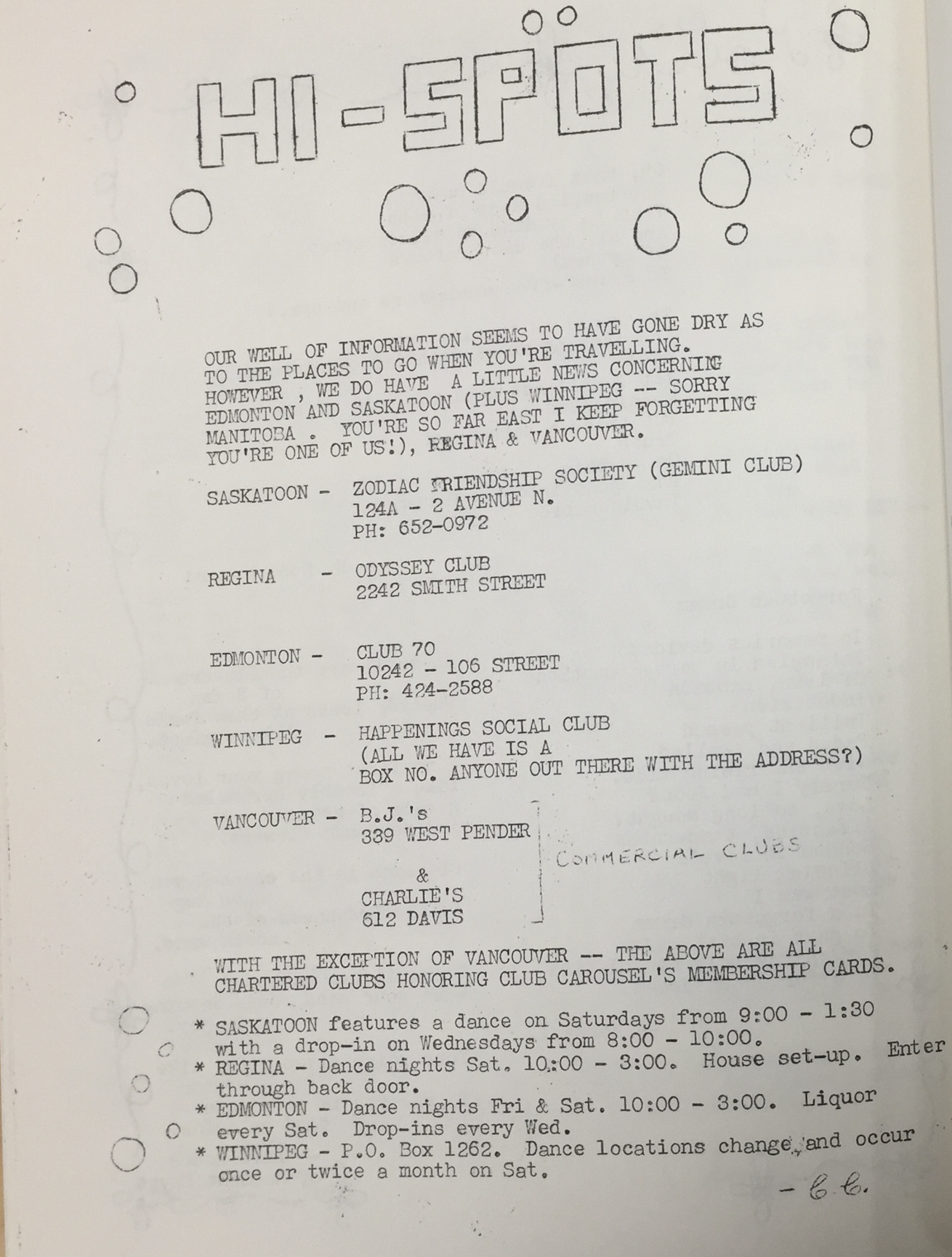
Carousel Capers was also a vehicle for connecting Western Canada’s emerging organized gay community. Articles were written about sister clubs, and the community listings in the magazine are an illuminating time capsule of their era.

September 1973 listings in Carousel Capers

We often say that Club Carousel was the dawn of the organized gay community in Calgary, and one of its primary communication vehicles was Carousel Capers.

{KA}

Club Carousel’s Birthdate Found

On the heels of the City of Calgary’s historic designation of Club Carousel, we discovered a remarkable NYC article written about the Club, six months after it opened.

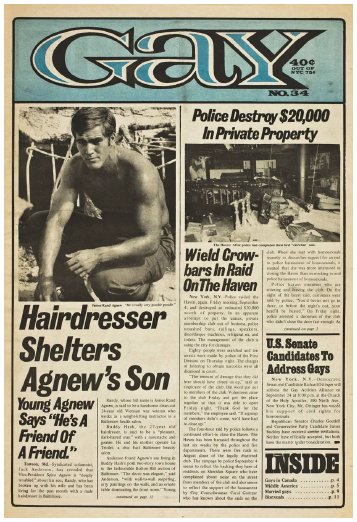
It was titled Liberation Canadian Style and published in GAY, New York City’s third post-Stonewall gay newspaper. Started in December 1969 by Jack Nichols and Lige Clarke, GAY’s varied content featured articles written by some of the era’s most significant LGBT rights activists. In September 1970, author John Scarth reported on his trip to Calgary and his experience at the fledgling Club Carousel.

Sept. 28, 1970 issue of GAY. Source: https://www.houstonlgbthistory.org/

Scarth summarized the history of Club Carousel and described its opening night as Friday, March 20, 1970. Previously, we had only determined that it opened in March 1970, but not the specific date.

Another intriguing fact—new to us—was that renowned American Gay Activist Frank Kameny came to Calgary in 1968 to speak at the University. “If there’s a gay bar in this town, it’s gotta be at the bottom of that,” Kameny quipped about the Calgary Tower.

Scarth’s article about 1970’s Calgary is a time capsule for gay liberation. We include the entire piece here.

Finding new sources is a delight for historians. Enjoy—and Happy Birthday Club Carousel!

{Thank you to historian Maya Bilbao for letting us know about this article.}

{KA}