Tag Archives: bisexual

On Hiatus & Heritage Park Connection

{We are taking a break and not staffing the history desk for the next couple of months, but look for new Calgary Gay History Project research in late May. —Kevin}

Thanks to everyone who came out for the presentation Our Past Matters – A History of Calgary’s 2SLGBTQ+ Community at Heritage Park last week. Our goal was to find a queer history connection to Heritage Park, and we did!

Kevin Allen presenting at Heritage Park. Photo: Patrick J. Monaghan

The “Sandstone House” on the grounds of Heritage Park is a replica of a house built in 1891 for James Bruce Smith (1849–1906), a lawyer from Lindsay, Ontario, who was a founder of the Calgary Bar Association in 1890 and who became the city solicitor in 1899. In 1901, he was charged with gross indecency due to his affair with Walter Joesph McHugh. History professor, Jarett Henderson, explores this story in detail: here.

The Sandstone House from Heritage Park’s Website

The house was located at 1011–4 Avenue West (later changed to SW), where the Avatamsaka Monastery exists today (and if you have a long memory, you might recall Calgary’s original Mountain Equipment Coop store).

Heritage Park published a biography of the storied house for Alberta History Magazine’s Winter 2023 issue explaining the house was famous for being rented to Colonel James Macleod (who named Calgary and facilitated Treaty 7) and his family in 1894. It was where he was living when he died of kidney disease. The famous Calgarian’s body lay in state inside the house for several days; it was there that his funeral procession began.

Special thanks to researcher Jason Brooks, who brought the connection to our attention.

Happy Spring, everyone!

{KA}

Winter Kept Us Warm @ 60

“Winter Kept Us Warm” comes from a line from T. S. Elliot’s poem The Wasteland, but it is also the title of a groundbreaking Canadian Film. 2025 is the 60th anniversary of the release of Winter Kept Us Warm by University of Toronto student David Secter. Cited as the first gay English-Canadian film, it received international acclaim, premiering in Cardiff, Wales, at the Commonwealth Film Festival in September 1965 (a first for a student-produced feature film). In 1966, the film was Canada’s first English language feature to be invited to the Cannes Film Festival.

Last year, a new 4K restoration of Winter Kept Us Warm was created, through Telefilm’s Reignited program, which funds the digital restoration of seminal Canadian films in collaboration with Canadian International Pictures, the avant-garde Blu-ray label resurrecting “vital, distinctive and overlooked triumphs of Canadian cinema.” Currently, the restored film is playing again in arthouse cinemas internationally. In addition, McGill University Press’s Queer Film Classics series recently launched a book by Chris Dupuis exploring the history of Secter’s movie and its cultural impact.

A still from the 1965 film Winter Kept Us Warm

Winter Kept Us Warm was inspired by Orson Welles’ Citizen Kane, which was made when the director was 24. Consequently, Secter ignored his fourth year of studies to focus on his own masterpiece. At 21, he put an ad in the student newspaper, The Varsity, asking, “Will the Great Canadian Film be produced at U of T?” and invited all interested students to join him in the venture.

With seed money from the Students’ Council of $750, he was able to shoot 12 minutes of the movie. After sorting through the footage, and with some impressed letters of support from more senior filmmakers, Secter hoped for financial support from the National Film Board (NFB), the Canada Council or the Ontario Arts Council.  However, they all gave it a pass. In the end, he was able to find the rest of the $8,000 budget himself through friends and his own personal donations.

(Ironically, it would be the NFB in May 1966, which would sponsor his showcase at  Cannes.)

The film’s gay subtext was deliberately staged by Secter, who wrote the film based on his own experience of falling in love with a male fellow student. He wrote that the film’s theme “is that friendship, like snow, is brilliant but ephemeral.” He had his volunteer crew on 24-hour notice for 5 weeks to capture the winter quadrangle romp scene he envisioned, waiting for the perfect weather conditions.

At a time when homosexuality was still criminalized in Canada, Winter Kept Us Warm proved to be pioneering; film critics in both the Toronto Star and Globe and Mail noted the film’s homosexual content.  Filmmaker David Cronenberg cites Winter Kept Us Warm as the most influential film in his life as well as to his discovery of cinema.

The film premiered in Canada at the Royal Ontario Museum in December 1965. It turned out to be a commercial success, playing in limited release across the country and on many University campuses. Secter was able to pay off his debts and attract $50,000 in seed money for his next film.

{KA}

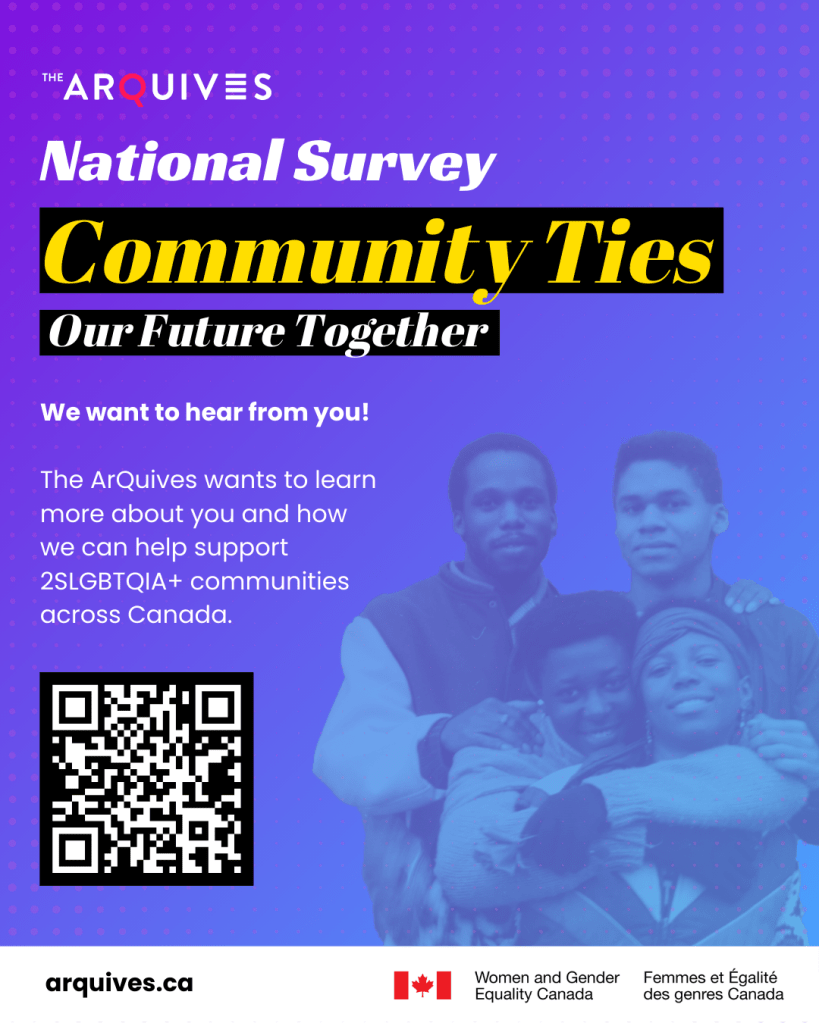
Join the Conversation: Community Ties with The ArQuives

{The Calgary Gay History Project is pleased to promote the ArQuives’ Community Ties: Our Future Together conversation in Calgary on Thursday, March 6th!}

The ArQuives: Canada’s LGBTQ2+ Archives is gearing up for an exciting new chapter and we want you to be part of it! We are starting a national conversation about how The ArQuives can best serve communities across Canada over the next 50 years. In February and March, we are hosting intimate, in-person gatherings in 12 cities: Calgary, Edmonton, Fredericton, Halifax, Montreal, Ottawa, Saskatoon, St. John’s, Vancouver, Whitehorse, Winnipeg, and Yellowknife. Bilingual facilitators will conduct sessions in Ottawa, Montreal, and Fredericton to serve Francophone participants in those cities. If you prefer a one-on-one conversation in French, please let us know and we will arrange that with you directly.

In each city, we’re gathering 15 LGBTQ2+ community members to share challenges, hopes and dreams related to how we Keep Our Stories Alive. There will be a short presentation and friendly facilitation by The ArQuives, and there will be an opportunity to participate in collaborating to make a zine that captures what makes your community great! Snacks and drinks will be provided.

While we’re in your city, we especially want to reach out to and meet:

  1. LGBTQ2+ community members who already are or might be interested in our programming;
  2. researchers, academics, and media who already or might use The ArQuives’ collections in their work; and
  3. partner organizations, including libraries, archives, museums, arts and heritage organizations, cultural institutions, and other LGBTQ2+ organizations.

We have developed an RSVP form for potential participants with a brief questionnaire designed to help us prepare for each session. Please share this link with others in your community, especially those from historically marginalized communities.

The ArQuives values diversity and is committed to addressing historical inequities within our organization. We would love to hear from LGBTQ2+ communities that have been systematically marginalized, including those who are Indigenous, women, trans, nonbinary, gender non-conforming, Black, people of colour, newcomers, and persons with disabilities. We’re hoping to have a wide range of conversations, including young adults and older members of our communities.

There is limited space, and honoraria are available for community members for whom attending is not part of their professional duties. If you cannot attend in person, there will be other ways to participate, including a national survey.

Thanks for your assistance and collaboration! Your insights will be crucial in building a stronger, more connected future for The ArQuives and the communities we serve.

If you have any questions or want to chat more about the project, please reach out to Nico Mara-McKay at projectcoordinator@arquives.ca.

{KA}