Tag Archives: art

From the Calgary Winter Club to Olympic Ice

{This is part one in our Winter Olympic Series, written by William Bridel. Enjoy!}

Brian James Pockar was born in Calgary on October 27, 1959. He began skating as a young boy at the Calgary Winter Club. According to Skate Guard, a figure skating history blog, in his early days on Winter Club ice, a coach, Winnie Silverthorne, approached Pockar’s parents after noticing his “daredevil-ness” and natural athleticism. While initially interested in ice hockey, Pockar chose to focus on figure skating and quickly rose through the competitive ranks within Canada.

At the age of 12, Pockar competed at his first national championships. Four years later, he won bronze at the 1976 World Junior Figure Skating Championships, and two years after that, became the national men’s champion of Canada for the first time. At the completion of his amateur competitive career, Pockar was a three-time national champion. He had also won several international medals, most notably the bronze at the 1982 World Figure Skating Championships. Pockar’s third-place finish in 1982 launched a 14-year medal-winning streak by Canadians in the men’s event at the global competition.

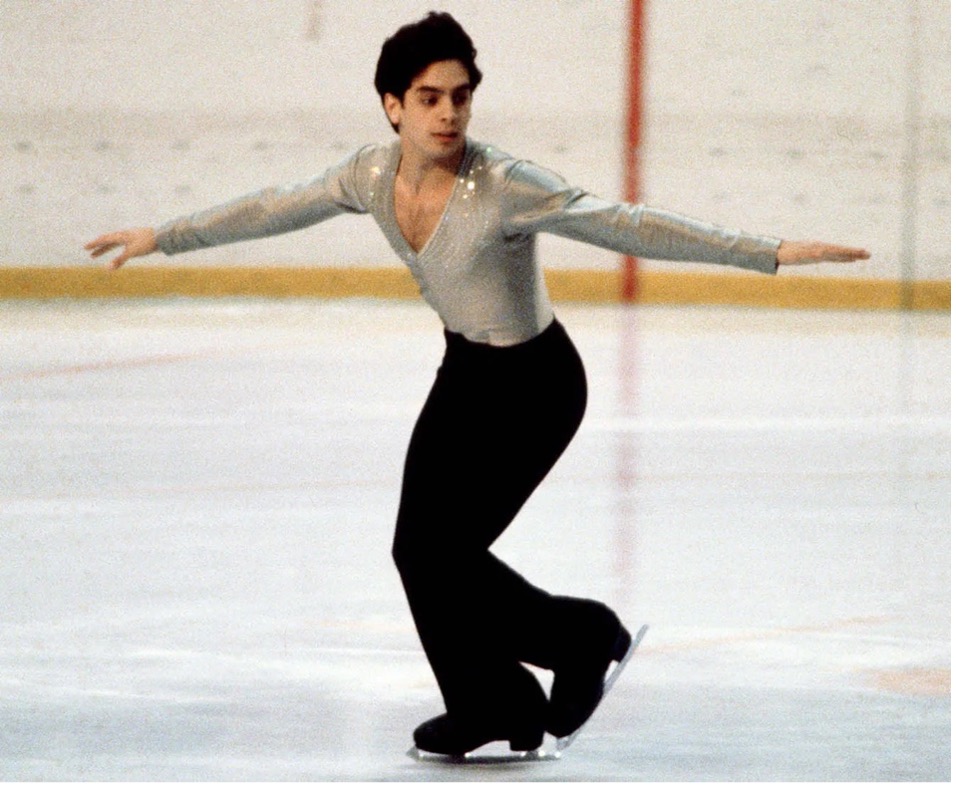
Pockar competing at the 1980 Olympic Winter Games. Photo retrieved from the Canadian Olympic Committee’s website.

Pockar was the lone Canadian entry in the men’s event at the 1980 Olympic Winter Games in Lake Placid, New York, a place he earned having won his third national title earlier that year. He finished 12th in all portions of the Olympic competition, an event won by the incomparable Robin Cousins of Great Britain. Pockar remains the last male from Calgary to compete in the Olympic Winter Games in figure skating. Pockar was also involved in the 1988 Calgary Olympics, credited as the artistic director of figure skating performances in the Closing Ceremonies.

As a young boy in the sport at the time of Pockar’s greatest successes, Brian was my idol. I marvelled at his technical abilities, but even more so, I loved his musicality, his style, his flair. I was nine when he finished third at the 1982 World Championships. I could execute his entire medal-winning performance in the basement of my family home in my sock-feet. The many triples he completed in his program? Well, those were only imagined in my rendition…but I knew the order of elements by memory and believed I “was” Brian Pockar in those moments. I also most certainly had a crush on him. He was a beautiful man. As Ryan Stevens of Skate Guard described him, he was “like the romantic lead in a silent movie.”

Frequently described as a private person, Pockar never declared his sexuality publicly, which was not unusual in the 1970s and ‘80s in sport generally, and in figure skating specifically. Only Great Britain’s John Curry, the 1976 Olympic champion in the men’s event, had discussed his sexuality in mainstream media at the time. According to sociologist and historian Dr. Mary Louise Adams, the first time Pockar’s sexuality was likely specifically mentioned publicly was in a media story published in 1998 about Brian Orser, another great Canadian figure skater. Orser was quoted as saying he was concerned about his own sexuality impacting professional opportunities in and outside of skating and used Pockar as an example. According to Orser, Pockar was fired from his broadcasting position with CTV—a role he held for several years after he retired from amateur competition—when network executives learned he was gay.

Pockar died of AIDS-related illness in Calgary on April 28, 1992. He was 32 years old. According to a statement issued by a family friend at the time of his passing, “Brian wanted to be remembered for his accomplishments in life and not for the cause of his death” (Maki & Toneguzzi, 1992, p. D1). Honouring that statement here, in addition to his many achievements in the sport noted above, Pockar is also credited with landing the first-ever one-foot triple Salchow/double flip combination in international competition—which is wildly difficult! He was inducted into the Alberta Sport Hall of Fame in 1989 and posthumously into the Skate Canada Hall of Fame in 2012. Per one of Pockar’s final wishes, a bursary was established in his name to help support young male figure skaters in the province—a bursary still given out annually.

Brian Pockar: Olympian. World medalist. Choreographer. Broadcaster. Calgarian.

{WB}

Sources

Adams, M. L. (2011). Artistic impressions: Figure skating, masculinity, and the limits of sport. University of Toronto Press.

Skate Alberta/Northwest Territories/Nunavut. (n.d.). About: Athlete Awards. https://skateabnwtnun.ca/about/awards-2/athlete-awards-athlete-funding/

Maki, A., & Toneguzzi, M. (1992, April 30). Friends mourn death of Pockar. Calgary Herald, D1.

Stevens, R. (n.d.) Brian Pockar. Skate Guard: Figure Skating History Blog. https://www.skateguardblog.com/p/brian-pockar.html?m=0

Winter Kept Us Warm @ 60

“Winter Kept Us Warm” comes from a line from T. S. Elliot’s poem The Wasteland, but it is also the title of a groundbreaking Canadian Film. 2025 is the 60th anniversary of the release of Winter Kept Us Warm by University of Toronto student David Secter. Cited as the first gay English-Canadian film, it received international acclaim, premiering in Cardiff, Wales, at the Commonwealth Film Festival in September 1965 (a first for a student-produced feature film). In 1966, the film was Canada’s first English language feature to be invited to the Cannes Film Festival.

Last year, a new 4K restoration of Winter Kept Us Warm was created, through Telefilm’s Reignited program, which funds the digital restoration of seminal Canadian films in collaboration with Canadian International Pictures, the avant-garde Blu-ray label resurrecting “vital, distinctive and overlooked triumphs of Canadian cinema.” Currently, the restored film is playing again in arthouse cinemas internationally. In addition, McGill University Press’s Queer Film Classics series recently launched a book by Chris Dupuis exploring the history of Secter’s movie and its cultural impact.

A still from the 1965 film Winter Kept Us Warm

Winter Kept Us Warm was inspired by Orson Welles’ Citizen Kane, which was made when the director was 24. Consequently, Secter ignored his fourth year of studies to focus on his own masterpiece. At 21, he put an ad in the student newspaper, The Varsity, asking, “Will the Great Canadian Film be produced at U of T?” and invited all interested students to join him in the venture.

With seed money from the Students’ Council of $750, he was able to shoot 12 minutes of the movie. After sorting through the footage, and with some impressed letters of support from more senior filmmakers, Secter hoped for financial support from the National Film Board (NFB), the Canada Council or the Ontario Arts Council.  However, they all gave it a pass. In the end, he was able to find the rest of the $8,000 budget himself through friends and his own personal donations.

(Ironically, it would be the NFB in May 1966, which would sponsor his showcase at  Cannes.)

The film’s gay subtext was deliberately staged by Secter, who wrote the film based on his own experience of falling in love with a male fellow student. He wrote that the film’s theme “is that friendship, like snow, is brilliant but ephemeral.” He had his volunteer crew on 24-hour notice for 5 weeks to capture the winter quadrangle romp scene he envisioned, waiting for the perfect weather conditions.

At a time when homosexuality was still criminalized in Canada, Winter Kept Us Warm proved to be pioneering; film critics in both the Toronto Star and Globe and Mail noted the film’s homosexual content.  Filmmaker David Cronenberg cites Winter Kept Us Warm as the most influential film in his life as well as to his discovery of cinema.

The film premiered in Canada at the Royal Ontario Museum in December 1965. It turned out to be a commercial success, playing in limited release across the country and on many University campuses. Secter was able to pay off his debts and attract $50,000 in seed money for his next film.

{KA}

Rainbow Elders Portrait Collection

{This week, we have a guest post from Calgary photographer Wilmer Aburto. In autumn 2023, Wilmer collaborated with the Rainbow Elders to capture portraits of members from our city’s 2SLGBTQIA+ communities. The portraits are dramatic and impactful, and we invited Wilmer to share his story. Enjoy – K.}

INSPIRATION

To honour 2SLGBTQIA+ elders and celebrate their remarkable resilience. The ‘Rainbow Elders Photographic Portrait Collection’ pays respect to Rainbow Elders Calgary, whose members identify as part of the Two-Spirit, Lesbian, Gay, Bisexual, Transgender, Queer/Questioning, Intersex, and Asexual communities. Each has contributed significantly to building a richer community in Calgary.

The photo shoots took place at the historic Lois Szabo Commons, named after a pillar of Calgary’s queer community who opened the city’s first queer-run social space and has been active in Rainbow Elders Calgary for years. Some portraits were also captured at the Calgary Board of Education Building.

Wilmer invited makeup artists Josee ‘La Güita’ Palacio and Subliminal Rabbit to create unique looks for each of the seven participants. The artists incorporated each person’s favourite colours and themes into their overall appearance. Once makeup and wardrobe were finalized, each participant was photographed.

Rainbow Elders and the Creative Team, October 2023

Wilmer was inspired by Vincent Cianni’s groundbreaking work documenting the experiences of 2SLGBTQ+ individuals in the US military. Cianni, who has been a long-distance mentor to Wilmer in previous collections, paved the way for capturing the stories of marginalized communities. His influential book, “Gays In The Military: Photographs And Interviews,” motivated Wilmer to shed light on the lives of 2SLGBTQ+ elders in Calgary, continuing the tradition of using photography to reveal hidden narratives and contribute to the broader historical record of 2SLGBTQ+ experiences.

Building on this foundation, Wilmer hopes to bring to Calgary more stories of seniors who are members of the 2SLGBTQ+ community, further expanding the scope of these important narratives and deepening our understanding of their unique experiences.

EXHIBITION

For Wilmer, it was paramount that these powerful portraits be reproduced on an imposing scale, allowing viewers to fully immerse themselves in the subjects’ experiences and emotions.

The collection made its inaugural appearance at The Grand during Calgary Pride’s Alphabet Mafia event in August 2024. The photographs were displayed in a striking 4 feet by 5.5 feet format, towering over attendees and commanding attention.

The monumental size of these prints not only honoured the subjects, many of whom were present at the event, but also symbolized the larger-than-life impact these individuals have had on their communities, as hundreds of guests gathered to pay tribute to their legacy and contributions.

ABOUT THE ARTIST

Wilmer Aburto Self Portrait

Wilmer Aburto is a Mohkinstsis (Calgary) based photographer born in Nicaragua. He is passionate about using art for social advocacy. Recently, Wilmer travelled to Nicaragua to facilitate art projects supporting youth in impoverished areas. He also gave artist talks and workshops for education providers, collaborating with organizations initiating, supporting, and promoting cultural projects in Nicaragua and Central America.

Wilmer has exhibited his photography at the Museum of Contemporary Art in Chicago. His work was featured on the cover of Freq magazine and selected for the Italian publication Imago Mundi, which was exhibited alongside the Venice Biennale. He has received several awards for Leadership, Inclusivity, Community Partnership, and Arts Culture.

You can find Wilmer on Instagram: @wilmerphotography

“I hope these portraits remind us to centre the voices of Calgary’s 2SLGBTQIA+ elders, so that we can learn from their experience and knowledge.”

{WA}