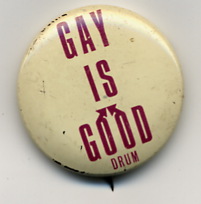
Gay is Good

Gay_is_GoodThe rallying cry of gay liberation throughout the 1970s, was in fact coined in 1968 by pre-Stonewall American gay rights activist Frank Kameny. Frequently found on placards and buttons, the slogan also made its way into famous liberation manifestos. Lesbian activist, Martha Shelley’s 1972 booklet, “Gay is Good” was, and still is, radical and explosive:

Look out, straights. Here comes the Gay Liberation Front, springing up like warts all over the bland face of Amerika, causing shudders of indigestion in the delicately balanced bowels of the movement.”

Gay is Good was heard in Canada also.  The country’s first large scale political demonstration on Parliament Hill was on August 28, 1971. Despite the rain, over 100 activists marched and picketed.  Toronto Gay Action’s Charlie Hill proclaimed Gay is Good during his historic speech in support of the “We Demand” brief submitted to the federal government a week prior.
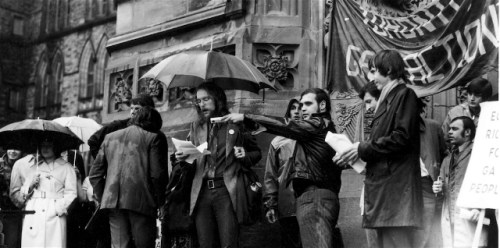
We demand image

Charlie Hill delivering demands in 1971.  Click photo to see CBC footage of demonstration.  Photo credit: Canadian Lesbian and Gay Archives.


Gay liberation made its way to Calgary in 1972 with the short-lived formation of a local chapter of the Gay Liberation Front.  Calgary liberation activists mobilized around a more permanent organization in June 1976: the Gay Information Resource Centre (GIRC).  In 1980 GIRC organized the first gay rights political demonstration in Alberta, with our very own “placard-waving homosexuals” on the steps of Calgary City Hall.

Gay is good.

{KA}

Homos on the Range

{Calgary Gay History Project’s Tereasa Maillie is working on a memorable history event – one night only – Friday, December 4th at Loft 112 – read the press release below and we hope you can join us – Kevin}

Supposedly, lightning never strikes twice in the same spot. But after 21 years apart, Calgary actors Barry Thorson and Steve Gin are challenging that notion.

In 1994, Thorson and Gin self-produced Harry Rintoul’s searing AIDS drama Brave Hearts, set atypically in the back yard of a party in Saskatoon. Equally uncharacteristic for the time were the play’s blue collar characters: a bitter, closeted seismologist and an openly gay ranch hand.

“At the time, AIDS was still a white-collar crime,” reflects Gin, who played the wise-cracking, Glen

Campbell-loving ranch hand GW. “Most of the AIDS dramas at that time were about well-to-do White gay men who lived in New York, San Francisco or Fire Island. AIDS – let along gay men – were still an invisible presence on the prairies.”

“These (characters) are people that an Alberta or a prairie audience identify with readily and understand,” adds Thorson. “They’re so down-to-earth, which I think is very appealing.”

On the evening of December 4 as part of events honoring World AIDS Day, Brave Hearts receives a staged reading at Calgary’s Loft 112 in Calgary’s East Village, with Thorson and Gin back in the saddle as GW and Rafe. A panel discussion follows, with representatives from the Calgary Gay History Project, HIV Community Link and Chromatic Theatre participating.

Brave Hearts first opened at Toronto’s Buddies in Bad Times Theatre in 1991 at a time when a diagnosis of AIDS was still considered a death sentence for many. Three years later, the prognosis wasn’t much better when the play premiered in Calgary at The Pumphouse Theatres. The actors rehearsed at the AIDS Calgary offices, and resource personnel from the organization facilitated talkbacks after each performance. Critical response to the production was positive, with the Calgary Herald proclaiming it “an act of courage.”

teatro berdache

“AIDS claimed a lot of the people we got to know through that show,” remembers Gin. “But others we came to know, especially the ones who were just recently diagnosed, are still here. They’re fine. And that’s so encouraging.”

So why revisit the show two decades later?

First and foremost, it’s a great script, garnering a Dora Mavor Moore Award nomination in its Toronto production. And for both actors in the Calgary production, there’s a feeling that people need to be reminded of the impact of AIDS in the community, especially the younger generation of gay youth who never witnessed its devastation first-hand.

Gin went on to helm Teatro Berdache, which ran professional productions in Calgary, Vancouver, Toronto and Montreal from 2000 to 2008. This year, it re-emerged as an interdisciplinary arts facilitator, running the successful Warhol-inspired Factory 112 series at Loft 112.

“We’re definitely older and greyer than we were in 1994,” laughs Gin. “And there’s no damn way we could ever pull this off onstage, ‘cause the characters are 26 and 31. “

“But so much of this play is about loneliness, and the need to reconnect. And I think that’s gonna resonate even more now, especially when the audience has a chance to talk about it with us afterward in the intimate space of the reading.”

Factory 112: Lonesome Cowboys & Brave Hearts runs for one night only at #112, 535 – 8th Avenue SE on Friday, December 4, 2015. Doors open at 7 pm with a 7:30 pm start. Admission is by donation, with all proceeds going to support HIV Community Link. Find the Facebook Event: here.

A Body Politic Revisited

Calgary Gay History Project Researcher Ayanna Smart recently left YYC to study in Ontario – we wish her all the best, and hope she returns when her studies are complete.  Here are her thoughts on her participation.  – Kevin

For six months last year, I was a volunteer with the Calgary Gay History Project. I was tasked with digitizing back copies of The Body Politic, an LGBT Canadian magazine that ran from 1971 to 1987. The Body Politic was one of the first and most influential Canadian LGBT publications, and was instrumental in helping build this community in Canada. Reading it now, in 2015, was one of the most amazing experiences I’ve had all year.

Screen Shot 2015-11-16 at 1.09.58 PM

A Seven Page Feature Article about Calgary’s Gay Community was published in September 1980.

The history of the LGBT community in Alberta and Canada is incredibly eye opening. Coming from the relative safety of the present, one can think of this period in LGBT history as one of painful battles. Seeing it though the eyes of those who were there revealed really positive and powerful attitudes and experiences. I was surprised to see how much optimism there was in the community in the 1970s, though I really shouldn’t have been. Canada’s LGBT community, post-Stonewall, was being established, growing in strength, and was very political. Because of Stonewall, this community had demonstrated evidence of their political and social power to effect change at the small and large scale. The Body Politic helped establish a supportive and politically active queer community.

In a time when people often came out ofter marrying an opposite sex parter, and coming out could easily mean losing family, the queer community was a very necessary place. The community pages and classified ads in the Body politic were full of people looking for ways to connect – to new friends, to new partners, to new social groups. Community groups were popping up everywhere, and the Body Politic made them easier to find. By helping erase isolation and build a community, the Body Politic supported the community and individuals.

The Body Politic, as is clear from the title, was also a highly political magazine. It reported on legal protections for LGBT persons, discriminatory and non-discriminatory employers, and the voting histories of political candidates. Reading through the Body Politic, I saw stories of lesbians demanding support from their unions, gay people demanding non-discriminatory media representation and queer people placing pressure on political representatives at all levels of government. The LGBT community was, at this time, very politically active.

AyannaIn a time when the presence of clubs supportive of LGBT youth in schools is a contentious issue, I am encouraged by the attitude and the work of Canada’s early LGBT communities. Community is a powerful thing, and with it we can change a nation.

{AS}