Author Archives: Kevin Allen

Video

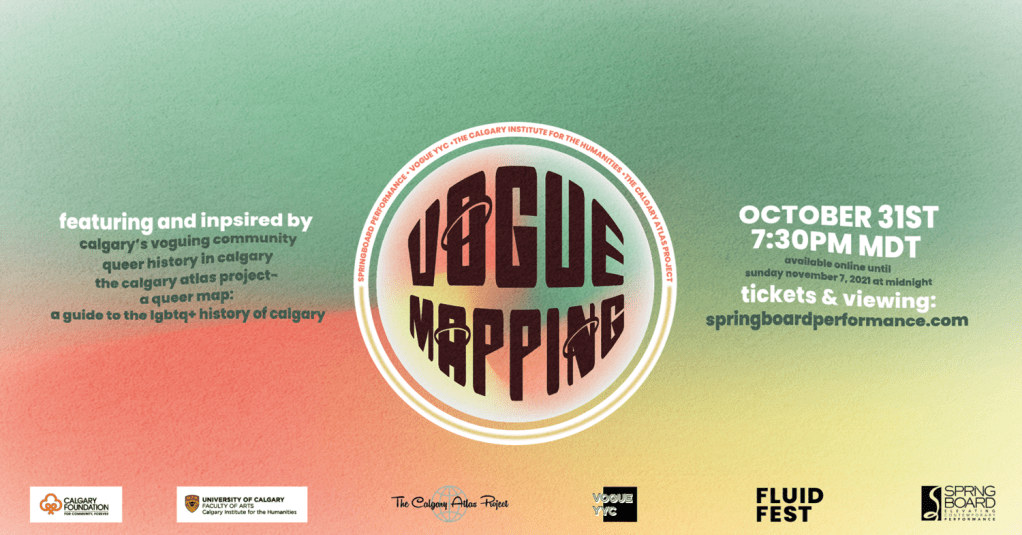
Vogue Mapping

{The Calgary Gay History Project is thrilled to bits that queer history in Calgary is getting this fresh artistic treatment—the videos are superb! You only have until this Sunday to check them out. – Kevin}

From Springboard Performance‘s Fluid Fest:

Inspired by Calgary Atlas Project’s A Queer Map, Vogue dancers bring significant queer history sites in Calgary to life. Featuring and inspired by Calgary’s Vogue community, queer history in Calgary, and The Calgary Atlas Project’s A Queer Map: A Guide to the LBGTQ+ History of Calgary {launched in 2019}.

Curated by Vogue YYC and Shandie Ta

Featuring:
Abby, Abhi, Bohlale, DJ, Jared, Kaew, Rocky, Roubert, Sarah, Shandie Ta

Partners: Springboard Performance, VogueYYC, The Calgary Institute for the Humanities, and The Calgary Atlas Project

Words: KEVIN ALLEN
Map art: MARK CLINTBERG
Design collaborator: JEFF KULAK
Graphic design: GLENN MIELKE
Interactive digital map: Timothy Lopez
Video: Devon Carter Wells, Beau Shaw, and Sabrina “Naz” Comanescu
Curation by Shandie Ta

Special thank you to Kevin Jesuino, Mark Clintberg, and James Ellison

Available online until Sunday, November 7 @ 12:00 PM [midnight]

The Golden Age of Gay Bars in YYC

{The Calgary Gay History Project is revisiting its most impactful blog posts—now numbering in the hundreds—since its inception nine years ago. The Golden Age of Gay Bars in YYC has been the source of much nostalgia since it was published on September 22, 2017. It recounts a time of oppression, community, possibility and camaraderie.}

Calgary was booming in the 70s. The city’s population increased about 50% in those 10 years. Club Carousel, the only gay club at the beginning of the decade saw its popularity wane as commercial gay bars opened in the city. The owners and operators had more capital to invest in their emerging discotheques, and the growing gay community flocked to them.

The Parkside Continental ran from 1973-1986 and was located at the corner of 13th Avenue and 4th Street SW (where Shelf Life Books is currently). The Parkside was named after a famous gay tavern in Toronto. Vance Campbell, a businessman and gay bar owner from Vancouver moved to Calgary to start the Parkside with local partners.

In the early years, there were provincial regulations about food being served with alcohol at bars. Rudy Labuhn, who was initially a DJ at the club and then manager, remembered that when the Parkside began they served 50 cent burgers to all drinkers.  He explained that the Province also limited the amount of recorded music that could be played. Fortunately, a straight bar called Lucifer challenged those rules successfully ushering in the age of disco to Calgary. Interestingly, the bar would end most nights with a song that was decidedly more downtempo: Broadway singer Maureen McGovern’s song, “The Continental.”

Vance

A grainy image of Vance Campbell in front of the Parkside Continental from the Body Politic, Sept. 1980.

The Parkside expanded upstairs creating a second bar called The Green Room. The Imperial Sovereign Court of the Chinook Arch in April 1976 was founded there; their first coronation followed in January 1977 at the Holiday Inn Downtown. Drag legend, Sandy St. Peters who grew up in Calgary and lived and performed across Canada, entertained occasionally at the Parkside. After a big Saturday night at the bar, she would run across the street to campily welcome churchgoers arriving Sunday morning for early service at the First Baptist Church. In addition to drag performances, Eartha Kitt famously did a highly regarded concert one night in the Green Room.

Screen Shot 2017-09-22 at 12.46.50 PM

Sandy St. Peters (1953-2001). Image Source: YouTube

Vance Campbell proved to be a divisive figure at times publicly opposing the local gay activist community, which revolved around Gay Information & Resources Calgary (GIRC), headquartered only one block away. He was described by the Body Politic in 1980 as one of the power brokers in the gay community “confident enough of his position to write to the mayor and counter GIRC’s claim that Calgary could face a gay rights march.”

Another reason perhaps why Campbell felt powerful was he was an owner of Calgary’s other gay bar of note: Myrt’s.  Opened in 1976, the sign on the building said Myrt’s Beauty Parlour and was located at 808 9 Ave. SW (now a parking lot). This gay lounge and disco were initially open Friday and Saturday nights for men only. As its popularity grew, it operated six nights/week and became a mixed club, reportedly played the best music in the city.

Parkside Discotheques

Advertisement in GIRC’s 1977 publication, “Gay Moods”

A hallway off the dance floor led to a 150-seat theatre known as the “Backlot” which also served as an after-hours bar. The gay community was encouraged to use it as much as possible; it was the venue for emerging theatre artists, Imperial Court drag shows, Mr Butch Calgary “Slave Auctions” and, on Sunday mornings, Metropolitan Community Church services. Myrts’ final song every night was Kermit the Frog’s “Rainbow Connection.”

Butch Bucks

Butch Bucks from a Calgary Slave Auction in 1978. Donated to the YYC Gay Archives by Terry MacKenzie.

The bar closed on New Year’s Eve 1981/1982 as the building fell victim to boomtown redevelopment. Myrt’s and the Backlot briefly moved to 17th avenue before it closed again. One former patron broke into the site and retrieved the neon “Backlot” sign. The preserved sign now hangs over the door of the contemporary Backlot bar on 10th Ave. SW.

Backlot

Neon sign at the Backlot Bar, 2017. Photo: Kevin Allen.

{KA}

Gay men are smarter than straight men – so says history.

{The Calgary Gay History Project is revisiting its most impactful blog posts—now numbering in the hundreds—since its inception nine years ago. Gay men are smarter than straight men—so says history has been, hands down, its most popular post since it was published on July 18, 2013. It also has a notable time reference to the big Calgary flood.}

The sixties were a boom-time for psychometric assessment, and in particular Intelligence Quotient (IQ) research. Perhaps one of the most famous and controversial papers of the time, was Arthur Jensen’s article, published in 1969, How Much Can We Boost IQ and Scholastic Achievement? It concluded that 80% of the variance in IQ in the population studied was the result of genetic factors due to race.

Similar lines of research were done on homosexuals. In Canada, a University of Toronto Social Work professor, John C. Spencer, published an article in the Canadian Journal of Corrections (1961). He looked at 132 sexual offenders in the Toronto Forensic Clinic. These incarcerated individuals were categorized into three groups: exhibitionists, pedophiles and homosexuals. Spencer concluded that while exhibitionists and pedophiles had essentially normal IQ’s, the average intelligence of the homosexual offender was significantly higher than average (IQ of 114 vs. the population average of 100). Reading between the lines, he may have been an early homosexual rights advocate as he mused openly about criminal law being a vehicle for moral condemnation (see article image below).

Other researchers confirmed the IQ findings. Renée Liddicoat, published A Study of Non-Institutionalized Homosexuals, also in 1961, and found that South African homosexual men and women had significantly higher verbal IQ scores than that of her heterosexual control group.

A 1949 study of 100 neurotic homosexual and 100 neurotic heterosexual soldiers similarly found evidence of higher intelligence scores and educational achievement amongst the gay soldiers (Winterstein-Lambert, E. Bulletin de la Faculté de Médicine de Instanbul). In fact, this paper’s conclusion was that the gay community did not need psychological treatment, rather job placement support in order to deal with neurotic symptoms.

However, like many IQ studies there is a potential for cultural bias in the research as well as other sources of error. Some studies showed no difference, and at least one showed reduced intelligence in homosexual men. A quirky finding in many intelligence studies was the homosexual male’s sensitivity to art and culture. Silvio Marone, in the International Journal of Sexology (1954) wrote: “homosexual behaviour is not rare among artists, and homosexuality has a great influence on art.”

Finally, speaking of great influences, the Calgary Public Library’s Magazine’s and Newspapers department was devastated by the recent flooding in Southern Alberta. Many of the articles researched for this website have come from that basement department (such as: this one). We are really saddened by this particular loss. Individuals interested in donating to the Library’s flood recovery fund can find more information: here.

{KA}