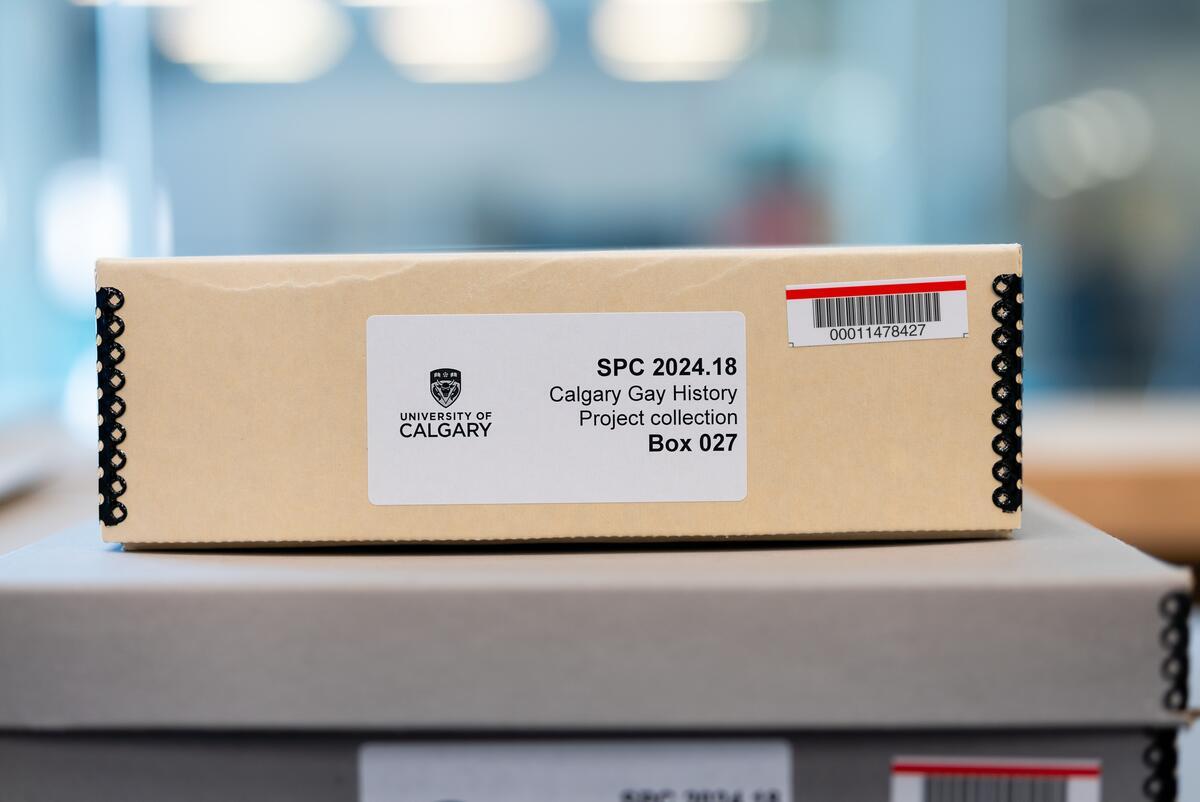
It is with delight, wonderment, and gratitude that we announce the launch of the Calgary Gay History Project Collection at the University of Calgary Archives.
Image by Andy Nichols, 2024, University of Calgary Archives Photographs, Libraries and Cultural Resources.
This now publicly accessible collection consists of published material, photographs, audiovisual material, ephemera, and other material related to the Calgary Gay History Project. This includes magazines, business directories and informational brochures, material from sporting events such as Western Cup, Outgames, and gay rodeos, show logs and audio recordings of radio shows, material from theatrical events such as Fairy Tales Film Festival and Third Street Theatre performances, as well as other 2SLGBTQ+ issues and concerns.
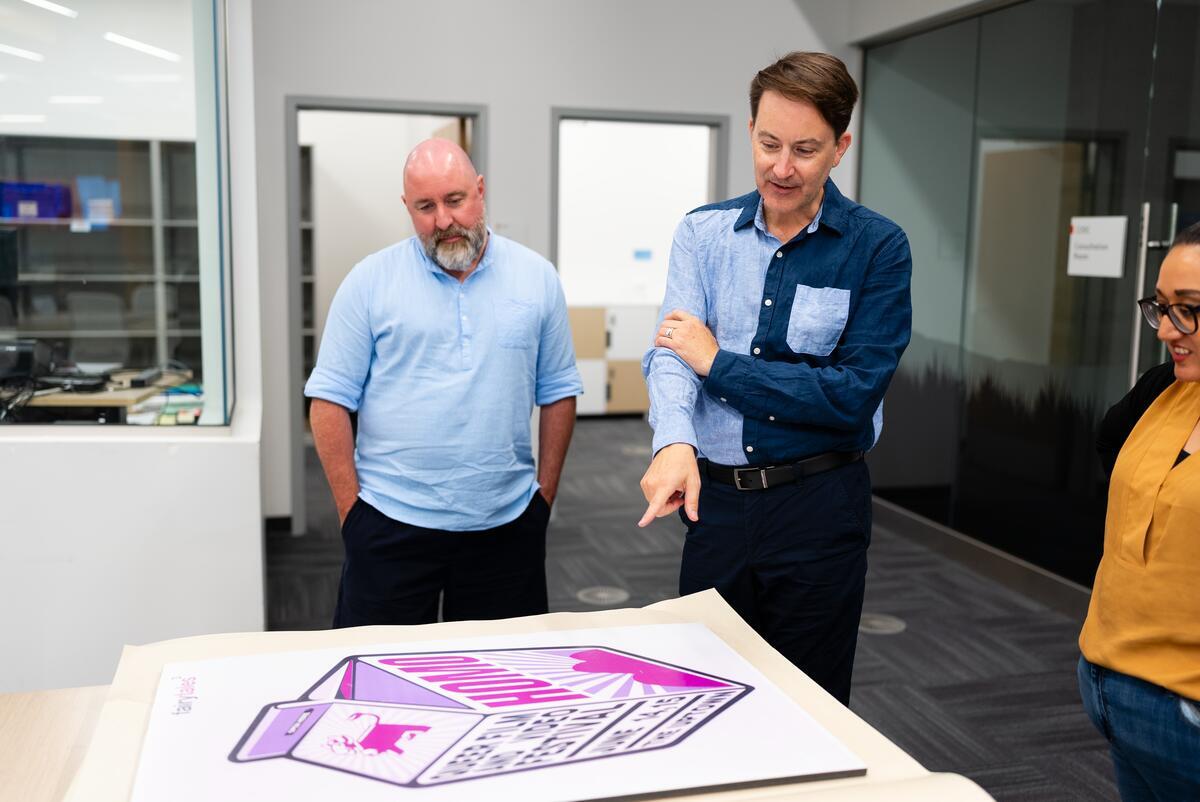
Dr. William Bridel, Archivist Kim Geraldi, and the Calgary Gay History Project’s Kevin Allen exploring the collection. Image by Andy Nichols, 2024.
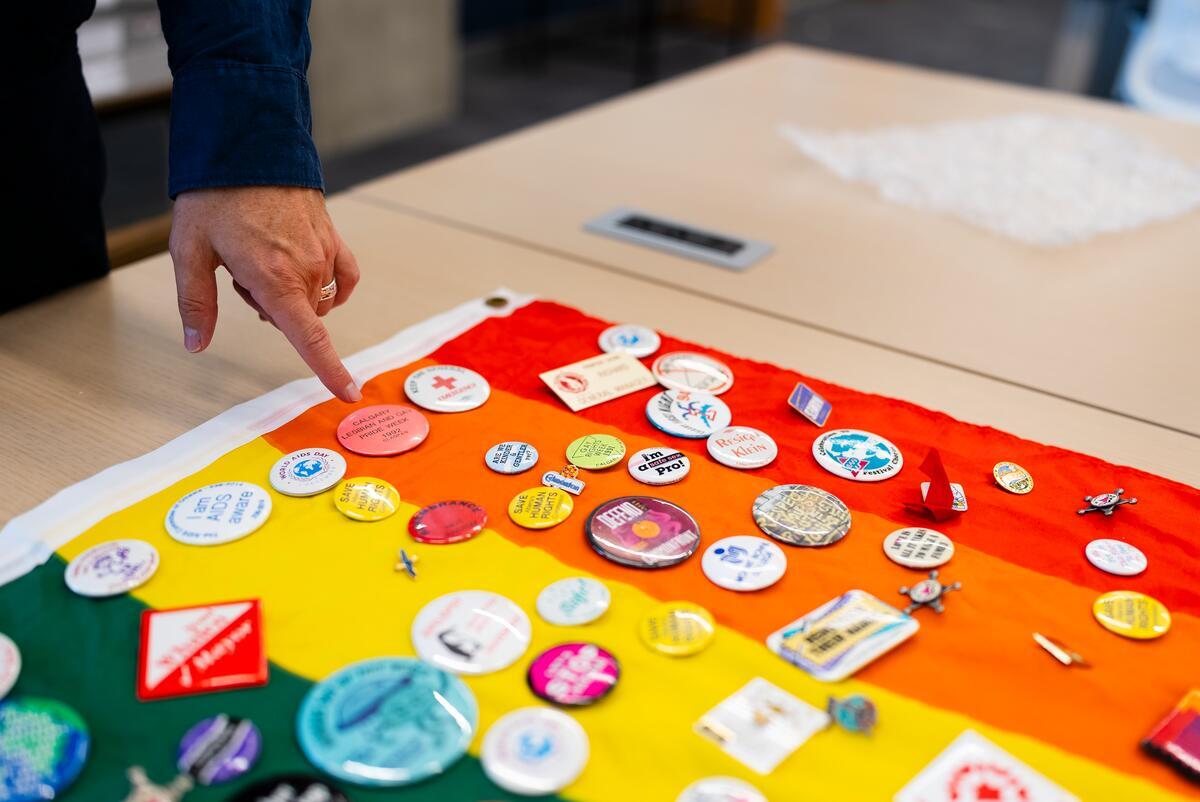
The collection has been gathered from many community organizations and donors, including: Calgary Outlink, Calgary Pride, Kevin Allen, Stevie Lee Anderson, Jonathan Brower, Kelly Ernst, Matt Gillespie, Richard Gregory, Robert Lawrence, Terry MacKenzie and Kenneth Peach, Neil McMullen, Nancy Miller, Judy Moore, Pam Rocker, Gene Rodman, Joey Sayer, Michael Wright, and several anonymous donors.
Pride Flag with historic buttons donated by Richard Gregory. Image by Andy Nichols, 2024.
We thank all the donors to the collection who entrusted us with their materials over the past decade. We are grateful to Dr. William Bridel, a professor at the U of C (and queer historian himself) who facilitated the transfer of materials from Kevin Allen’s overloaded condo to the University. Finally, we thank archivist Kim Geraldi, who handled our collection so enthusiastically and tenderly.
William, Kevin and Kim looking at early Fairy Tales Film Festival Posters. Image by Andy Nichols, 2024.
A launch party for the Calgary Gay History Project collection is tentatively being planned for October. Our Past Matters—now future generations of researchers can explore queer Calgary’s storied past!
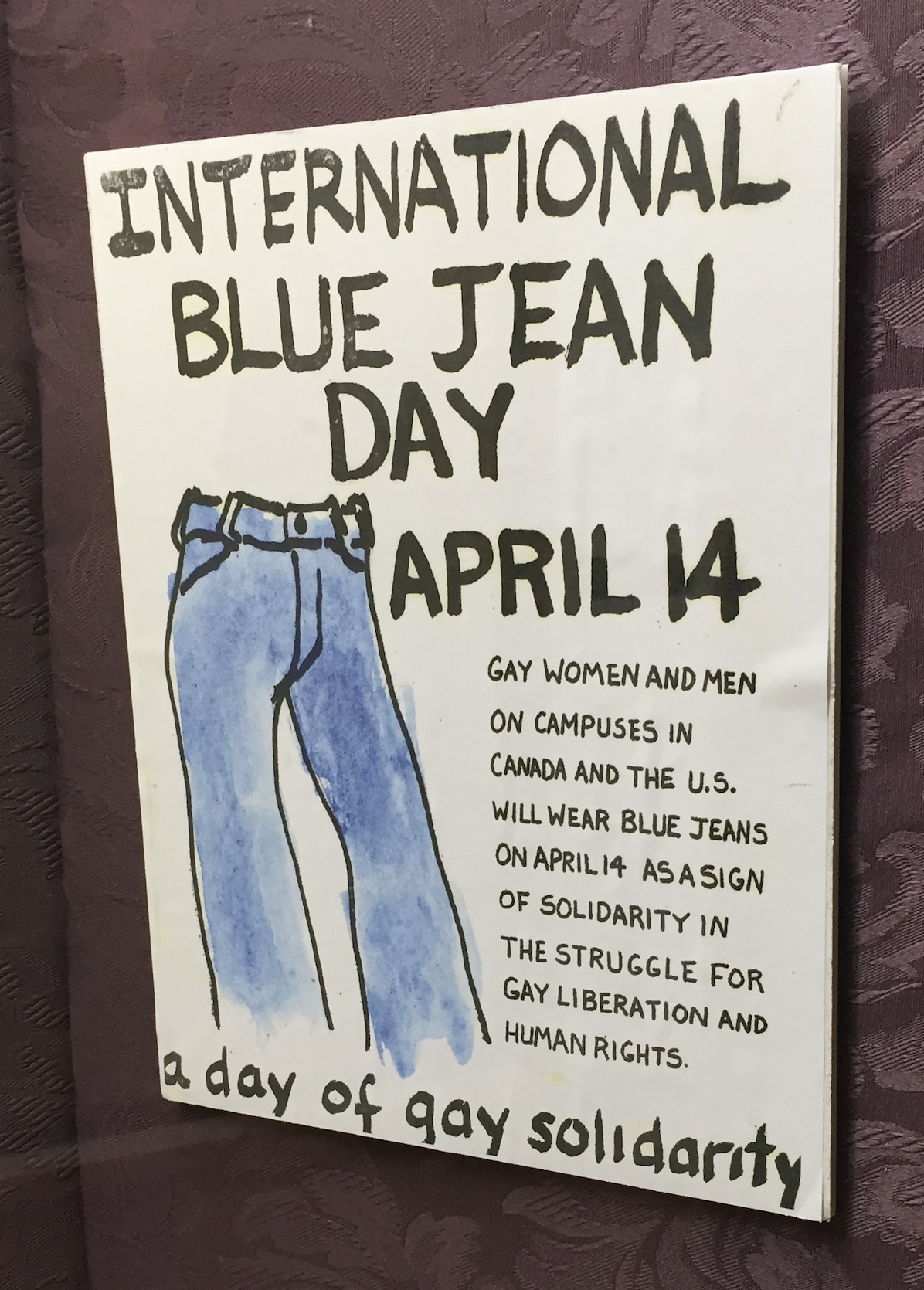
In April, wear blue jeans to support gay rights—so says history!
One of our earliest Calgary Gay History Posts was about Blue Jeans Day at the University of Calgary in the early 1990s. However, we recently discovered details about how the event echoed a gay liberation initiative first begun at Rutgers University by the groundbreaking Rutgers Student Homophile League.
The first Blue Jeans Day occurred in 1970 at Rutgers (although the first advertised event happened in 1974). Blue Jeans Day was traditionally held on a Friday in April and, by the late ’70s, had spread to dozens of campuses in Canada and the United States.
Vintage Poster, Campus Unknown
When it was resurrected at colleges in the late 1980s, the event migrated to October to align with National Coming Out Day. Although we have yet to find evidence that the U of C hosted Blue Jeans Days events in the ’70s, we found them on many other campuses.
1978 Poster from the SaskatchewanArchives
International Blue Jeans Day was often declared at the University of Saskatchewan with little advanced notice. The event forced heterosexuals to find something else to wear! This hilarious event was held by the Gay Academic Union, which existed from 1975-1982.
2023 marks the 50th anniversary of the first queer peer support organization in Calgary: the People’s Liberation Coalition (PLC).
Started in January 1973, the People’s Liberation Coalition served the Calgary gay community by offering information and counselling using a peer support model. The PLC office was located at the Old Y (CommunityWise) in room 314, and they attempted to have office hours from 7-11 p.m., seven days a week.
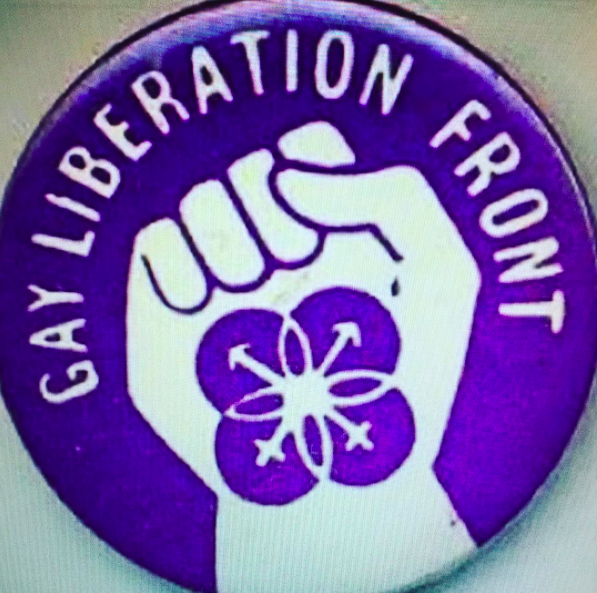
The group was an evolution of the Gay Liberation Front (GLF), which had begun meeting in September 1972, spearheaded by University of Calgary grad student Rick Sullivan.
GLF Button from the early 1970s
Lesbian activist, My (Myra) Lipton attended these early GLF meetings. She and Rick would attend Human Sexuality classes at the U of C as guest speakers. According to a student journalist, My called for women’s freedom to control their bodies and “engage in whatever sexual activities they prefer.” She also stated that the “greatest threat to the male role is solidarity among women, and lesbianism epitomized that solidarity.”
Biweekly consciousness-raising meetings of the GLF were held in the Beltline. Doug Jameson, a university student then, remembered the meetings in rundown apartments. He said, “people talked about the place we were at and trying to get petitions going to give to the government. There were about a dozen of us, and we were known to the RCMP.”
In fact, the RCMP came to Rick Sullivan’s apartment one night to question him about his activities with the GLF and The Gauntlet, attempting to intimidate him. The RCMP even requisitioned his student record from the University of Calgary, but the Registrar refused to cooperate.
Meanwhile, the GLF brainstormed the idea of a peer support organization. My Lipton cheekily wanted to call it, “Does Your Mother Know?” a phrase she often asked those who were coming out. However, to the larger group, the name People’s Liberation Coalition stuck, and they found a space at the Old Y and a roster of volunteers to offer peer support. Shortly after its inception, the PLC announced their intention to sponsor “a mixed boogie” at a local community hall.
My remembered: “the PLC was breaking new ground in Calgary. The immediate need that we had to convey to people who were coming out was that they were OK—it was society that had the problem.”
Mount Royal College student Rex Leonard saw a poster for PLC at his on-campus guidance centre. He headed to the Old Y that night and surprised PLC volunteer Joanne, who was answering the phone that night—there were not many drop-in visits! Rex’s world expanded as he was introduced to more gays and lesbians. He appreciated that the organization was centred around social activism, not just a place to find a romantic partner. Rex became a dedicated PLC volunteer.
An Australian gay activist named Brian Lindberg, who travelled through Western Canada later in 1973, described the movement in Calgary as going through a difficult period. He wrote:
“The gay information centre was staffed by only a few people (one in particular) who continued to maintain the service even though little assistance could be obtained. Considering the population size of Calgary, I was surprised not to find a well-organized gay liberation movement.”
The PLC ran out of steam as key members moved away from the city, and no replacements were found. Keeping the office open seven days a week proved challenging, and after about a year of operating, the PLC faded away.
Queer peer support was resurrected in June 1975 as Gay Information and Resources Calgary (GIRC) by My Lipton and Windi Earthworm. There has been a more or less continuous peer support service at the Old Y for 50 years. This legacy is continued by the esteemed Calgary Outlink today.





 Calgary Gay History