Tag Archives: queer

Six months hard labour for being gay in 1946

On Monday, May 13th, 1946 Calgary Police Inspector Reg Clements wrote up an occurrence report regarding the arrest and sentencing of Alfred V. Andrew who pled guilty to the “charge of gross indecency”, which meant homosexual behaviour.

Screen Shot 2017-07-11 at 3.40.10 PM

Inspector Reg Clements in 1950, when he became Calgary Chief of Police. Photo: Glenbow Archives: NA-2861-9

The report explains that on Saturday, May 11th at 8:30 PM, Constable F.C. Shipley was on patrol downtown. The officer noticed a young man loitering in front of the Alexandra Hotel and questioned him. The youth replied that he was waiting for his cousin who had gone upstairs with another man to his room. Suspecting that something was wrong, he interrogated the young man and gleaned more information, including which room the cousin had gone to. Shipley proceeded there where he found another youth in the room with Andrew who had his pants opened in front. Shipley felt that an offence had been committed and arrested him on the spot.

Screen Shot 2017-07-11 at 4.47.42 PM

Alexandra Hotel in 1930 at 226, 9th Ave. SE. Opened in 1911, demolished in 1980 to make way for Arts Commons. Source: Glenbow Archives.

Both the cousins and Andrew were brought to Police Headquarters for questioning. After the cousins had provided testimony, Andrew was charged with gross indecency. He was held in remand until the 13th when he pleaded guilty at the Police Court in front of Magistrate D. C. Sinclair. The jail sentence was for six months of hard labour.

Screen Shot 2017-07-11 at 5.00.52 PM

Calgary Police Headquarters in the 1940s at 333 – 7th Avenue SE.  Source: Glenbow Archives.

Upon Inspector Clements recommendation, the next day Constable Shipley was awarded an entry in the Calgary Police Merit Book and received three months promotion towards his next rank for his “alertness and attention to duty” in the Andrew arrest.

The police documents do not reveal the ages of the cousins nor of Andrew, but in 1946 homosexual acts were illegal at any age. The documents also refer to the cousins as boys, but in the context of the Police Court, these individuals were likely between 16-21 years of age. Other more documented cases called an 18-year-old, “a mere boy,” and an earlier Police Court Magistrate, Colonel G. E. Sanders, was plagued by juvenile delinquents as old as 21.

{KA}
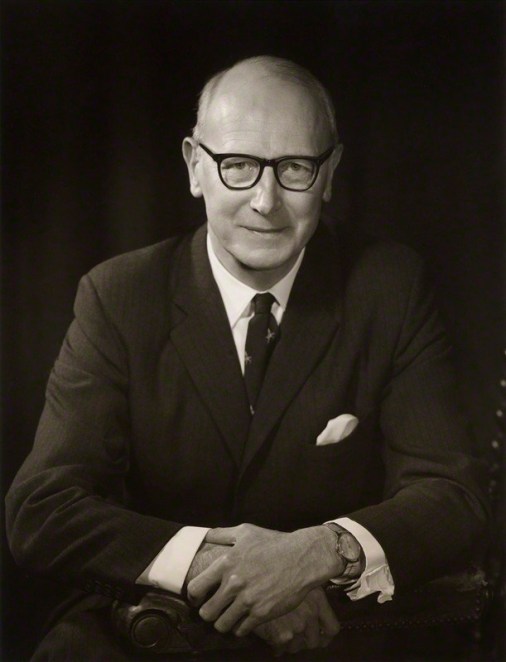
 

Sir John Wolfenden in YYC

Sir John Wolfenden came to Calgary in 1973 as part of the University of Calgary’s distinguished lecture series. His public lecture delivered at MacEwan Hall on April 4th was titled: ”Crime and Sin: The Distinctions drawn in the Wolfenden Report.”

NPG x165818; John Frederick Wolfenden, Baron Wolfenden by Godfrey Argent

John Frederick Wolfenden, Baron Wolfenden by Godfrey Argent (Creative Commons © National Portrait Gallery, London) from Notches Blog

Sir Wolfenden, Vice Chancellor of Reading University in the United Kingdom, was appointed to head an inquiry into British homosexuality in August 1954. The impetus for the public inquiry was the uproar about the Lord Montagu scandal. Edward Montagu was a British Peer found guilty of having had consensual homosexual sex and was imprisoned for 12 months along with two others, Michael Pitt Rivers and Peter Wildeblood who received 18-month sentences each. At the time they joined over 1,000 men in British prisons due to same-sex sexual activity.

Wildeblood was the only defendant to admit to his homosexuality, and in 1955 released a book about his experience suffering at the hands of the law and the British establishment. The book called, Against the Law proved very popular. He wrote a second book on the subject of homosexuality the following year, called A Way of Life, which included twelve essays positively describing a number of homosexuals he had known.

Wildeblood became a key witness into the Wolfenden Inquiry and helped inform the inquiry’s unexpected recommendation that: “homosexual behaviour between consenting adults in private should no longer be a criminal offence.” The report further stated: “homosexuality cannot legitimately be regarded as a disease, because in many cases it is the only symptom and is compatible with full mental health in other respects.”

Wolfenden’s report titled the Report of the Departmental Committee on Homosexual Offences and Prostitution was published in September 1957 and sent ripples throughout the Commonwealth. It took ten years, and a different government, to translate the report’s recommendations into law, but decriminalization of homosexual behaviour in the UK happened in July 1967.

Wolfenden Report

Archival copy of the Wolfenden Report

At his lecture in Calgary, Wolfenden told the audience “there are areas of private life that are outside the law.” He explained that his report took the stand that homosexuality was possibly immoral, but not illegal. He asked how far should a government legislate the behaviour of people and what are the boundaries of morality and legality and where do they join?

Wolfenden Distinguished Lecture Series_Apr 73 copy

Advertisement in the Gauntlet Newspaper on March 28, 1973.

At the time the report was written, he explained that 90% of all blackmail cases in the UK were related to male homosexuality. Wolfenden said that by relaxing the laws against it, the legal aspect of the blackmail had been removed.

Individual freedom was paramount for him. “The function of law is to ensure to me the freedom to do what I want to do, so long as my freedom doesn’t impinge on someone else’s freedom to do whatever he wants to do,” he concluded.

As an interesting historical footnote, Peter Wildeblood, one of the UK’s earliest gay activists, left the UK in the 80s and became a Canadian citizen. He died in Victoria, BC in 1999.

{KA}

p.s. Recently I had the chance to see an archival copy of the Wolfenden Report – it was a real thrill to see an original of the document that so influenced Canadian legal thinking!

A Woman’s Place Bookstore

Social worker Carolyn Anderson started what became a feminist community hub in Calgary in the early 80s called: A Woman’s Place Bookstore. At that time, alternative feminist and lesbian spaces, shops, and music festivals were cropping up across North America. An informal network between them was forged by women’s publications such as the still widely circulated newsletter Lesbian Connection.

After a trip to California, Carolyn discovered a lesbian bookshop that inspired her. Yet her bookstore evolved almost by accident. As a social worker, her area of expertise was in sexual abuse and its recovery, yet Carolyn found a dearth of books on the topic locally. So at professional conferences, she started buying multiple copies of the books she was interested in. She would then sell them to colleagues and clients out of the trunk of her car.

In fact, she amusingly started calling her car, “A Woman’s Place Bookstore,” but then women started requesting other reading materials and even feminist music. The car’s trunk quickly became too full. She found a business partner in Jacquie Stutt, talking one night over a curling game, and they opened a storefront in 1983.

Located in the Beltline at 1412 Centre Street, one entered a lavender door into feminist bibliophilic bliss. At any time you might be greeted by a fluffy dog, goddess jewelry, friendly staff and other shoppers when you entered: plus lots and lots of books.

Screen Shot 2017-07-05 at 5.23.48 PM

A Woman’s Place Bookstore Owner Jacquie Stutt with Buddy

Carolyn remembers: “The back room was where we had all of the lesbian stuff, all of the lesbian music, so people could go back there and, lots of times, people didn’t even know there was a back room! It looked like, maybe it was a business office or a storage room, but if you were gay you knew what it was, and we would make sure you knew what it was. People didn’t even really get what the gay stuff was if they weren’t gay.”

In the first years of the store, it was well known that Canada Customs officials would seize books with gay or lesbian content. So, Carolyn would have her shipments sent to friends in Montana and then drive down to get them – smuggling the books into Calgary.

Many customers who were too nervous to go into gay bars found a gentler entry point to the community through shopping for books and reading the community bulletin board/information centre. Any activities of interest to women were posted there; you could drop off event posters or call the store and relay event information to staff. For shoppers, the store had non-sexist children’s books, fiction, poetry, self-help tapes and books, calendars, recovery books, jewelry, t-shirts, women’s music, and – if you were still undecided – gift certificates!

By the late 90s, Jacquie had become the sole owner of the bookstore but it began to suffer from the movement of the “b-list” female prostitution stroll into the area (as defined by Calgary Police). Sometimes bookstore staff had to chase away cruising johns and customers began to stay away. The store was sold to a new owner in 2003 and moved to Marda Loop where it existed for a few more years before the business finally closed its doors.

Throughout its existence, the store was an anchor for Calgary’s lesbian community. On multiple occasions, the Calgary Gay History Project has heard from women who told us that this store saved their lives by ending their isolation.

{KA}