The Body Politic was one of Canada’s earliest and most influential LGBT newspapers. Published from 1971 to 1987, it covered national and regional news, activism and LGBT representation and helped to connect Canada’s LGBT community.
Through my involvement with the Queer History Project, I have been reviewing the Body Politic, and specifically looking for articles about Calgary and Alberta, and national events that affected the LGBT community. After reviewing most issues of The Body Politic published in the 1970s, a picture of life for LGBT people in Canada in that decade has emerged – one of endemic prejudice, but also one of hope. I am struck by the growth of a strong community and its persistent efforts toward legal protections in the face of adversity.
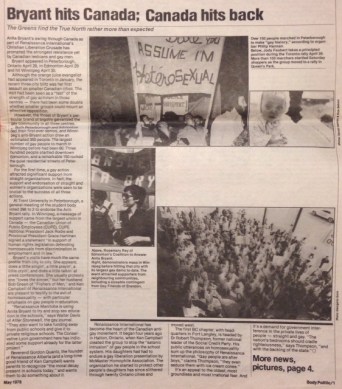
The Body Politic, May 1978
Unsurprisingly, in the 1970s, homophobia and open prejudice were widespread and far more common in Canada than they are today. The lack of legal protections for LGBT persons both reflected society’s views and permitted this marginalization. For instance, in a 1977 incident, two men spotted kissing in a car in Edmonton were arrested on charges of gross indecency. The trouble did not stop there. Instead, shortly thereafter, their employers were alerted. Needless to say, being fired because of one’s sexual orientation in the 1970s was not uncommon.
Just one year later, in 1978, the Alberta School Trustees Association successfully passed a resolution requesting that the provincial government not introduce legislation preventing local school boards from “dealing with proven incidents of homosexuality among… employees, elected officials or student enrollment.” In fact, the Alberta Individual Rights Protection Act did not include sexual orientation as a prohibited ground for discrimination until a Supreme Court case two decades later in 1998.
Although Canada in the 1970s did appear to be a hostile environment for LGBT people, during that time there was also a sense of optimism amongst LGBT people. Local groups appeared in many cities, national conferences were held, and The Body Politic communicated news, issues and stories to people across the country. Our community was far better connected than it had ever been.
The power of community work was also becoming clear during this time. For example, the LGBT community supported members by helping to fund the legal costs of persons fired because of their sexual orientation. In 1976, Calgary’s Gay Information and Resources was established with the financial support of members of the LGBT community. The organization ran a counselling and information telephone line and provided resources for community members. The Alberta Gay Rights Association (ALGRA) was formed in 1979 to “coordinate efforts in the areas of civil rights, rural outreach, public education and inter-group communication.” A stronger and more united community was being formed.
From my review of the 1970s issues of The Body Politic, it seems the LGBT community of the 1970s was a more publicly visible, more political and more connected group of people than ever before. The Body Politic was a powerful tool and provided an important service during that time, conveying the many views of the LGBT community to readers across the country.
{AS}


