Tag Archives: drag

History With a Drag Queen

The newly formed QriTical Research Hub at Mount Royal University is hosting History with a Drag Queen next Thursday, February 8th at MRU’s West Gate Social. Doors open at 6:30 PM.

This event will be a teach-in hosted by the fabulous Karla Marx! 

Karla is a drag queen, burlesque artist, and comedian, using the art of drag to shed new light on the histories of fascism and the contemporary rise of global fascist politics. 

Developed and embodied by Dr. Victoria Bucholtz (History Dep. MRU), Karla Marx is known for her comedic brilliance, riveting historical analysis, and cheeky approach to educating through entertainment.

Karla Marx is inviting you, the audience, to learn more about the ideologies and impacts of fascism, and to think critically and carefully about the role that “sexual anxiety” is playing in our current social and political landscape. Taking inspiration from Jason Stanley’s book, How Fascism Works: The Politics of Us and Them (2018), fascist leaders often position themselves as the protectors of women and children against “dangerous homosexuals.” In the context of growing and loudening anti-2SLGBTQIA+ movements in Canada – often under the guise of “protecting the children” – this teach-in will offer individuals a chance to better understand the functioning of “sexual anxiety” in right-wing movements.

Check out her Instagram here: karla.marx

When?  February 8th 

  • Doors open at 6:30 pm
  • ‘Class’ starts at 7:00 pm
  • Ends at 10:00 pm

Where?  MRU’s West Gate Social

You can find more information about this event here: www.qriticalhub.com/events 

The QriTical Research Hub is a connector and intellectual hub created by, with, and for 2SLGBTQIA+ MRU faculty, students, staff, and the broader community. Their goal is to create a space to engage with research, pedagogies, and social change mobilizations that challenge cisgender and heterosexual norms from an intersectional lens.

{KA}

Our History Matters

Calgary Gay History Project Researcher, Tereasa Maillie, has curated a history series to celebrate the 30th anniversary of Calgary Pride!

Beginning tomorrow, the first of ten online programs, launches. The series includes the history of LGTBQ+ newcomers in Canada, the HIV/AIDS pandemic in Calgary, and films on gay and lesbian life in ‘50s and ‘60s. On September 4th, the series will go out with a kick and a twirl: History is a Drag will feature performances by top drag artists taking a new spin on our stories and histories.

“We really need a celebration of culture, of gender, and of sexually diverse communities in 2020! So let’s challenge the histories we hold at the same time,” Tereasa explains. The series intentionally explores history from different angles, lenses, and identities.

The series is free and held online through Showpass. View the full calendar of Calgary Pride’s Learning Series workshops at https://www.calgarypride.ca/learning-series/

forbiddenlove

Film Poster from the NFB’s groundbreaking lesbian history doc.

Forbidden Love: The Unashamed Stories of Lesbian Lives (1992)
August 14, 7-9 pm
National Film Board – 1 hour 30 minutes with discussion to follow. A Queer film classic, Forbidden Love is a historical documentary on what was happening for Lesbians in ‘50s and ‘60s Canada. Interviews from women of all ages and cultures are interspersed with a pulp lesbian romance story. Join Natalie Meisner, Lalangi Ali, Tereasa Maillie, and Lois Szabo as they discuss the film’s impact on them personally and their understanding of Canadian history.

Gross Indecency: The Everett Klippert Story (2018)
August 15, 7-8 pm
TELUS Originals – 17 minutes with discussion to follow. Join director Laura O’Grady, Kevin Allen, and lawyer Brian Crane to discuss Everett Klippert, the last Canadian to be jailed for homosexuality. Winner of the Calgary International Film Festival 2018 Best Alberta Short.

klippert2

Kevin Allen in a scene from the film, Gross Indecency: The Everett Klippert Story. Photo courtesy, Spotlight Productions

AIDS in Canada: The Forgotten Pandemic
August 20, 7-8:30 pm
HIV/AIDS is still with us: More than 70 million people have been infected with HIV and about 35 million have died from AIDS since the start of the pandemic in the late 1970s. A frank and open discussion on the epidemic with survivors, medical experts, and historians of our country’s response.

Queer the Music
August 21, 7-8:30 pm
Local musicians, including Toni Vere, speak about the history of Queer music in Calgary and share their own stories. Join us for some powerful musical performances too.

Rainbow Connection: History of LGTBQ+ Newcomers in Canada
August 24, 1-3pm
Canada has been a leader in recognizing LGBTQ+ refugee claims and resettling refugees fleeing persecution based on their sexual orientation and gender-based identity. Join the discussion with a panel of experts on the history of LGTBQ+ immigration and refugees to Canada.

Small Town Queer- Film Series
August 27, 7-8:30 pm

TELUS Story Hive – 2019 – Three 20 minute shorts with discussion to follow
Join us for an online screening of Laura O’Grady’s three excellent films about Fort McMurray, Medicine Hat, and Lethbridge’s Queer communities, which includes a discussion after each section about the history of small town life. Panelists include members of the Queer community from these towns.

Origins
August 28, 6-7:30 pm
An exciting discussion with the founders of Calgary Pride about the early days, the changes in our community, and how Pride has shaped our city.

Queering the Archives
September 1, 7-8:30 pm
Local historians and archivists will share stories hidden in the records and discuss the need for archives and museums to support Queer history.

Queer Art Destroys History
September 2, 7-8:30 pm
A lively panel with LGTBQ2S+ artists who tackle art, society, and history, confronting and sharing Calgary’s Pride.

History is a Drag – Performance
September 4, 7-8:30 pm
Three outstanding drag performers take a page from Calgary’s history to reinterpret it in their own way. Shane On You, Nada Nuff, and Farrah Nuff will transform your ideas on what history is with stories and songs.

{KA}

Full Court Press decades on in YYC

{Our sympathies go out to the friends and family of David Crosson, a lovely, witty man who passed away this week. A successful interior designer, he was also pivotal in the city’s gay media history through his work as editor of Outlooks Magazine from 1997 – 2005. He will be missed. – Kevin}

No other gay organization in Calgary has the long and storied history of the Imperial Sovereign Court of the Chinook Arch (ISCCA). A chapter in the International Court System, the ISCCA hosts many drag events throughout the year as well as their signature coronation ball which elects a new Empress and Emperor annually. ISCCA events are dependably fabulous and fun. They often are also fundraisers for important community causes.

The Court System started in 1965 in San Francisco, and the first Canadian chapter began in Vancouver in 1971.  In the early 70s, a handful of gay friends from Calgary who were active at Club Carousel escaped to Spokane, Washington for a long weekend road trip. By chance, they encountered a drag ball hosted by the Imperial Court of Spokane. Not only did they have a terrific time, but they met other gays from all over North America who were also in attendance. The Calgarians were hooked: in the next couple of years, they travelled to other Court events in Seattle, Portland, Vancouver, and Anchorage.

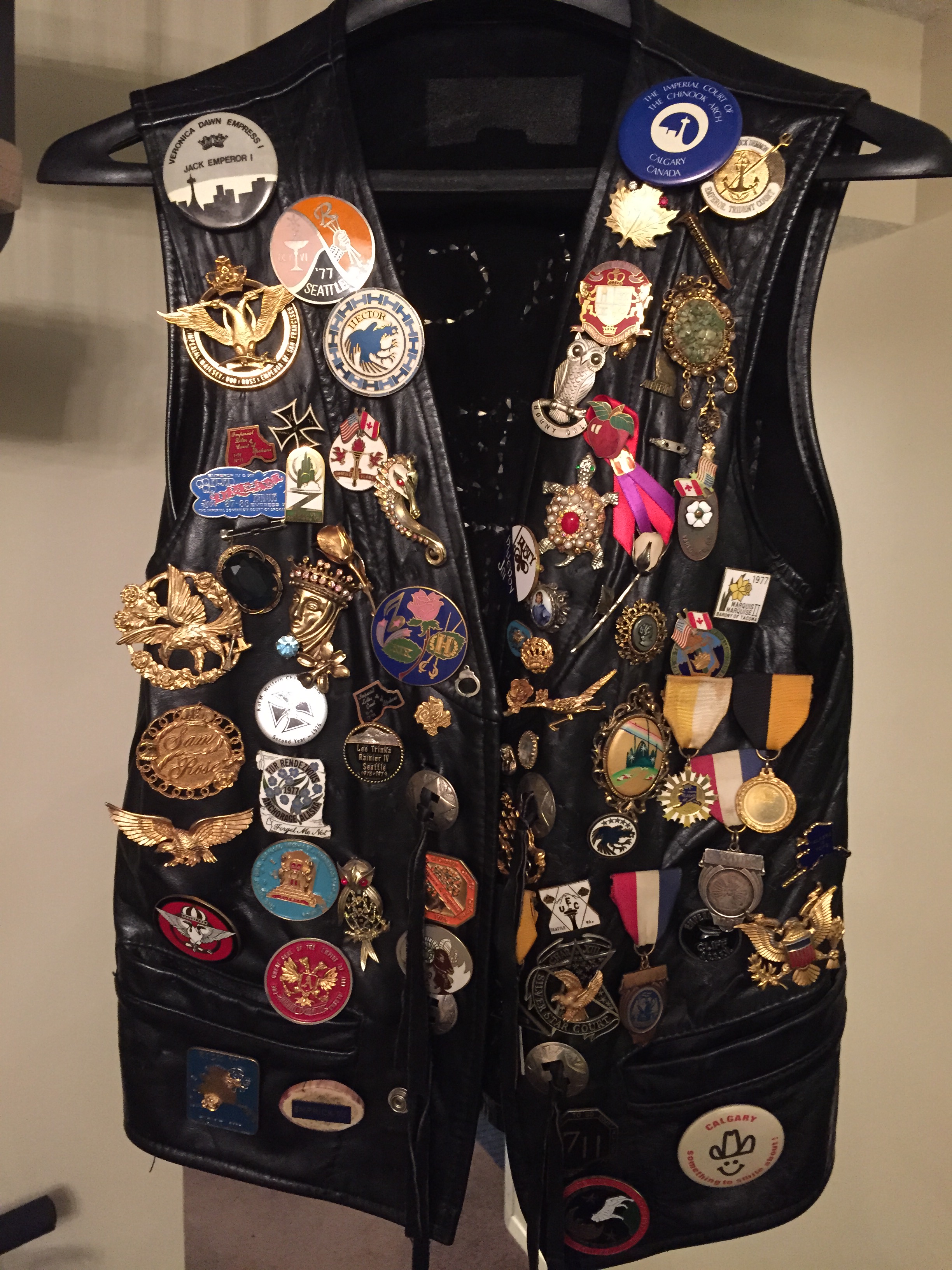
Jack's vest for ISCCA post

Court organizer and First Emperor, Jack Loenen, owned a leather vest with souvenir pins from Court events he travelled to.

Organization of the Calgary court began in April 1976. An application was made to the Mother Court of Canada in Vancouver, and by June of that year, Calgary’s charter was granted. The organizers looked for local inspiration in naming their court, settling on “Chinook Arch” as an iconic Calgary phenomenon. Legally they registered themselves as a daughter group of the Scarth Street Society which also operated Club Carousel. Their first major function was the coronation ball held in January 1977 at the Holiday Inn. With a small loan of $500 from the Club, they hosted an event that made history. It was one of the most elaborate balls the Court system had seen to date, featuring a sit-down dinner and the crowning of Calgary’s first Empress Veronica Dawn and first Emperor Jack. Representatives from Courts in San Francisco, Seattle, and Alaska were in attendance.

In the first year of operations, the Calgary Court had paid back their loan and ended the year $1700 in the black. Generally speaking, any profits the Court makes from their activities are donated to worthy causes. However, in the 70s it was sometimes difficult to find charities who would accept support from the gay community. Emperor Jack, in an Outlooks interview, remembered that the children’s hospital rejected their potential donation then because it came from a gay group. In contrast, the Children’s Wish Foundation was a group who early on did accept gay monies and consequently has been a recipient of ISCCA’s philanthropy ever since.

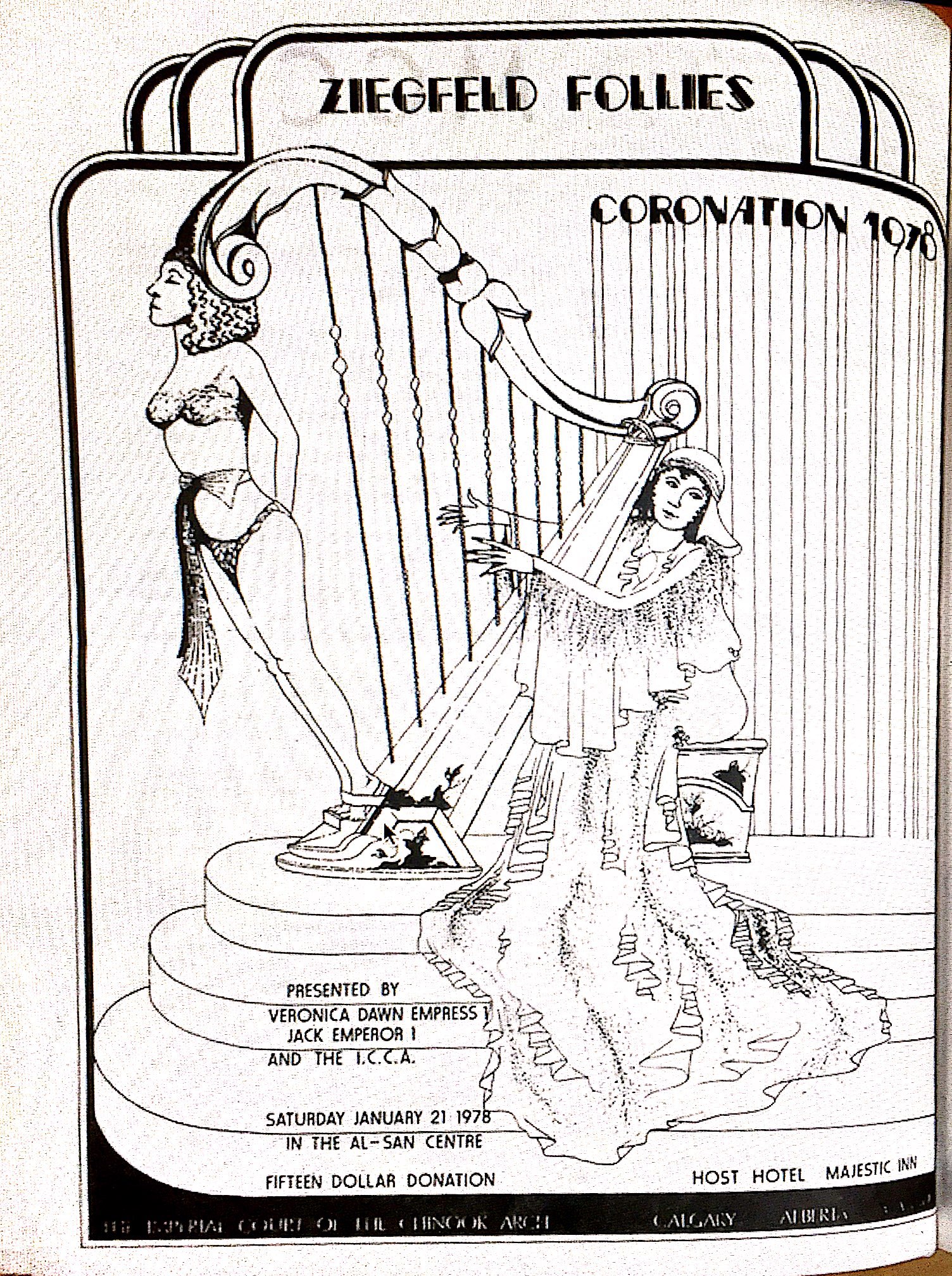
Ziegfield

Coronation ’78 Advertisement in Gay Moods Magazine (GIRC)

In the Court’s fourth year of operations, it decided to become independent of the Scarth Street Society and go its own way. There were some communication issues between the two groups, and Club Carousel itself had come to a natural end as members migrated to the more popular commercial gay bars which had emerged in Calgary.

Like the police/pride debate of this summer, Calgary’s LGBTQ2 community has been polarized before. In 1980, the community was extremely divided on the idea of having a gay rights march as part of the national conference of the Canadian Lesbian and Gay Rights Coalition which the city was hosting. A representative from the Court said to the Calgary Herald: “the minute you start flaunting yourself, you’ve got a problem [The march] is an embarrassment to the entire community.”

However, feelings changed. 11 years later at Calgary’s first Pride Parade, Calgary’s 15th Empress, Tiffany (Lawrence Steedman), led the parade in a purple beaded gown and confidently faced down protesters who spat and cursed. Tiffany said: “I’m proud to represent my community. Every drag queen wants to be empress, it’s an honour.” Member of Parliament Svend Robinson, who spoke at that event gave the nod to the Court explaining that it had been drag queens who bravely were the vanguard of the gay rights movement in North America.

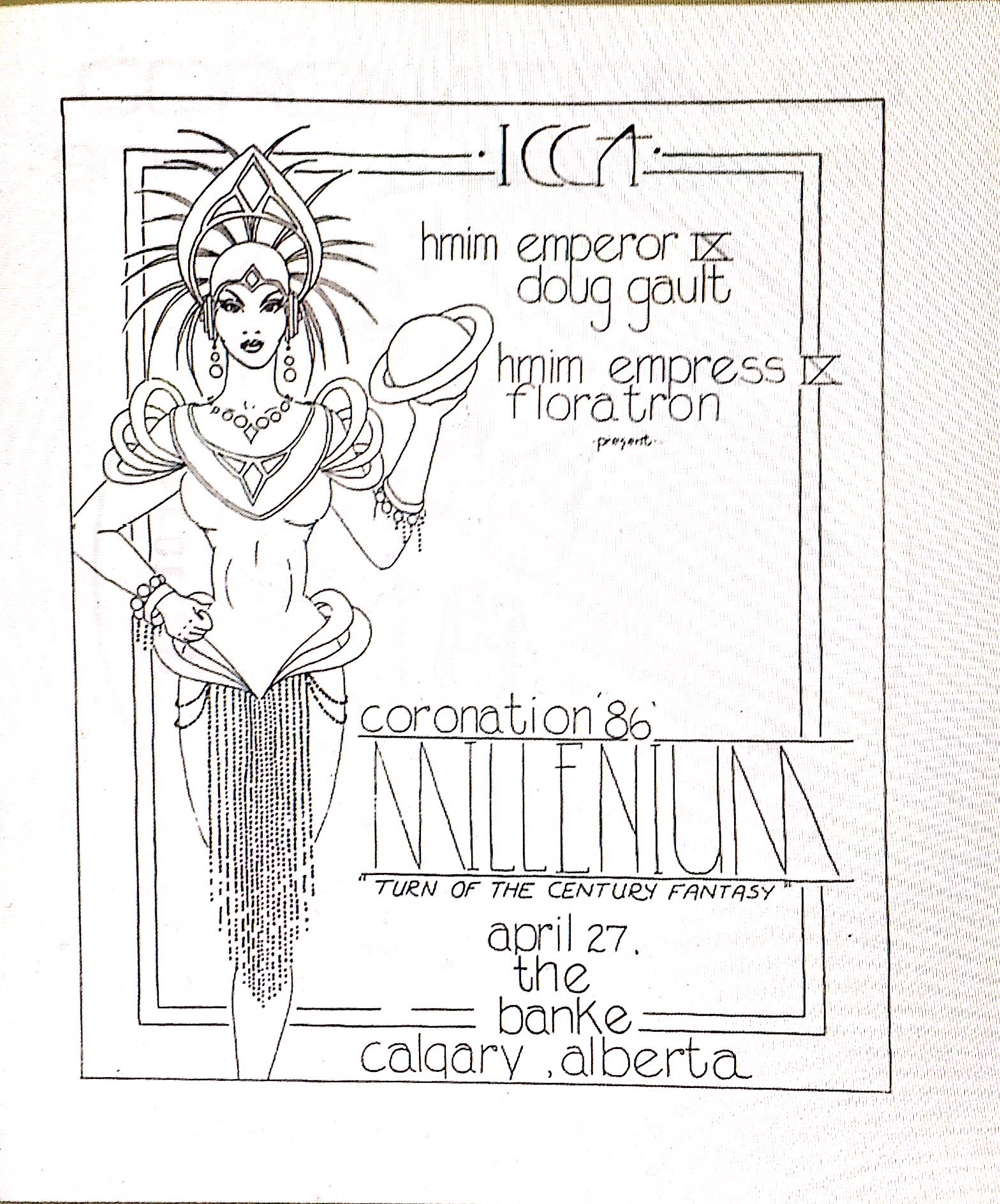
Coronation 86

Coronation ’86 Poster from the Broach Magazine

Toronto writers from The Body Politic were bemused by the Court when they wrote an in-depth feature about Calgary’s gay community published in September 1980:

“The court system seems to be a purely western phenomenon, and rather bizarre to most easterners. Most gay activists, even western ones, seem slightly embarrassed by the whole thing and tend to react as if they’re being forced to talk about a tribal custom they really wish the anthropologists hadn’t discovered. [The Court] simply throws the biggest gay parties Calgary gets to see, and the intrigue behind who gets elected Emperor and Empress probably makes a run at the Calgary mayoralty seems rather tame.”

Ironically, a Toronto Court would form later in that decade holding its first coronation ball in November 1987.

Other notable Calgary Court events include Mayor Ralph Klein’s famous impromptu speech at the 5th annual coronation ball in 1981. The speech, in support of the gay community, proved ground-breaking and those in attendance gave him a three-minute standing ovation. Sadly, he recanted his sentiments in the controversy that quickly followed.

In 1989, Court members ended up in a court of the legal kind, over a tiara snatching incident. The crown was stolen as a ransom for an outstanding debt on ball gowns which allegedly was owed by the queen who had won it.  The judge eventually acquitted the five accused of stealing the headpiece “due to an honest misunderstanding.”

Empresses

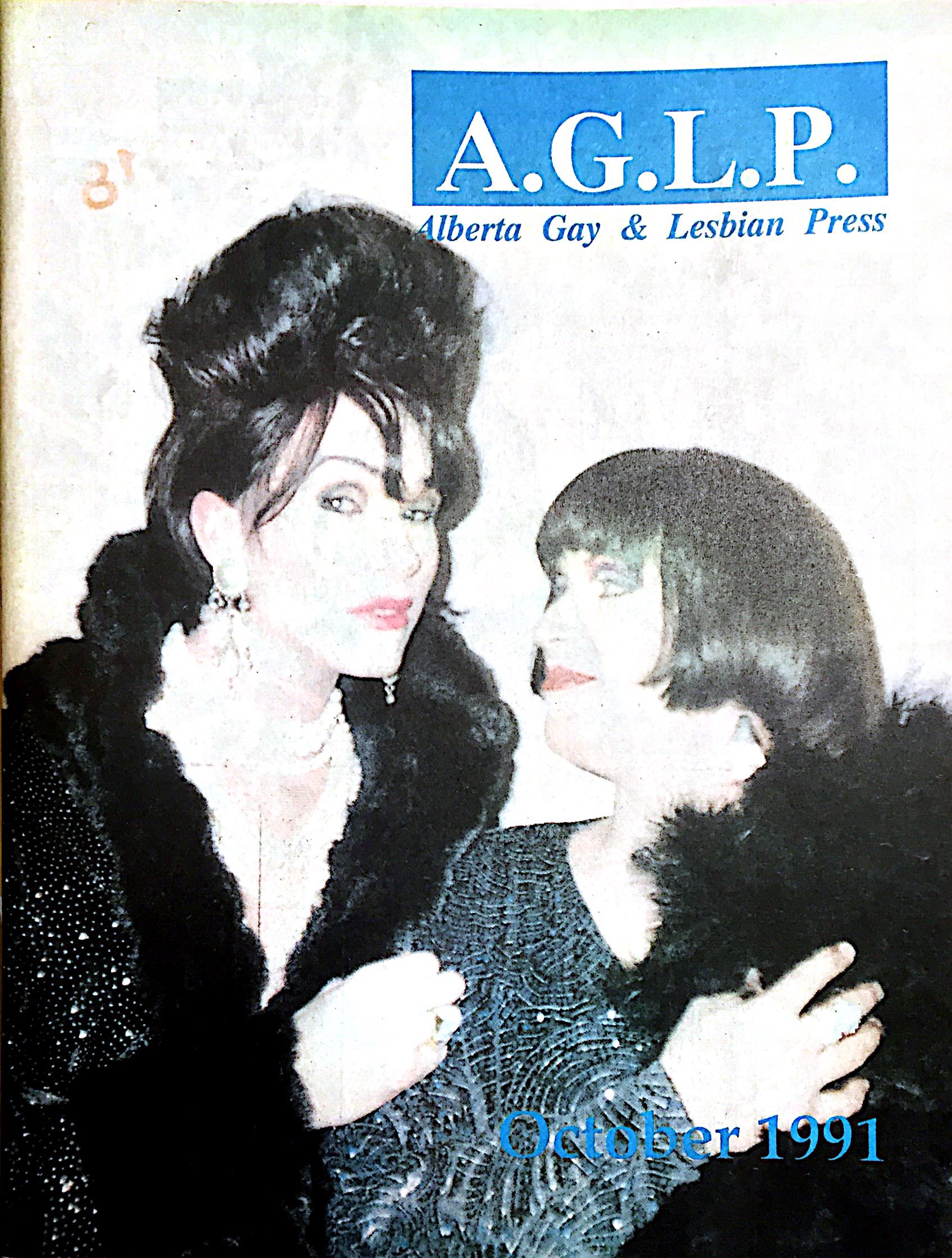
Empress XIII Justine Tyme and Empress XIV Ty Morgan on the cover of AGLP.

The ISCCA also has sponsored daughter Courts into existence.  In September 1990 they were instrumental in granting a charter to Regina’s Court: the Imperial Sovereign Court of the Governing Body, Golden Wheat Sheaf Empire.

However in Calgary, perhaps the ISCCA’s biggest impact has been philanthropy. The Court took a leadership role during the AIDS crisis in Calgary, advocating for HIV prevention and conducting pivotal fundraising for AIDS research and housing of people with AIDS. Since its inception more than 40 years ago, the Court has raised and donated hundreds of thousands of dollars for causes close to their heart. Good work we can all celebrate.

{KA}