
{October is Queer History Month! We are excited to share new research from our friend, historian and professor, William Bridel – Kevin.}
Out on the Rink: A Brief History of Queer Hockey in Calgary
Dr. William Bridel, University of Calgary
For the past few years, I’ve been working on a project that explores the role and meaning of sport in Calgary’s queer history, focusing on the 1960s through to the early 2000s. Along with a former student, Connor MacDonald, we’ve interviewed several folks and I’ve spent a lot of time exploring media and organizational documents found in various archives including the Calgary Gay History Project Collection, housed at the University of Calgary. I have been grateful to gather many incredible stories about friendships, community, achievements, belongingness, and empowerment, stories that come from a variety of sports and different decades. But given that in the fall many—certainly not all, but many—Canadians’ thoughts turn to the sport of ice hockey I thought I’d share here some of what I found in that regard. This is also particularly timely as there’s been a pretty significant change in Calgary’s queer hockey scene (yep, there is one!) in 2025. But more on that later.
One day early on in my research, I came across a short article in the July 1993 issue of Perceptions, a bimonthly then monthly publication that covered queer happenings in Manitoba, Saskatchewan, and Alberta. The story that caught my eye was simply titled “Queer Hockey” and was submitted by the International Gay Lesbian Hockey Association (IGLHA). Following a brief history of the organization, the article explained that the IGLHA were seeking to establish contacts with queer hockey players in Western Canada while also actively recruiting players and/or volunteers for Gay Games IV, which were held in New York in June 1994. Included on the sports-roster for those Games was ice hockey, with open, women’s, and men’s divisions offered. Calgary was very well represented at those Games in a variety of sports, but it is unclear from the materials I have found whether any Calgarians ended up connecting with IGLHA and/or played in the ice hockey tournament in New York.
Admittedly, after finding that article about the IGLHA, hockey slipped off my radar until I uncovered a series of articles in mainstream media related to a so-called “AIDS scare” in the National Hockey League (NHL) in 1991 as well as a number of stories including homophobic comments made by a well-known coach by the name of Pat Burns in 1992. The next time in my research that hockey showed up was in a media article published in 2000. Canadian national team star Nancy Drolet came out publicly when a local reporter showed up at her wedding looking for a “story.” As Drolet framed it in an interview with Xtra, a queer media outlet based in Toronto: “He acted like it was the scoop of the century, but I’ve always been open and honest about my relationship with my family and friends…. But this gave me an opportunity to clarify some false impressions” (Webb, 2000, p. 13). But none of this information was about Calgary specifically and I didn’t know there was much of a hockey story to tell, at least not within the time period in which I was most interested.
Then, during an interview with one of my research participants, hockey came up in the conversation. While the participant, Rob, spoke early on in our discussion of having played high-level competitive hockey growing up, I wasn’t anticipating learning from him that there was a primarily gay hockey team playing in a Calgary men’s league in the late-1990s, the type of league often referred to as “men’s beer league hockey.” Rob noted during the interview that while they didn’t explicitly refer to themselves as a gay hockey team and that there were straight players on the roster, they also didn’t hide who they were and were quite well known as “the gay hockey team” in Calgary’s queer sport community. In Rob’s own words on forming the team:
“I was particularly interested in playing and continuing with hockey. So that’s how I kind of started up the hockey group. I started putting feelers out. There were a couple other people, friends in Calgary that were hockey players. They hadn’t played at the same level as me, but they were gay hockey players that I could start, like, a nucleus with. So, there was three or four people that kind of joined up and we started gathering and finding other people to join so that we could enter a team into the league that played out of the Olympic Oval…. That was in 1998 to 2000. ’98-99 was our first year, ’99-2000 was our second year. I remember putting up posters in Grabba Java [a coffee shop in Calgary known to be welcoming to the 2SLGBTQIA+ community]…. I can’t remember if I explicitly said a gay hockey team or not. There was one guy I remember recruiting from that.”
The team dissipated when Rob relocated to the West Coast. The presence of this team in that league in the late 1990s and early 2000s is an important part of Calgary’s queer sport history, regardless of whether other teams were aware they were playing against a team of queer athletes and allies. It was, after all, only one year prior to the team’s first season together that Alberta was forced by the Supreme Court of Canada to recognize discrimination based on sexual orientation as a violation of human rights. And the team’s first year playing pre-dates the actual amendment of the Alberta Human Rights Act to include sexual orientation by 10 years. Representation and claiming space mattered then and continue to matter now.
Some 15 years following Rob’s team’s debut in the Olympic Oval men’s hockey league, the Calgary Pioneers formed under the umbrella of the Calgary Gay Hockey Association (CGHA). An article in Gay Calgary® published in October 2016 and written by Michael Nguyen, explained the origins of CGHA and Pioneers hockey:
“After coming out to his former teammates, Mike Bell found himself without a team to play with, going into his league’s playoff games. In a place like Alberta—with a typically conservative reputation—it’s not always easy to be a sexual minority; let alone trying to find an accepting place as a gay hockey player. The good ol’ hockey game can be a bit of a disappointment when it comes to conversations in the locker room and, to prevent others experiencing what he had, Bell decided to take action. When Bell followed up with league organizers following his ousting, he found there were no protection or equality policies in place for gender and sexual minorities.”
The CGHA and the Pioneers found allies in organizers of the men’s recreational hockey league operated out of WinSport, the multisport facility located in Calgary’s Olympic Park. In an interview with the CBC in November 2016, Pioneers co-founder, Bell (from the quote above), noted that the formation of CGHA and the Pioneers was a way to create a safe space to play hockey as well as to challenge homophobia and other forms of discrimination:
“You want to have people around you that are supportive of what you are trying to achieve in terms of an environment”, he said. “If you have a whole team trying to create that safe environment, that is a lot more effective than having one person trying to create that environment”. (Bell, 2016, paras. 23-24).
Justin Connelly, an original player on the Pioneers, welcomed the opportunity to play on a gay hockey team and offered the following reflection on its formation and evolution:
“The Calgary Pioneers started out of a need for gay men to play hockey within their own community. A founder of the Pioneers [Bell] was asked not to play on their former team when some teammates found out about his sexuality. The Pioneers became a safe place for LGTBQ+ individuals to play hockey and find a sense of community within the sport they loved. The Pioneers grew into the CIHA and grew into a safe place for all within the LGTBQ+ community and allies alike.”
Reflecting growing interest and numbers, the CGHA formed an additional team in 2017—the Calgary Villagers. This team played in an introductory league, welcoming folks new to the sport or perhaps returning to hockey having played when they were younger. With still more interest, a third team was added; initially called the Panoptics this team would eventually become a second Villagers team. These teams played at three different levels in two different leagues: The Pioneers remained part of WinSport’s league while the Villagers played in Calgary’s CCSL (Co-Ed Sports Leagues). As alluded to in Connelly’s quote above, during this same period of time—2019 to be precise—the CGHA was renamed to the Calgary Inclusive Hockey Association (CIHA) in a very specific effort to be more welcoming to more of Calgary’s 2SLGBTQIA+ population.
2025 brought even more changes to queer and inclusive hockey in Calgary, with all three CIHA teams being rebranded under a unifying name: The Calgary Flare. The three different teams are named Sol, Luna, and Terra. With a soft launch of the new name and look during Pride Cup Alberta—an annual ball hockey tournament held during Edmonton’s Pride Fest—the Flare officially launched the rebrand during Calgary’s Pride Week with social media announcements including professional photos and videos and walking in the Pride Parade sporting their new jerseys…on a very sunny and hot Labour Day Weekend, I might add.
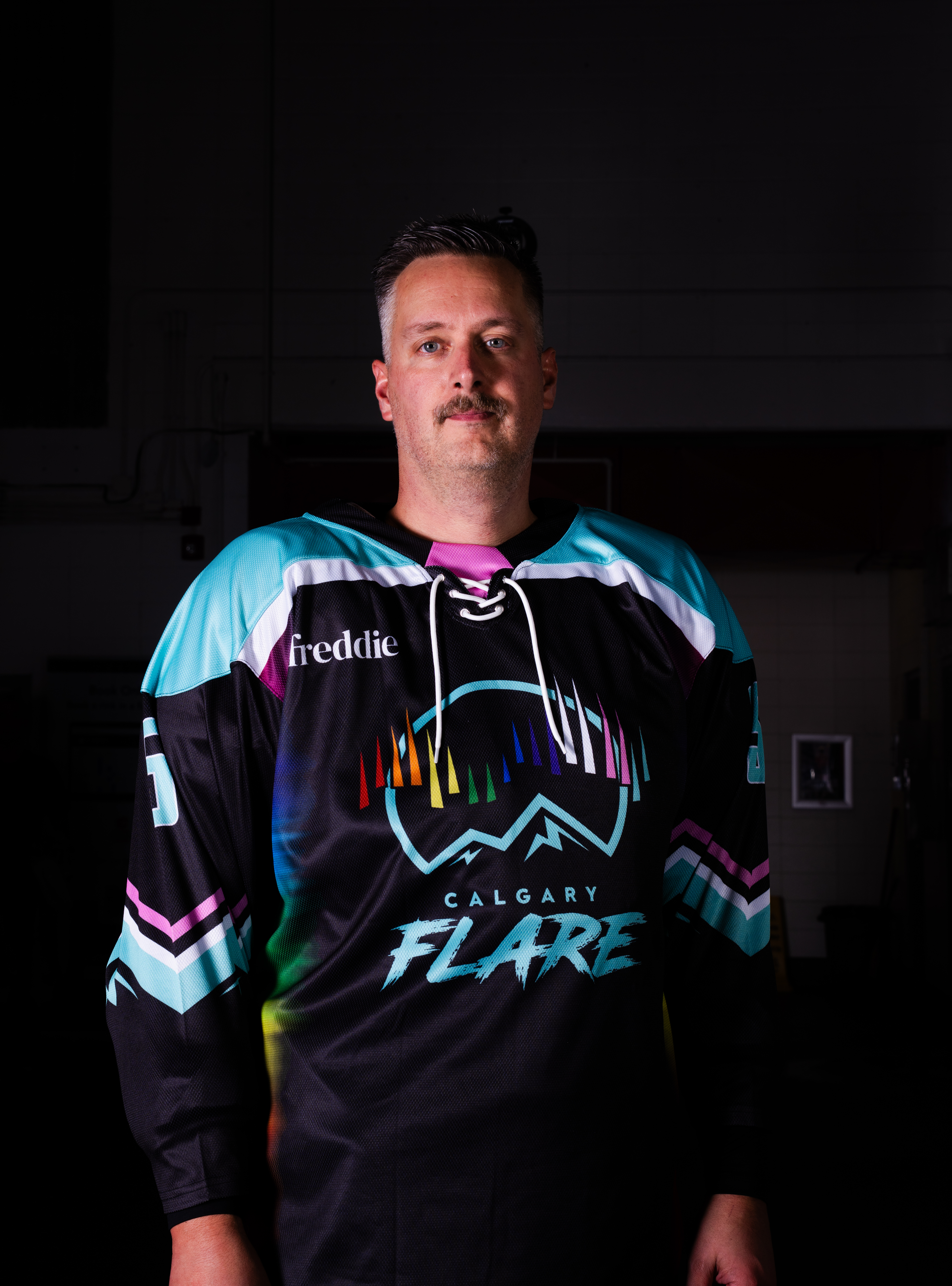
Photo credit: CIHA/Matt Daniels. Photography funded by Freddie.
A member of CIHA for a number of years and current Director of Sponsorships, Mike Haska was a key figure in the rebrand. When asked about the reasoning behind the change to name and look, Haska commented that,
“the most powerful aspect of our rebranding project was the fact that the push to change arose from CIHA’s increasingly diverse membership. As we added players to our roster who are trans, lesbian, bisexual and queer identifying, our members posed questions to us on the Board about whether the name and logo on the jerseys was something that all our players could feel a sense of alignment to. The fact that we evolved our identity in order to encompass and embrace a more inclusive representation of hockey players is something that this association and all its members and leaders, past and present, can be very proud of because it shows their efforts have effected meaningful change.”
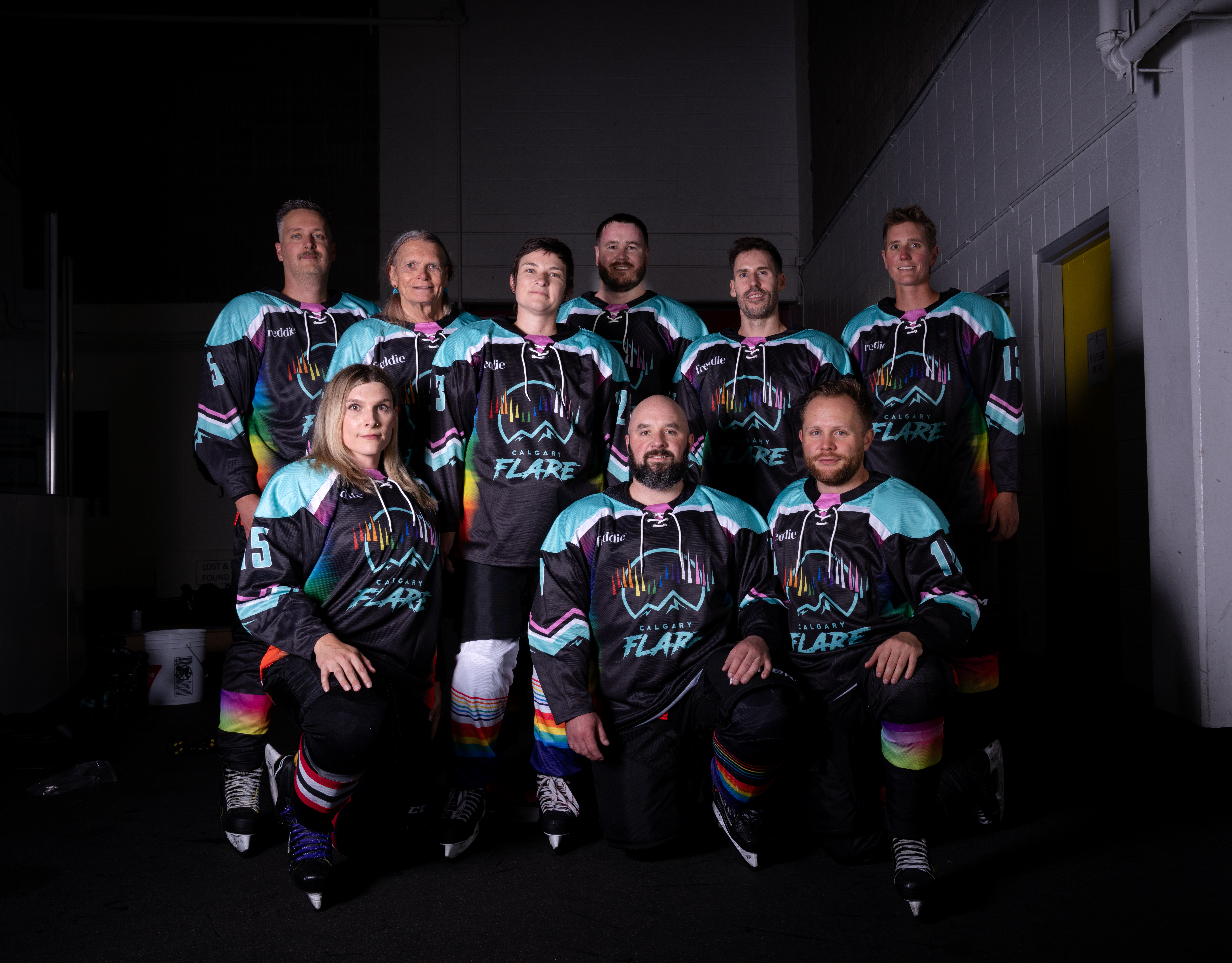
Continuing the mission to create safe and inclusive hockey spaces for 2SLGBTQIA+ hockey players who may have left the sport or felt isolated within it, the Flare also, quoting from their website, serves as “a beacon to these players, signaling they belong” and reflects that the queer and trans communities are “bold, colourful, and full of character,” living and leading lives, well, “with flair”. In addition to the three Flare teams, a team started in 2024 by Bell and other former Pioneers—the Renegades—plays in the WinSport league. While not connected to CIHA, the Renegades provide another space for members of Calgary’s queer community to participate in a sport they enjoy, and in a sport that—like so many others—has been terribly unwelcoming and unsafe for trans and queer folks.
Queer sporting spaces, such as these hockey teams and associations, are part of Calgary’s queer history and have played a role in challenging the norms of sport that told so many of us that we didn’t belong. That said, there remains much more work to be done. We can learn from our past as we forge ahead to our future.
References
Bell, D. (2016, November). Gay recreational hockey team breaks new ground in Calgary. CBC. https://www.cbc.ca/news/canada/calgary/calgary-gay-hockey-team-1.3844819#:~:text=A%20Calgary%20man%20felt%20he,the%20team%2C%22%20he%20said
Brennan, H. (2025, April). Calgary’s first gay hockey team looks a lot different 10 years later. Yahoo! News. https://ca.news.yahoo.com/calgary-first-gay-hockey-team-180208734.html
Nguyen, M. (2016, October). Pioneers on the ice: Calgary “Cs” new era of gay friendly puck handling. Gay Calgary Magazine. https://www.gaycalgary.com/Magazine.aspx?id=154&article=5330
Webb, M. (2000, September 5). Team Canada athlete comes out: High-scoring Nancy Drolet’s high-profile marriage. XTRA!, 13.
{WB}



 Calgary Gay History