Tag Archives: AIDS

Homos on the Range

{Calgary Gay History Project’s Tereasa Maillie is working on a memorable history event – one night only – Friday, December 4th at Loft 112 – read the press release below and we hope you can join us – Kevin}

Supposedly, lightning never strikes twice in the same spot. But after 21 years apart, Calgary actors Barry Thorson and Steve Gin are challenging that notion.

In 1994, Thorson and Gin self-produced Harry Rintoul’s searing AIDS drama Brave Hearts, set atypically in the back yard of a party in Saskatoon. Equally uncharacteristic for the time were the play’s blue collar characters: a bitter, closeted seismologist and an openly gay ranch hand.

“At the time, AIDS was still a white-collar crime,” reflects Gin, who played the wise-cracking, Glen

Campbell-loving ranch hand GW. “Most of the AIDS dramas at that time were about well-to-do White gay men who lived in New York, San Francisco or Fire Island. AIDS – let along gay men – were still an invisible presence on the prairies.”

“These (characters) are people that an Alberta or a prairie audience identify with readily and understand,” adds Thorson. “They’re so down-to-earth, which I think is very appealing.”

On the evening of December 4 as part of events honoring World AIDS Day, Brave Hearts receives a staged reading at Calgary’s Loft 112 in Calgary’s East Village, with Thorson and Gin back in the saddle as GW and Rafe. A panel discussion follows, with representatives from the Calgary Gay History Project, HIV Community Link and Chromatic Theatre participating.

Brave Hearts first opened at Toronto’s Buddies in Bad Times Theatre in 1991 at a time when a diagnosis of AIDS was still considered a death sentence for many. Three years later, the prognosis wasn’t much better when the play premiered in Calgary at The Pumphouse Theatres. The actors rehearsed at the AIDS Calgary offices, and resource personnel from the organization facilitated talkbacks after each performance. Critical response to the production was positive, with the Calgary Herald proclaiming it “an act of courage.”

teatro berdache

“AIDS claimed a lot of the people we got to know through that show,” remembers Gin. “But others we came to know, especially the ones who were just recently diagnosed, are still here. They’re fine. And that’s so encouraging.”

So why revisit the show two decades later?

First and foremost, it’s a great script, garnering a Dora Mavor Moore Award nomination in its Toronto production. And for both actors in the Calgary production, there’s a feeling that people need to be reminded of the impact of AIDS in the community, especially the younger generation of gay youth who never witnessed its devastation first-hand.

Gin went on to helm Teatro Berdache, which ran professional productions in Calgary, Vancouver, Toronto and Montreal from 2000 to 2008. This year, it re-emerged as an interdisciplinary arts facilitator, running the successful Warhol-inspired Factory 112 series at Loft 112.

“We’re definitely older and greyer than we were in 1994,” laughs Gin. “And there’s no damn way we could ever pull this off onstage, ‘cause the characters are 26 and 31. “

“But so much of this play is about loneliness, and the need to reconnect. And I think that’s gonna resonate even more now, especially when the audience has a chance to talk about it with us afterward in the intimate space of the reading.”

Factory 112: Lonesome Cowboys & Brave Hearts runs for one night only at #112, 535 – 8th Avenue SE on Friday, December 4, 2015. Doors open at 7 pm with a 7:30 pm start. Admission is by donation, with all proceeds going to support HIV Community Link. Find the Facebook Event: here.

The Effect of AIDS on Calgary

AIDS created both personal and political crises in Canada and our gay communities were irrevocably changed.  Now in hindsight we are beginning to see the shape of those changes and understand their impact.  For one, it politicized the gay community dramatically – the stakes could not be higher – people were dying in a backdrop of little information and government action. For two, it brought the community closer together after years of division from fractious identity politics (read this interesting article about survivors of the AIDS crisis and the role of lesbians).  For three, the public at large could no longer ignore or fail to notice the queers amongst them.

Red ribbon

AIDS was first reported in Alberta in 1983: the first death a bisexual Calgary man in early June.  On June 30th, Alberta was the second province in Canada to declare AIDS a notifiable disease.  Grassroots organizing by Calgary’s gay community began almost immediately.  By late July, the city’s gay club owners raised and donated $10,000, to the University of Calgary to become the foundation for an AIDS research and education fund.

One year later (1984) the number of confirmed AIDS cases in Alberta had grown to six with only two men still alive – and every one was a gay or bisexual man.  For ten years the stats kept getting darker and bleaker until newly diagnosed cases peaked in 1994 at 134.  From then onwards, sex education and cocktail drug therapies started bringing the numbers and the mortality down. Calgary was the hardest hit city in the province.

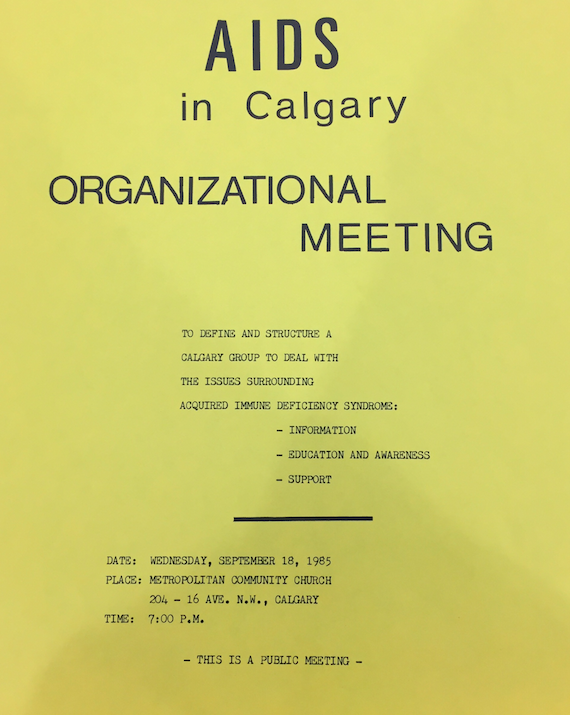
The first meetings for what was to become AIDS Calgary began in September 1985.  Doug Young, a gay activist and community organizer collected papers from those early meetings, which can be found at the Glenbow Archives.  Sadly, he himself died of AIDS in 1994.

Screen Shot 2015-07-16 at 6.30.47 PM


Nationally, the recently launched AIDS Activist History Project is working to document Canadian AIDS activism in the 1980s and 1990s.  The Calgary Gay History Project will work collaboratively with the project to preserve our local stories.  As always, if you do have something to share, please contact us: here.

{KA}

Russian Gays Time Travelling Backwards

During the recent Sochi 2014 Olympics, a lot of the focus was on the countries’ anti-gay laws.   The Russian law outlaws pro-gay “propaganda” that could be accessible to minors.  Critics say it is so restrictive and vague that it deters almost any public expression of support for gay rights.  What was missing from the reports was the historical reasons for this decision.  The attitudes and legislation in Russia against Gay and Lesbians is unfortunately not new.

LGBT marchers defy St. Petersburg anti-gay law.  Source: 76 Crimes.

Marchers defy St. Petersburg anti-gay law. Source: 76 Crimes.

An article from the Calgary Herald dated June 1993 proclaimed, “Russia: Anti-gay law wiped from books”.  In 1993, Russian legislators had formally lifted the Soviet era law declaring male homosexuality a crime.  The law, Article 121, was a holdover from the criminal code and made Russia one of the few countries in Europe that considered male homosexuality a crime punishable up to five years in prison.  Ten men were sentenced in 1992 for the crime, while in 1989 some 500 men were sent to jail for being homosexual.

One of the fall-outs from criminalizing gay people is the increase in AIDS and lack of treatment in Russia.  Many gay men “were very scared they would be thrown in jail if they went to the doctor for a STD,” said Dima Lychev, editor of the gay newspaper, One In Ten.  Such restrictions had cast doubt on official stats on AIDS in Russia at the time, saying 650-700.  Activists have said the actual number is at least 10 times higher.

Around 1.4 million people in Russia, Eastern Europe and Central Asia were living with HIV at the end of 2011, representing an HIV prevalence of 1 percent.  Around 140,000 became infected in 2011 and 92,000 died from AIDS related illnesses; there was a 21 percent increase in AIDS-related deaths between 2005 and 2011.

The other question is how did Russia make such a political and social about-face from 1993 to today’s sense of intolerance?  Many blame it solely on Vladimir Putin, Russia’s President for this change.  Actor and playwright, Harvey Fierstein in an Op-Ed in the NY Times writes the whole thing is scapegoating, used by politicians to solidify their bases and draw attention away from failing policies. This is a campaign of distraction, where a minority is attacked and the population is given an outlet for their anger at the system. Firestein likens it to the tactics used by the German Nazis against the Jews pre-1939. And he may be correct: recent moves into the Ukraine as well are part of a smoke screen like anti-gay laws to put the focus away from a poorly performing economy, social injustice, and political corruption in Russia. And the people appear to have fallen for it.

{TM}