Author Archives: Kevin Allen

LGBT History Month – check out this CBC video from 1959!

Happy October, which also happens to be LGBT History Month in North America.  LGBT History Month began in 1994, founded by Missouri high-school history teacher Rodney Wilson who was concerned about the lack of LGBT issues in the education curriculum.

October was chosen by Wilson because National Coming Out Day already was established and well known, on October 11, and October commemorated the first march on Washington by queer activists in 1979. LGBT History Month is intended to encourage honesty and openness about being lesbian, gay, bisexual or transgender.

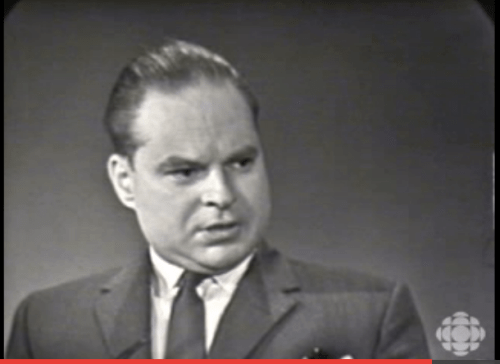
Speaking of honest and openness.  I discovered this early pioneering video on the CBC’s digital archives website, titled,  Homosexuality in Canada: A psychiatric ‘problem’.”  The synopsis is as follows: “It’s 1959, and homosexuality is a topic few are willing to discuss. Like some of the people interviewed on the street in this CBC Television clip, many believe that homosexuals should be locked up. Most in the medical profession believe homosexuality is, at best, a psychiatric problem. But a gay man — interviewed in silhouette to protect his identity — says society has to get used to homosexuals, and not the other way around.”

The 27-minute documentary concludes with an interview of British lawyer, H.A.D. Oliver who concludes nobly, “We feel – many of us – that the homosexual who performs what to him is a natural act, in the privacy of his home, with other adults similarly inclined, does no harm to society.  He does not interfere with society, and why therefore should society interfere with him?”  Why indeed…
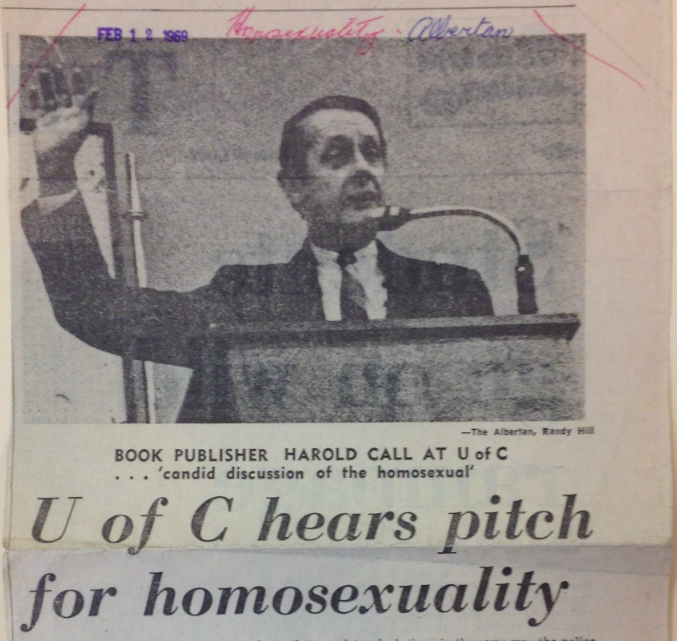
Open minds at U of C. In 1969 before Stonewall?

On Tuesday, February 11th, 1969 more than 300 staff and students at the U of C attended a lecture in MacEwan Hall by Harold Call, gay publisher and activist.  He was speaking at a University of Calgary Civil Liberties Association session billed as Homosexuality: A police industry.

Harold Call, born in Trenton, Missouri on September 20, 1917, was one of the founding members of the San Francisco chapter of the Mattachine Society.  Call created and edited the Mattachine Review, one of the earliest periodicals dedicated to discussing issues of the homosexual community.

In his address he spoke of sexual equality and the legalization of homosexual acts between consenting adults.  He also spoke of the economic value of the homosexual and the victimization of homosexuals at the hands of North American police officers.  He noted, “it is a happy field for the law to work in because it could state it was working to keep the community morally clean.”

Of note were three city detectives who sat quietly three rows from the front.  During the discussion session when any members of the vice-squad present were invited to comment, they did not move, and left soon after.

“Calgary lawyer, Max Wolfe, also sat on the stage during the session and took the stand after Call.  He said there were not too many instances of homosexuality in Calgary. ‘You can draw your own conclusions, it could be the police are shutting their eyes to it or the homosexuals are being reasonable circumspect, about their activities, or both.'”

The first gay-sympathetic mainstream article published in Canada

In just a few months it will be the 50th anniversary of what is widely considered the first article in a mainstream Canadian publication that is sympathetic to homosexuality.

Sidney Katz did a two-part story in the Feb. 22, 1964 and Mar. 7, 1964 issues of MACLEAN’S MAGAZINE.  The report documents a very marginalized but collectivizing community.

Katz’ investigation was triggered by widespread condemnation of the discovery by the press, of The Club: a member’s only privately run gay bar in Toronto.  Katz profiles the community’s outrage as well as discovers that the gay men and women he meets are surprisingly, “normal.”  Although persecuted by society, his interviewees have largely the same hopes and aspirations as other Canadians.

He also uncovers a vibrant community that exists apart from the straight world, filled with doctors, auto mechanics, bookstores, etc., that deal with an exclusively gay clientele.

He writes: “Can homosexuals look forward to making progress in their campaign for just treatment in employment and other matters?  Much will depend on their attempt to re-make their public image into a less threatening one.  This might be accomplished dramatically and expeditiously by large numbers of homosexuals publicly identifying themselves – an act that would require almost unimaginable courage.  I have only met a few homosexuals prepared to take such a bold step at this time.”