
The gay liberation manifesto, With Downcast Gays: Aspects of Homosexual Self-Oppression, by Andrew Hodges and David Hutter turns 50 this month. You can read it online: here.
The slim 1974 treatise, first published in London, England, was reprinted multiple times in many countries. Pink Triangle Press, the publisher of Canada’s gay liberation newspaper, The Body Politic, produced the first North American edition in 1977, selling out its 6000 copies in less than two years. A second edition was printed in 1979.
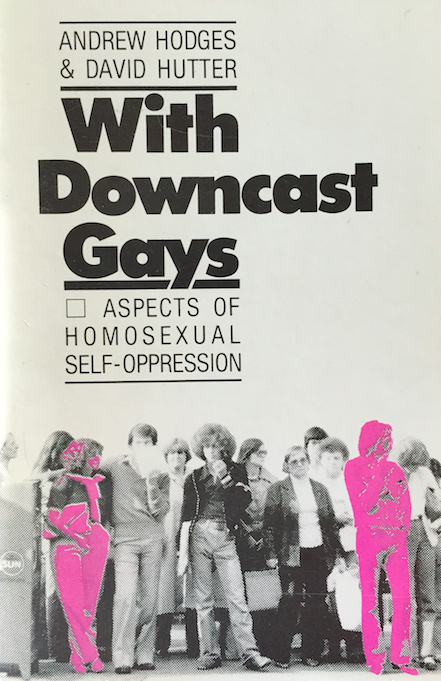
With Downcast Gays is an articulated call to action for gays everywhere: You must fight for your pride and self-respect. The authors explain that self-disclosure (coming out) is essential in overcoming self-oppression. This message found an eager audience in its readers and paved the way for the outing movement and debate over its practice in the 1980s.
The authors make an example of the famous novelist and social commentator, E. M. Forster, whose gay novel Maurice (written in 1914) was only published posthumously in 1971. They write:
The novel which could have helped us find courage and self-esteem he only allowed to be published after his death, thereby confirming belief in the secret and disgraceful nature of homosexuality. What other minority is so sunk in shame and self-oppression as to be proud of a traitor?
At times angry, and at times thoughtful, With Downcast Gays is still worth reading. Hodges asserts: “Gay people have no country.” Although many human rights have been gained since 1974, what spaces and places belong to us today? And which places do not?
Hodges concludes:
No homosexual is an island. When gays say that they have to be ‘discreet’, they support the idea that homosexuality – our homosexuality – is offensive; when they describe themselves as “a typical case”, they label us as ‘cases’. Oppression is as much the creature of self-oppression as the converse. External oppression we can only fight against; self-oppression we can tear out and destroy.
{KA}
Postscript: In 1992, Andrew Hodges wrote a book about Alan Turing, which became the basis for the 2015 Academy Award-winning film The Imitation Game.


 Calgary Gay History