Tag Archives: Gay history

The Effect of AIDS on Calgary

AIDS created both personal and political crises in Canada and our gay communities were irrevocably changed.  Now in hindsight we are beginning to see the shape of those changes and understand their impact.  For one, it politicized the gay community dramatically – the stakes could not be higher – people were dying in a backdrop of little information and government action. For two, it brought the community closer together after years of division from fractious identity politics (read this interesting article about survivors of the AIDS crisis and the role of lesbians).  For three, the public at large could no longer ignore or fail to notice the queers amongst them.

Red ribbon

AIDS was first reported in Alberta in 1983: the first death a bisexual Calgary man in early June.  On June 30th, Alberta was the second province in Canada to declare AIDS a notifiable disease.  Grassroots organizing by Calgary’s gay community began almost immediately.  By late July, the city’s gay club owners raised and donated $10,000, to the University of Calgary to become the foundation for an AIDS research and education fund.

One year later (1984) the number of confirmed AIDS cases in Alberta had grown to six with only two men still alive – and every one was a gay or bisexual man.  For ten years the stats kept getting darker and bleaker until newly diagnosed cases peaked in 1994 at 134.  From then onwards, sex education and cocktail drug therapies started bringing the numbers and the mortality down. Calgary was the hardest hit city in the province.

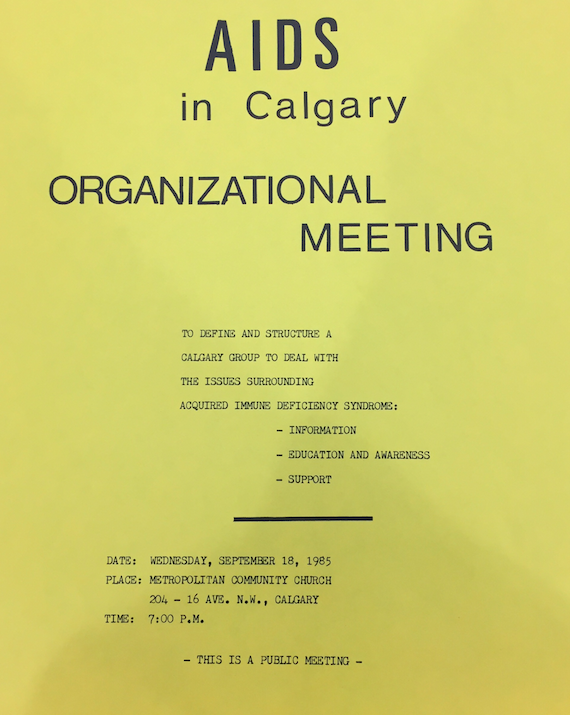
The first meetings for what was to become AIDS Calgary began in September 1985.  Doug Young, a gay activist and community organizer collected papers from those early meetings, which can be found at the Glenbow Archives.  Sadly, he himself died of AIDS in 1994.
Screen Shot 2015-07-16 at 6.30.47 PM


Nationally, the recently launched AIDS Activist History Project is working to document Canadian AIDS activism in the 1980s and 1990s.  The Calgary Gay History Project will work collaboratively with the project to preserve our local stories.  As always, if you do have something to share, please contact us: here.

{KA}

Calgary Gay History Project in Saskatchewan!

We are travelling to Saskatoon and Regina, August 5-9, to do some research in the Neil Richards Collection of Sexual and Gender Diversity located at the University of Saskatchewan in Saskatoon.  Check out this recent CBC article which describes the collection as one of the largest of its kind in the country.

Screen Shot 2015-07-09 at 2.12.26 PM

CBC image of a poster in the Neil Richards Collection of Sexual and Gender Diversity/U of S Archives.

Not only will be looking for Calgary citations in the collection, but we will also be meeting with Mr. Richards to discuss best practices for setting up our Calgary gay history archive.

Any former Calgarians or visitors to Calgary, who are now living in Saskatchewan, and who may have stories about our LGBTQ history are invited to contact Kevin – we are keen on interviewing you!

{KA}

Seeking the 620 crowd!

Before Club Carousel in the late 1960’s there was a bar called the 620 club at 620 8th Avenue SW near the site of the old Uptown Theatre.  Frequented by both gay men and lesbians, you accessed this underground bar by stairs in the back alley between 5th and 6th streets.

620 8 Avenue SW

620 8th Avenue SW Calgary today: image Google Earth

It opened in 1967 or 1968, and was owned by a man described as short and swarthy, with a big nose and a limp.  The 620 was just a number on the door, and there was no alcohol served – there was only popcorn and pop machines. The room was not very big, and was decorated by a lot of christmas tree lights with a central light bulb (red?) hanging from the ceiling.

Former producing director of Alberta Theatre Projects, Michael Dobbin, remembers: “It was a time when if you saw someone you recognized at the club [from one’s day-to-day life] it made you feel kind of queazy and you left.  It was only open on the weekends.  Getting there, you would sneak down the laneway, look both ways and then quickly go down the stairs.”

“One night I remember that it was really crowded and there were these three guys in suits – one of whom I found quite attractive – so I went up to him and asked him to dance and he responded gruffly, “No!’   When I went back to my friends, they asked me what I had done, and they said to me, ‘they are the police stupid, the light is flashing!'”

Before homosexuality was decriminalized in 1969 any same-sex couple dancing together was potentially subject to arrest under the charge of gross indecency.  The 620 Club used the flashing light to alert its clientele to suspected police presence, and dancing would either cease or gay men and lesbians would switch partners and grab each other to dance.

Lois Szabo in a 1973 edition of Carousel Capers wrote that: “In the past, many gay clubs have been set up and these businesses were primarily concerned with earning a fast buck!”  Her editorial point being that Club Carousel was the first gay club owned and operated by the community.

To date, that is all we know about the 620 club whose existence is still a bit of a mystery to the Calgary Gay History Project.  If you, or anyone you know has a recollection of the 620 club, we would be grateful if you would contact Kevin Allen at calgarygayhistory@gmail.com.

{KA}