Category Archives: Gay history

Fairy Tales 22 Launches

Readers of the Calgary Gay History Project know that we are fans of the fabulous queer film fest, Fairy Tales. The annual event produced by the Calgary Queer Arts Society is now in its 22nd iteration. The Festival often takes a special interest in our community’s history and resiliency. That resilience is being tested in 2020 with the global pandemic, yet impressively the Festival has pivoted to offer all of its films online.

{They also have a fun magpie theme for 2020 – very YYC – Join the Digital Flock!}

Check out the entire festival schedule; running from May 14 – 24, 2020. There are 38 films from over 14 countries to see, but here is a list of ones with historical interest.

May 14 at 7:00 PM (tonight). Fairy Tales launches with

Stonewall: Paving The Way For Gay Pride.  Every year in June, the Gay Pride parade is a wild party. It hasn’t always been like this. While 2020 marks the parade’s 50th anniversary, it was originally the first time gays and lesbians walked the streets in New York, claiming publicly to be out, and this procession was intended to commemorate the Stonewall riots that had occurred a year earlier.
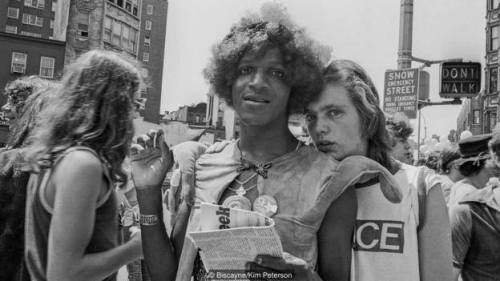
stonewall

May 20 at 7:00 PM

Sex, Sin, and 69. This is a historical, retrospective film about the 1969 legislation to ‘decriminalize’ homosexuality in Canada. Told through contemporary voices including queer academics, historians, activists, educators, artists, and community builders, the film attempts to challenge our understanding of queer history by shining a light on widely adopted misconceptions surrounding decriminalization.

May 22 at 7:00 PM

Button OUT! A short film that is a lively animated personal homage to the filmmaker’s own history of protest and the wider story of the LGBTQ2S+ experiences contained in the collection of over 1200 buttons housed at the ArQuives: Canada’s LGBTQ2S+ archives in Toronto.

May 22 at 7:15 PM

Bitter Years. This feature film retraces the life of Mario Mieli, among the founders of the Italian Homosexual Liberation Movement, created at the beginning of the Seventies. Born in 1952 in Milan, Mario killed himself in 1983, before he was 31. He was an activist, an intellectual, a writer, and a performer: a key figure in the Italian cultural panorama at that time.

May 24 at 7:00 PM

Take Me to Prom. This short film traces the evolution of queer acceptance in society by asking a multigenerational selection of people to recount a story from their high school prom. It notably includes Marc Hall, whose 2002 court case over his school’s refusal to allow him to bring a same-sex date to his prom, became a landmark LGBTQ2 rights case in Canada.

{KA}


HIV Community Link at 35

{The Calgary Gay History Project is presenting a series on AIDS history reflecting on how Calgarians and Canadians reacted to this earlier pandemic. This installment was written by Project researcher, Tereasa Maillie.}

Screen Shot 2020-05-06 at 3.24.23 PM

Globe and Mail excerpt from April 20, 1984

HIV Community Link has been active in the Calgary community providing support and education for over 35 years as a registered society. Its roots were in the early 1980s epidemic reaching Calgary, and little information was available to help people combat this deadly virus. Homophobia, prejudice, and discomfort around the ways HIV was transmitted blocked discussion and treatment.

In response, gay and lesbian activists first met in late 1983 to decide on a plan of action, and join together to advocate for infected people. AIDS Calgary Awareness Association was born, and according to activist Doug Young’s personal notes, the first meetings were about the legal fight for people who were HIV positive. They were not alone: Montreal, Toronto, and Vancouver had also started their own chapters based on the many groups that had begun in the USA.

Known as AIDS Calgary, the group registered as a society on October 9, 1985. Their first office was at #300, 1021 – 10th Avenue S.W. and staffed by a core group of volunteers under Doug Morin, the first Executive Director. Money was tight, but LGTBQ2 organizations such as the Imperial Sovereign Court of the Chinook Arch donated funds and held community events. In the 1990s, AIDS Calgary began hosting their own signature fundraiser called Calgary Cares. The special event included silent auctions of local fashion designers’ clothes, a stage show, and dinner. The AIDS Walk and Run started 25 years ago; it has raised approximately $1.8 million to fund the agency and its services in Calgary.

Screen Shot 2020-05-06 at 3.16.00 PM

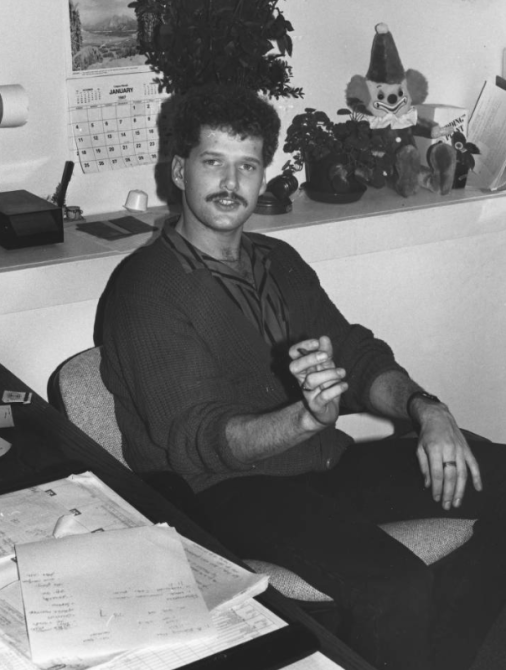
Doug Morin – Executive Director of AIDS Calgary, Dec. 1986. Photo source: University of Calgary Digital Archives

With this help, AIDS Calgary was able to expand their outreach and advocacy, including their hotline and newsletters: Ellipse, 360 degrees, and AIDS Calgary News. Part of their advocacy work was to lobby the government to fund research, promote health programs, and help end the stigma surrounding HIV positive people in Canadian society. In two National AIDS conferences (1985 in Montreal and 1986 in Toronto), AIDS Calgary joined with other organizations to create the Canadian AIDS Society. The goal was to tap into a larger umbrella group’s powers of shared information, advocacy, and support for all members.

In 2013, AIDS Calgary Awareness Association changed their name to HIV Community Link, as they also offered programs and services in Medicine Hat and Brooks. Their focus remains “on health promotion, increasing access to testing, delivering effective harm reduction programs, and reducing the stigma associated with HIV.”

{TM}

AIDS vs. the ’88 Olympics

{The Calgary Gay History Project is writing a series about AIDS history reflecting on how Calgarians and Canadians reacted to this earlier pandemic.}

If you lived in Calgary in 1988, you would remember the heightened sense of reality and esprit de corps that was the Winter Olympics. It was a time of Hidy and Howdy, sun ice jackets, and the frequent repetition of Calgary’s Olympic colour palette: teal, purple, orange, red, and pink. It was also a time of AIDS.

Gay bus driver, Mark Perry-Schaub, was a volunteer driver for the Calgary ’88 Olympics Committee (OCO). For three years, he participated in transportation planning with the OCO but was ousted from his position in December 1987 when he informed them of his then-recent AIDS diagnosis. He fought to be reinstated and, when denied, took up his cause through local media. The 25-year-old Perry-Schaub was told by volunteer manager Paul Taylor that he could no longer work on the transportation committee because in case of a traffic accident, OCO did not want him to either administer first aid or bleed on anyone.

The media pressure worked. The OCO managed to find Perry-Schaub a different volunteer job after a significant amount of public scrutiny. The OCO’s press secretary Bill Payne said: “We have an obligation to minimize the risk at any time. Some might say it’s a slight risk, but at what point do you take action?”

Perry-Schaub told reporters after his closed-door meeting with OCO officials: “I would rather be in transportation where I was trained. In my opinion, I think OCO has over-reacted. I felt I’d been railroaded into a new position.”

AIDS Calgary Executive Director, Doug Morin, was critical of the OCO. He stated: “It’s a decision based on inaccurate and incomplete information. Mark is not a threat to himself, OCO staff, or volunteers. There’s no significant risk that can’t be dealt with through adequate precautions.” Morin also noted that the OCO refused an AIDS Calgary offer to provide educational materials to the organization.

A week after the meeting, the OCO offered Perry-Schaub the choice of a dozen new jobs. He selected a position in the main press centre’s video distribution office. It turned out that the job was the last big project of Perry-Schaub’s life; he died just a few weeks after the games concluded in February 1988.

Despite being weakened by illness, Perry-Schaub put in long hours in the media centre video library, distributing cassettes of Olympic events to journalists. “It was really important to him to be an Olympic volunteer,” said Terry Steward, manager of OCO information services and Perry-Schaub’s boss. He added that OCO officials had reservations about letting Perry-Schaub work in the media centre for fear that visiting journalists might complain – however none did, even after learning about his situation.

By mid-March, Perry-Schaub was admitted to hospital with pneumocystis carinii pneumonia (his third bout). He died on April 1st, 1988. More than 200 people attended his memorial service, but his parents stayed away. They had disowned their son because he was gay.

Screen Shot 2020-04-24 at 5.27.25 PM

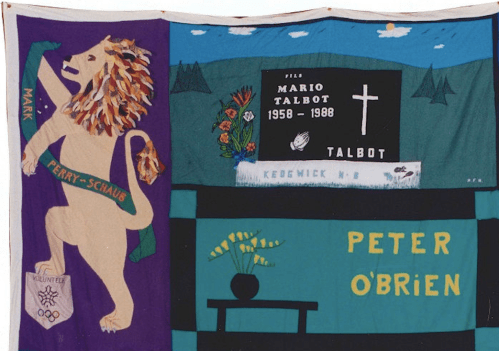
Mark Perry-Schaub’s panel (left), part of Section 24 from the Canadian Aids Memorial Quilt website.

When the AIDS memorial quilt made its stop in Calgary in July 1989, 14 local panels were added to the 1000 visiting ones. They were hung in layered sections in the Calgary municipal building atrium. One of the new panels was in tribute to Mark Perry-Schaub made by his friend Dave McKeen whom he had met at AIDS Calgary.

Perry-Schaub’s panel is adorned with a huge heraldic lion, draped with a banner bearing his name as well as the symbols of the Calgary Winter Olympics where, according to his friends, he had the time of his life.

{KA}